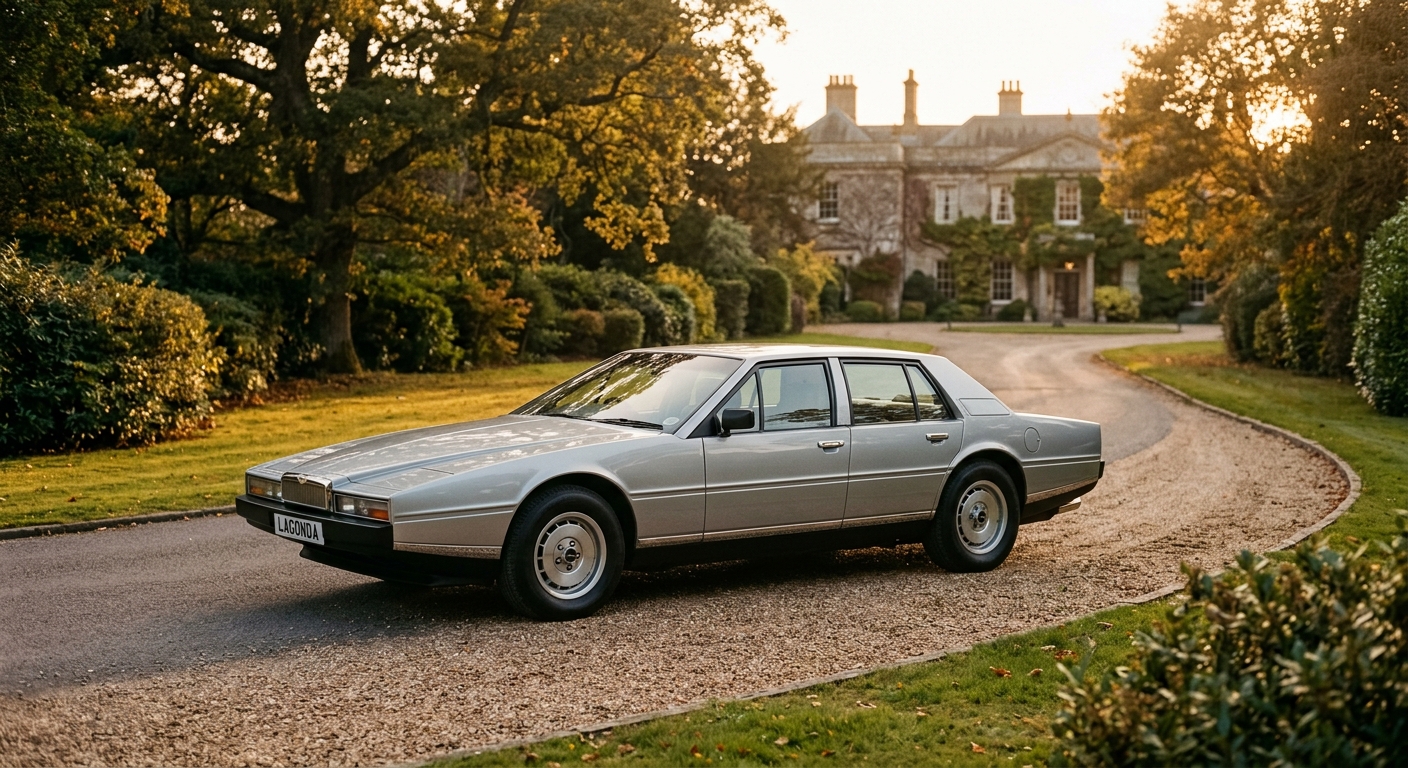
In 1984, while most luxury sedans still clung to traditional curves and analog instruments, Aston Martin unleashed something that looked like it had been teleported from the year 2010. The Lagonda wasn’t just a car; it was a bold statement about what the future of luxury motoring could look like, wrapped in the most audacious body ever to wear the famous wings badge.
A Vision from Tomorrow
The Lagonda story began in the late 1970s when Aston Martin’s then-owner decided the company needed a flagship luxury sedan to compete with Rolls-Royce. What emerged was nothing short of revolutionary. Designer William Towns created a shape so radical that it seemed to defy automotive convention entirely. The car was essentially a four-door wedge, with sharp creases and geometric panels that made contemporary Ferraris look conservative.
But the real shock came when you opened the door. Inside, instead of traditional gauges and switches, drivers were greeted by what Aston Martin proudly called the world’s first fully digital dashboard. LED displays showed everything from speed to fuel level, controlled by touch-sensitive panels that would have looked at home on the bridge of the Starship Enterprise.
The Digital Gamble
By 1984, Aston Martin had worked out most of the early electronic gremlins that plagued the first Lagondas. The digital systems, while still temperamental by today’s standards, were functioning more reliably. The cathode ray tube displays glowed with amber text and graphics, providing information in a format that was utterly alien to luxury car buyers of the era.
The technology extended beyond just the dashboard. The Lagonda featured electric adjustment for nearly everything, from seats to mirrors, all controlled through the digital interface. Climate control was managed through a computer-like system that felt decades ahead of its time, even if it occasionally decided to stop working entirely.
Driving the Future
Beneath all that space-age technology sat a thoroughly traditional Aston Martin heart. The 5.3-liter V8 engine, borrowed from the company’s sports cars, delivered smooth and substantial power through a three-speed automatic transmission. The driving experience was uniquely contradictory: futuristic in its presentation, but fundamentally old-school in its character.
The Lagonda rode on a stretched version of the DBS platform, giving it impressive road presence and a surprisingly comfortable ride quality. Despite its radical appearance, it handled more like a traditional luxury sedan than a spaceship, with soft suspension tuning that prioritized comfort over cornering prowess.
The Price of Innovation
Owning a Lagonda in 1984 was an exercise in patience and deep pockets. The digital systems, while impressive when they worked, were notorious for their reliability issues. Many owners became intimately familiar with their local Aston Martin service departments, and parts costs were astronomical even by luxury car standards.
Yet for those who persevered, the Lagonda offered an ownership experience unlike anything else on the road. It was a conversation starter, a technological showcase, and a rolling piece of automotive art all rolled into one impossibly angular package.
The 1984 Aston Martin Lagonda remains one of the most polarizing cars ever built, a machine that dared to reimagine what luxury could look like in the digital age. While its electronics may seem primitive today and its reliability questionable, there’s no denying that Towns and Aston Martin created something genuinely unique. For those brave enough to own one, the Lagonda offers an ownership experience that’s part time capsule, part science experiment, and entirely unforgettable.