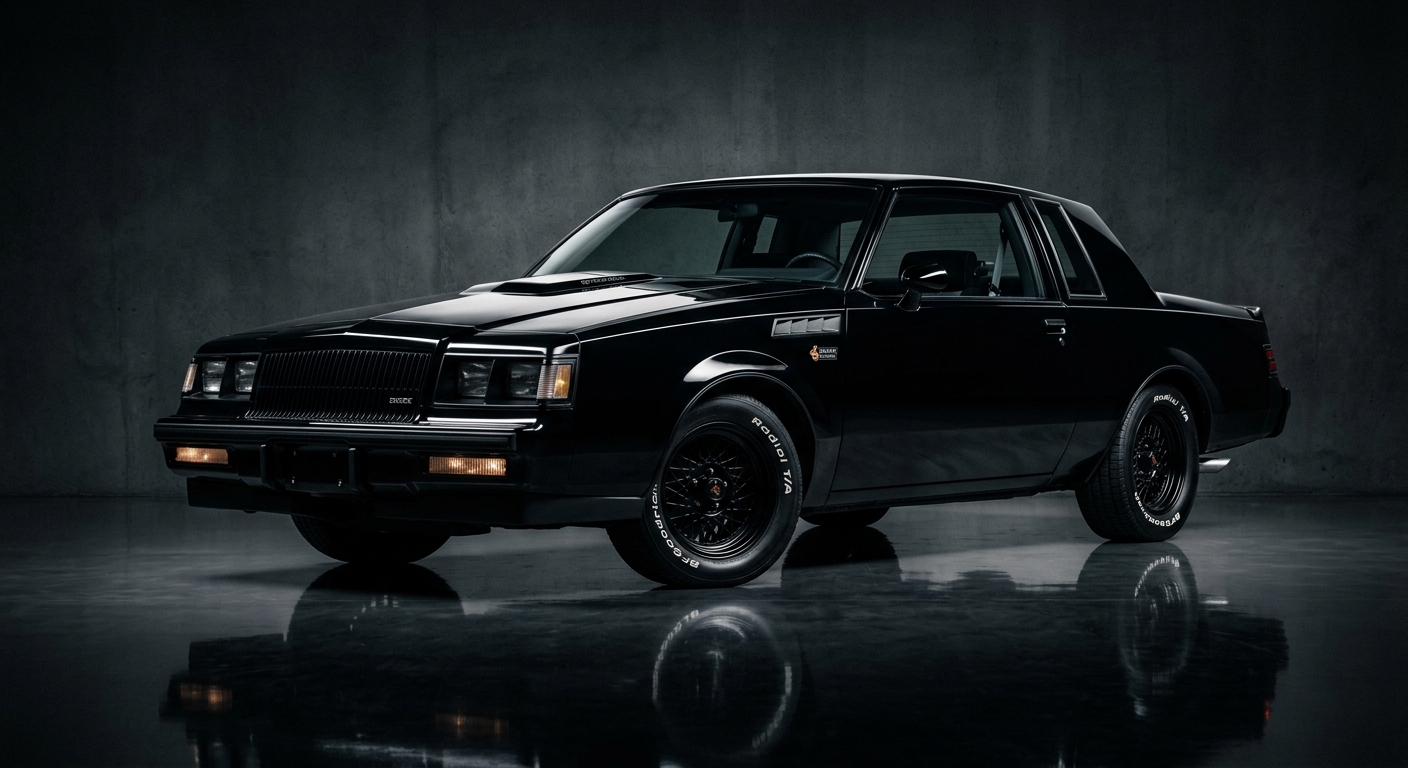
In 1987, while the automotive world was obsessing over flashy Ferraris and fuel-sipping econoboxes, Buick quietly unleashed something genuinely terrifying onto American streets. The Grand National wasn’t just another muscle car revival: it was a turbocharged sledgehammer wrapped in funeral black paint, capable of embarrassing Corvettes at traffic lights while maintaining the facade of a sensible family sedan.
The Turbo Revolution
What made the Grand National so revolutionary wasn’t its looks, though the all-black aesthetic was certainly menacing. It was what lurked under that distinctively bulged hood: a 3.8-liter turbocharged V6 that produced 245 horsepower and a stump-pulling 355 lb-ft of torque. In an era when most American V8s were strangled by emissions equipment, Buick’s engineers proved that forced induction was the path forward.
The turbo V6 delivered power in a completely different way than traditional muscle cars. Where big-block V8s provided immediate, linear thrust, the Grand National’s engine built boost progressively, then unleashed a surge of torque that could overwhelm the rear tires without warning. It was intoxicating and terrifying in equal measure.
Driving the Dark Side
Behind the wheel, the Grand National felt like driving a barely contained explosion. The car would idle quietly, almost demurely, then transform into a savage when the turbo spooled up. The experience was addictive: the subtle whistle of the turbocharger building boost, the slight hesitation as the engine gathered itself, then the violent rush forward as all that torque hit the pavement.
The G-body chassis, shared with the Chevrolet Monte Carlo and Pontiac Grand Prix, wasn’t particularly sophisticated, but it was robust enough to handle the power. The suspension setup favored straight-line performance over cornering prowess, which was exactly what buyers wanted. This was a car built for stoplight dominance, not track days.
Interior and Comfort
Inside, the Grand National maintained Buick’s traditional focus on comfort, though with sinister black appointments throughout. The seats were supportive enough for spirited driving, and the dashboard featured a full complement of gauges including the all-important boost gauge. It was a proper GT car: fast enough to thrill, comfortable enough for long highway cruises.
Cultural Impact and Legacy
The Grand National arrived at a perfect cultural moment. It was the automotive equivalent of the 1980s themselves: dark, powerful, and unapologetically excessive. Movies, music videos, and popular culture embraced the car’s villainous aesthetic. It became the default choice for screen bad guys and anyone who wanted to make a statement without saying a word.
More importantly, the Grand National proved that American performance wasn’t dead, just evolving. While competitors struggled with ancient V8 technology, Buick demonstrated that turbocharging could deliver both power and relative efficiency. The car was a preview of the turbocharged future that wouldn’t fully arrive for another two decades.
The Final Chapter
1987 marked the end of the line for the Grand National, as Buick discontinued the G-body platform. Only 20,193 examples were built that final year, making it both the most produced and most desirable variant. The company went out with a bang, offering the even more extreme GNX in limited numbers, but the regular Grand National remained the sweet spot of performance and relative affordability.
The 1987 Grand National stands as proof that sometimes the most unlikely manufacturers create the most memorable machines. This sinister Buick combined devastating performance with everyday usability, wrapped in an aesthetic that still looks menacing today. It remains the definitive turbocharged muscle car and a bargain compared to its contemporary rivals.