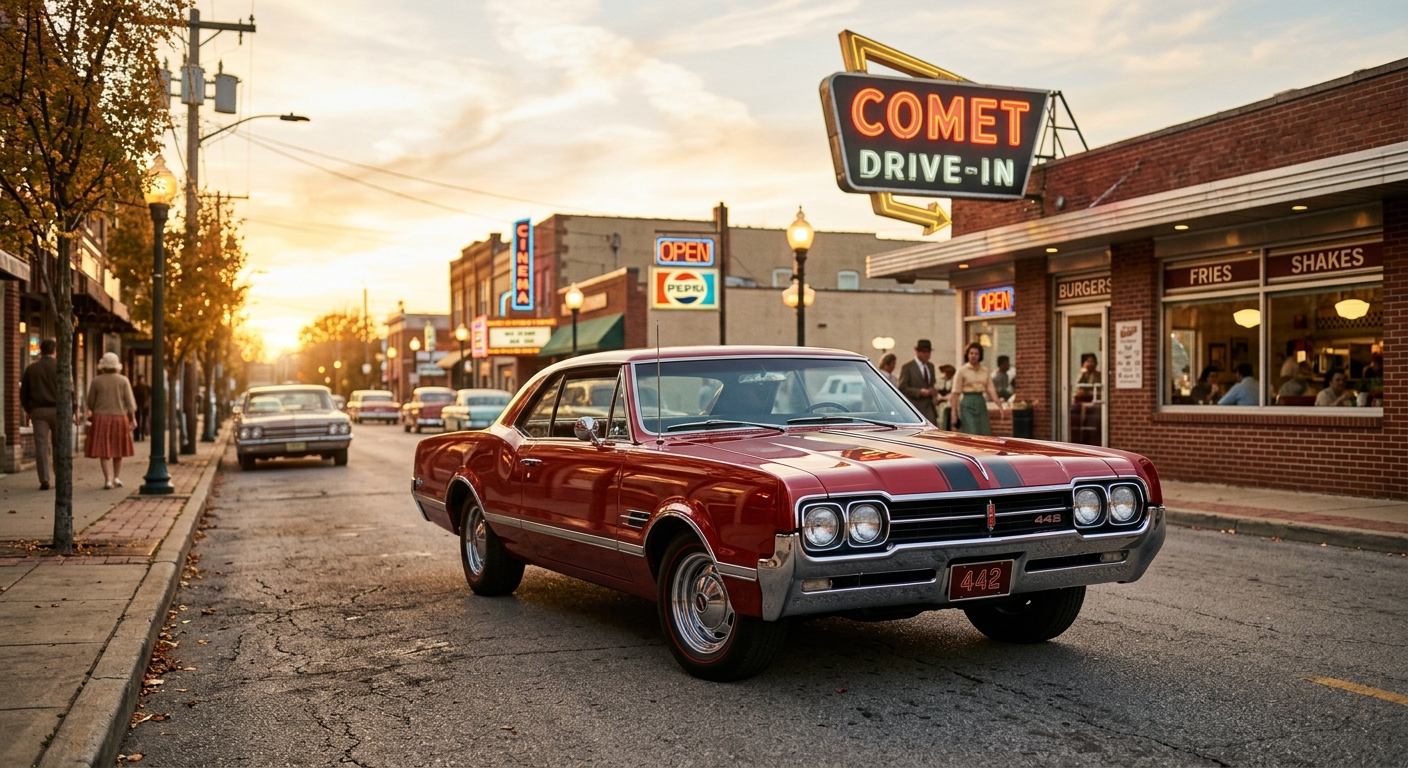
While Plymouth had the Road Runner and Dodge boasted the Charger, Oldsmobile took a different approach to the muscle car wars of the 1960s. The 442 wasn’t just about raw power; it was about delivering that power with a level of refinement and sophistication that set it apart from its more boisterous competitors. This was muscle with manners, brute force wrapped in executive packaging.
The Perfect Storm of Engineering
The 1966 model year marked a pivotal moment for the 442, as Oldsmobile transformed it from a simple option package into a standalone model with serious performance credentials. The name itself told the story: 4-barrel carburetor, 4-speed manual transmission, and dual exhausts. Under the hood sat Oldsmobile’s magnificent 400 cubic inch V8, producing 350 horsepower and 440 lb-ft of torque.
What made the 442 special wasn’t just the numbers, though they were certainly impressive. It was how Oldsmobile’s engineers managed to combine that raw American V8 power with a level of drivability that made it equally at home cruising to the country club or tearing up the local drag strip. The engine was a masterpiece of smooth power delivery, with torque that seemed to stretch from idle to redline without ever feeling peaky or temperamental.
Driving the Dream
Behind the wheel, the 442 reveals its dual personality immediately. Around town, it’s surprisingly docile, with light steering and a compliant ride that masks its performance intentions. The interior is pure 1960s luxury, with comfortable bucket seats, full instrumentation, and enough chrome to blind a small aircraft. Everything feels substantial, from the heavy thunk of the doors to the solid click of the shifter moving through the gears.
But plant your right foot, and the gentleman transforms into a street fighter. The 400 cubic inch mill roars to life with a sound that’s part symphony, part thunder. Power delivery is immediate and relentless, pushing you back into those comfortable seats as the speedometer needle sweeps past legal limits with alarming ease. The four-speed manual transmission is a joy to operate, with positive engagement and perfectly spaced ratios that make the most of that massive torque curve.
Handling the Power
For a car of its era and size, the 442 handles surprisingly well. The suspension, while tuned for American tastes (meaning comfort over outright precision), still provides enough control to make spirited driving genuinely enjoyable. The steering has that classic muscle car feel: light at parking speeds but weighty and communicative when you’re pushing hard through corners.
The brakes, admittedly, are the weak link in the package. Four-wheel drums were standard, and while adequate for normal driving, they fade quickly under repeated hard use. It’s a reminder that these cars were built in an era when straight-line performance mattered more than ultimate stopping power.
Cultural Impact and Legacy
The 442 represented Oldsmobile’s attempt to capture younger buyers who might otherwise have gravitated toward Pontiac’s GTO or Chevrolet’s growing stable of performance cars. It worked, becoming one of the most respected muscle cars of its generation and establishing Oldsmobile as a legitimate player in the performance game.
Unlike some of its more radical contemporaries, the 442 aged gracefully, maintaining its appeal long after the muscle car era ended. Today, it’s recognized as one of the most well-rounded cars of the entire muscle car movement, offering a perfect blend of performance, comfort, and style that few competitors could match.
The 1966 Oldsmobile 442 remains one of the most underappreciated gems of the muscle car era, offering a sophisticated take on American performance that few competitors could match. It proved that muscle cars didn’t have to sacrifice refinement for power, creating a template that influenced performance cars for decades to come.