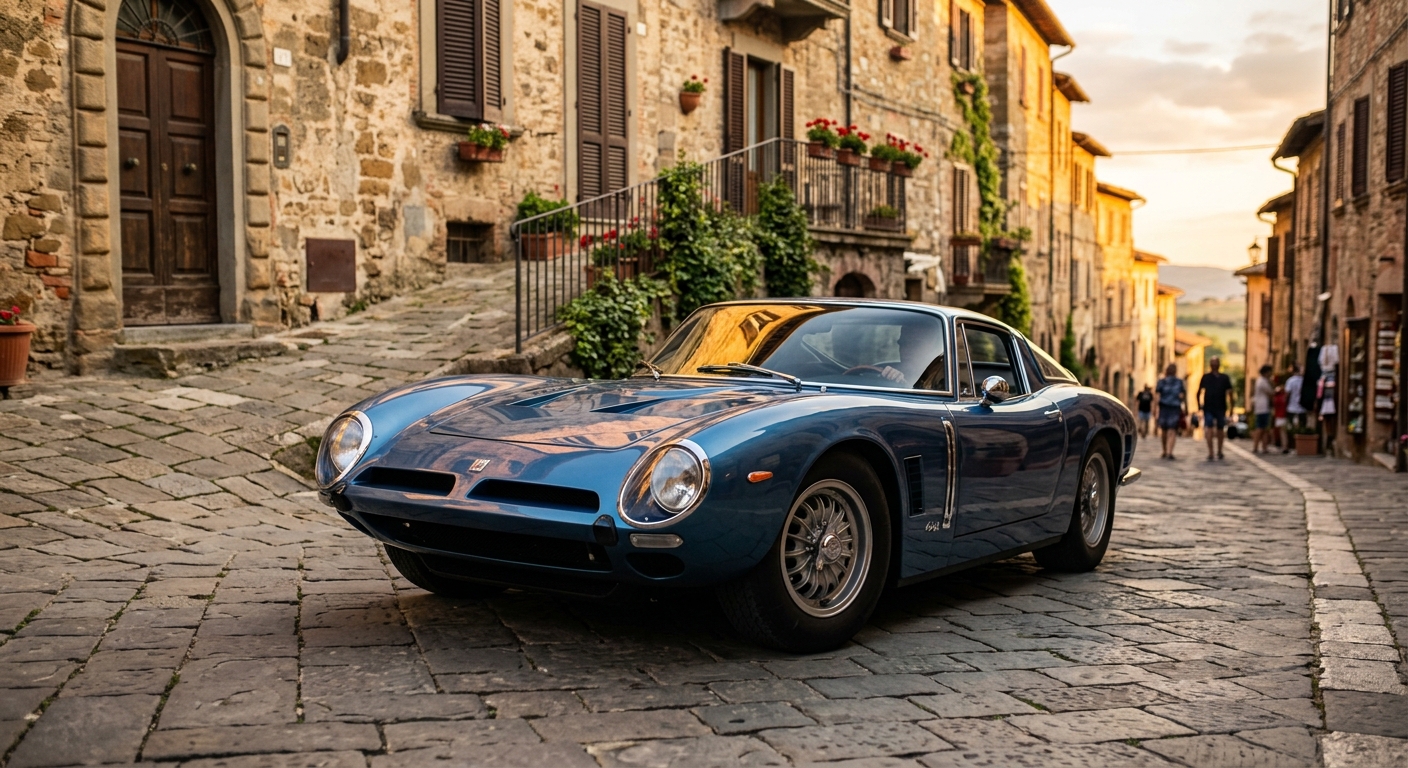
In the shadow of Ferrari and Lamborghini lies one of Italy’s most compelling automotive stories. The Iso Grifo A3/C represents the final evolution of a car that dared to challenge the establishment by combining Italian artistry with American muscle. This is the story of a manufacturer that almost rewrote the supercar rulebook.
The Maverick’s Last Stand
By 1973, Iso Rivolta was fighting for survival in a rapidly changing automotive landscape. The A3/C variant of the Grifo represented the company’s most desperate and brilliant gambit: take everything they’d learned about building world-class grand tourers and distill it into the purest possible form. The result was a car that matched the performance of its more famous contemporaries while offering something they couldn’t: genuine exclusivity.
The A3/C designation stood for “Competizione,” and unlike the standard Grifo, this variant was built with racing intentions from the outset. Only 412 examples of the Series II Grifo were ever built, making the A3/C one of the rarest supercars of its era. Each car was essentially hand-built in Iso’s modest facility in Bresso, Italy, where craftsmen who had learned their trade in the luxury goods industry applied their skills to automotive construction.
American Heart, Italian Soul
Under the Grifo’s dramatically sculpted hood sat a 454 cubic inch Chevrolet big block V8, producing 390 horsepower in its final tuned state. This engine choice was controversial at the time but proved prescient: while Italian manufacturers struggled with increasingly complex V12s, Iso’s American powerplant offered reliability, serviceability, and tremendous torque delivery.
The engine was mated to a ZF 5-speed manual transmission, the same unit used in the De Tomaso Pantera and various other exotics of the era. This combination delivered performance that embarrassed cars costing twice as much: 0-60 mph came in just 5.4 seconds, while top speed approached 170 mph.
Bertone’s Masterpiece
The Grifo’s bodywork, penned by Giorgetto Giugiaro during his tenure at Bertone, remains one of the most striking designs of the 1970s. The A3/C featured subtle but significant changes from the earlier cars: a more aggressive front spoiler, wider rear fenders to accommodate larger wheels, and a distinctive rear window treatment that improved both aesthetics and aerodynamics.
Every panel was hand-formed, and the attention to detail rivaled anything coming from Maranello or Sant’Agata. The fit and finish quality varied slightly from car to car, giving each Grifo its own personality while maintaining the overall design integrity that made the model so visually arresting.
The Driving Experience
Behind the wheel, the Grifo A3/C revealed its dual personality. Around town, it was surprisingly docile, with the big V8 pulling cleanly from low revs and the ZF gearbox offering precise, mechanical shifts. The steering was heavy by modern standards but communicated road surface changes with remarkable clarity.
On winding roads, the car transformed into something approaching greatness. The chassis, developed with input from racing drivers, offered remarkable balance for such a large, heavy car. The suspension setup favored composed high-speed cruising over razor-sharp handling, but the trade-off resulted in a car that could cover ground at an incredible pace without beating up its occupants.
The End of an Era
The 1973 oil crisis effectively ended Iso’s brief but brilliant run. Rising fuel costs made big-displacement engines politically incorrect overnight, and the company’s limited resources couldn’t support development of alternatives. Production ceased in 1974, making the A3/C the final chapter in one of automotive history’s most interesting stories.
Today, the Grifo A3/C represents one of the collector car world’s best-kept secrets. Values remain reasonable compared to equivalent Ferraris or Lamborghinis, yet the driving experience and visual drama are arguably superior. For those seeking an entry point into serious classic supercar ownership, few cars offer the Grifo’s combination of performance, beauty, and exclusivity.
The Iso Grifo A3/C stands as a testament to what happens when ambition meets artistry. In a world obsessed with badge snobbery, it offers something rarer than any prancing horse: the chance to own automotive history that most people will never recognize. Sometimes the best secrets are the ones hiding in plain sight.