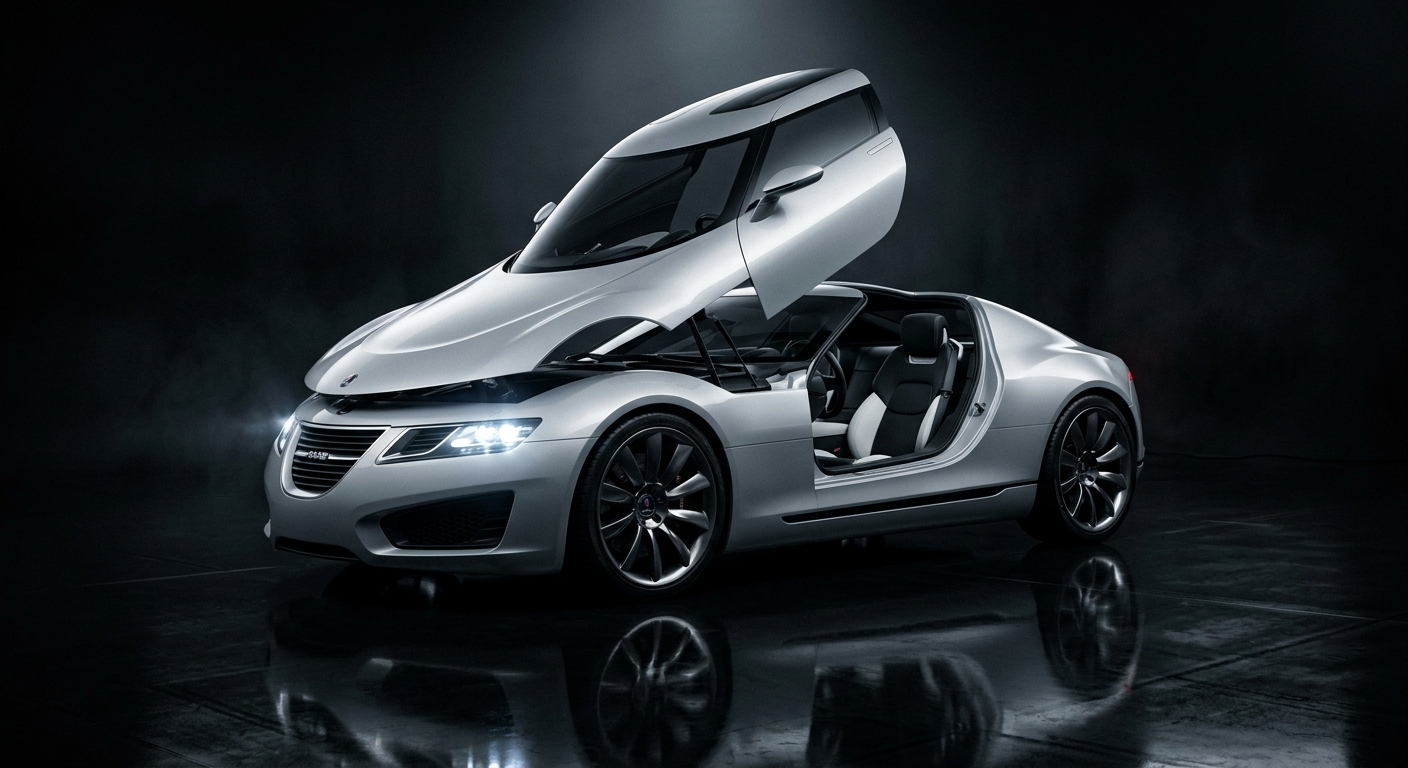
In 2005, Saab unveiled perhaps the most audacious vision of what a Swedish supercar could be. The Aero X concept wasn’t just another pretty show car, it was a manifesto written in carbon fiber and turbocharged ambition. With its fighter jet canopy, aircraft-inspired proportions, and 400-horsepower BioPower V6, this was Saab’s declaration that quirky didn’t have to mean slow.
Born from the Sky
The Aero X emerged from Saab’s deep aviation heritage, embodying everything the brand learned from decades of building fighter jets. The most striking feature was its transparent canopy that hinged forward like a Gripen fighter, eliminating conventional doors entirely. This wasn’t just styling theater, it was pure Saab DNA expressed in automotive form.
Underneath the dramatic bodywork lived a 2.8-liter twin-turbocharged V6 engine running on E85 ethanol fuel. The BioPower setup produced 400 horsepower, channeled through a six-speed automated manual transmission to all four wheels. Saab claimed a 0-60 mph time of 4.9 seconds and a top speed electronically limited to 155 mph, numbers that put it in serious supercar territory.
Swedish Innovation on Four Wheels
The Aero X showcased Saab’s commitment to environmental responsibility without sacrificing performance. The E85 ethanol fuel system wasn’t just green washing, it was a serious attempt to prove that sustainable fuels could power supercars. The lightweight carbon fiber construction kept weight to just 2,645 pounds, helping the relatively modest power figure deliver genuine excitement.
Inside, the cabin felt more spaceship than sports car. The dashboard featured a head-up display projected onto the windscreen, while the seats were carved from lightweight magnesium frames. Everything was designed around the pilot metaphor, from the fighter-style instrumentation to the center-mounted ignition that required a flip-up cover like a weapons system.
The Future That Never Was
Perhaps more than any other concept car, the Aero X represented a future that felt tantalizingly close to reality. Saab had the engineering expertise, the manufacturing capability, and the brand heritage to build something like this. The company even hinted at production possibilities, suggesting a limited run of 2,000 units priced around $150,000.
But General Motors had other plans. The American giant saw Saab as a premium brand, not a supercar manufacturer. The Aero X remained forever frozen as a one-off dream, a glimpse of what Swedish performance could have become. When Saab finally collapsed in 2011, the Aero X stood as both a monument to innovation and a reminder of squandered potential.
Today, the Aero X sits in Saab’s museum in Trollhättan, a beautiful artifact from an alternate timeline where quirky Swedish engineers were allowed to build their ultimate expression of automotive artistry. It remains one of the most compelling concept cars ever created, a perfect fusion of Scandinavian design philosophy and genuine supercar performance.
The Aero X remains one of motoring’s greatest what-ifs, a concept so compelling and production-ready that its cancellation feels like automotive vandalism. With Saab’s aviation DNA expressed in pure automotive poetry, this Swedish fighter jet for the road deserved its moment in the sun.