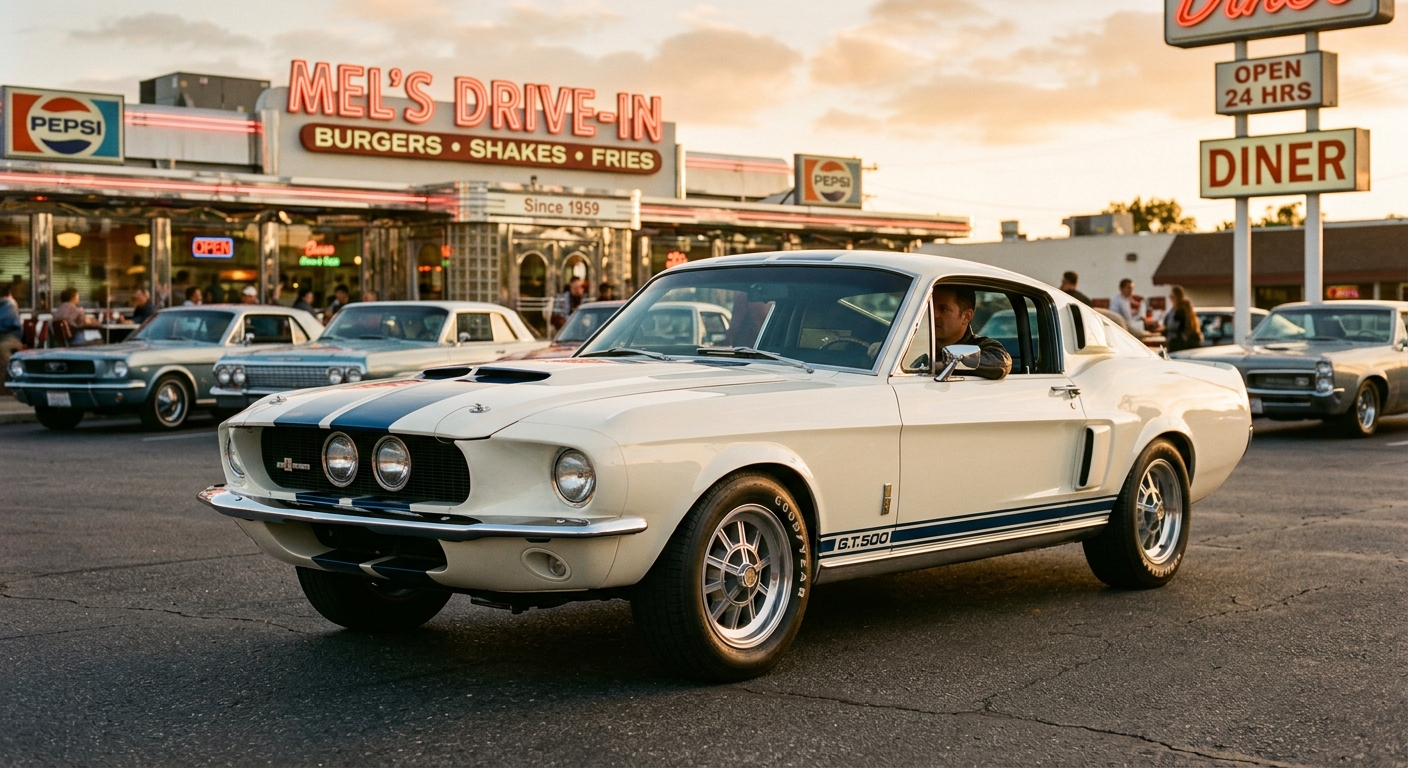
In 1967, Carroll Shelby took the small-block fury of his GT350 and decided to stuff a 428 cubic inch Police Interceptor V8 under the hood. The result was the GT500, a car that transformed the Mustang from spirited pony car into something approaching genuine supercar territory. This was American muscle distilled to its purest essence: more power, more aggression, more everything.
The Birth of Big-Block Shelby
The GT500 represented a fundamental shift in Shelby’s philosophy. Where the GT350 relied on high-revving small-block intensity, the GT500 brought lazy, torquey brutality courtesy of Ford’s 428 Police Interceptor engine. Rated conservatively at 355 horsepower, the real output was likely closer to 400 horses, making this the most powerful production Mustang of its era.
Shelby American didn’t just drop in a bigger engine and call it done. The GT500 received unique fiberglass bodywork including a distinctive hood with functional scoops, side scoops behind the doors, and a rear spoiler. The front end was completely redesigned with a custom grille and driving lights, giving the car an unmistakably aggressive face that announced its serious intentions.
Driving the Legend
Behind the wheel, the GT500 feels like controlled violence. The 428’s massive torque curve means effortless acceleration from virtually any rpm, with a soundtrack that’s pure Detroit thunder. The car launches hard off the line, though the primitive suspension and skinny bias-ply tires of the era mean traction is often optional.
The steering is heavy and direct, requiring real muscle to thread the car through corners. This isn’t a scalpel like later sports cars; it’s a sledgehammer that rewards commitment and punishes hesitation. The brakes, though upgraded from standard Mustang fare, still require planning and respect given the car’s substantial performance envelope.
Racing Heritage and Street Presence
While the GT350 was born on the racetrack, the GT500 was conceived as more of a grand tourer, a car that could devour highway miles in supreme comfort while still delivering tire-shredding performance when provoked. The interior featured more luxury appointments than its small-block sibling, including air conditioning as an option and more refined trim pieces.
Only 2,048 GT500s were built in 1967, making it significantly rarer than the GT350. Each car was hand-built at Shelby American’s facility in Los Angeles, with final assembly taking place after the base Mustang fastbacks arrived from Ford’s San Jose plant. This limited production and hands-on construction approach gave each GT500 a unique character that mass-produced muscle cars couldn’t match.
The Cobra Connection
The GT500 shared DNA with Shelby’s legendary Cobra roadsters, particularly in its approach to power delivery and raw mechanical feel. Carroll Shelby’s philosophy of maximum performance through brute force engineering was evident in every aspect of the car, from its functional hood scoops to its side-exit exhausts that announced the car’s presence blocks away.
The 1967 Shelby GT500 established the blueprint for American performance that still resonates today: massive displacement, thunderous sound, and enough torque to spin the earth backwards. It’s a car that rewards respect and punishes the timid, representing the peak of 1960s muscle car excess. For collectors seeking the ultimate expression of Carroll Shelby’s vision, few cars deliver the same combination of rarity, performance, and pure automotive theatre.