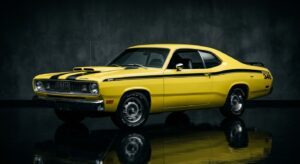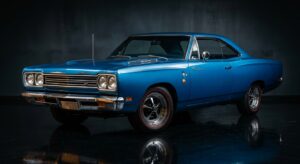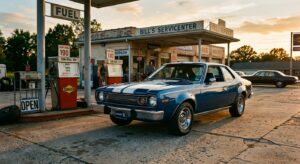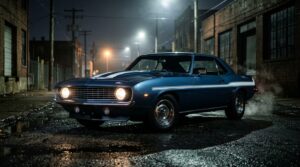
It is 1 a.m., the traffic lights are blinking yellow, and the only sound on the empty boulevard is a high-revving small-block Ford wailing past 6,000 rpm. The 1970 Mustang Boss 302 was never meant to be a gentle cruiser. It was built to win Trans-Am races, and at night, with the world quiet around it, you hear every bit of that purpose.
Born to Beat the Camaro
The Boss 302 exists because of a rulebook. The SCCA Trans-Am series capped engines at 305 cubic inches, and Ford needed a homologation special to go racing against the Chevrolet Camaro Z/28. Under Ford design chief Larry Shinoda, who had come over from General Motors, and with engineering support from Kar Kraft, the Boss 302 debuted for 1969 as a road-going version of the race car. For 1970 it was refined, and it arguably became the better-looking and better-sorted machine.
The heart of the car is a 302 cubic inch V8 fitted with the new Cleveland-style cylinder heads, with huge canted-valve ports and big valves that let the engine breathe at high rpm. Ford rated it at 290 horsepower, a figure widely understood to be conservative. A solid-lifter camshaft, a four-barrel Autolite carburetor, a forged-steel crankshaft, and four-bolt main bearing caps completed a recipe built for sustained abuse. A rev limiter was fitted, and for 1970 the car also carried a mechanical set-up that rewarded drivers who kept the tach needle high.
1970 Changes: Cleaner and Smarter
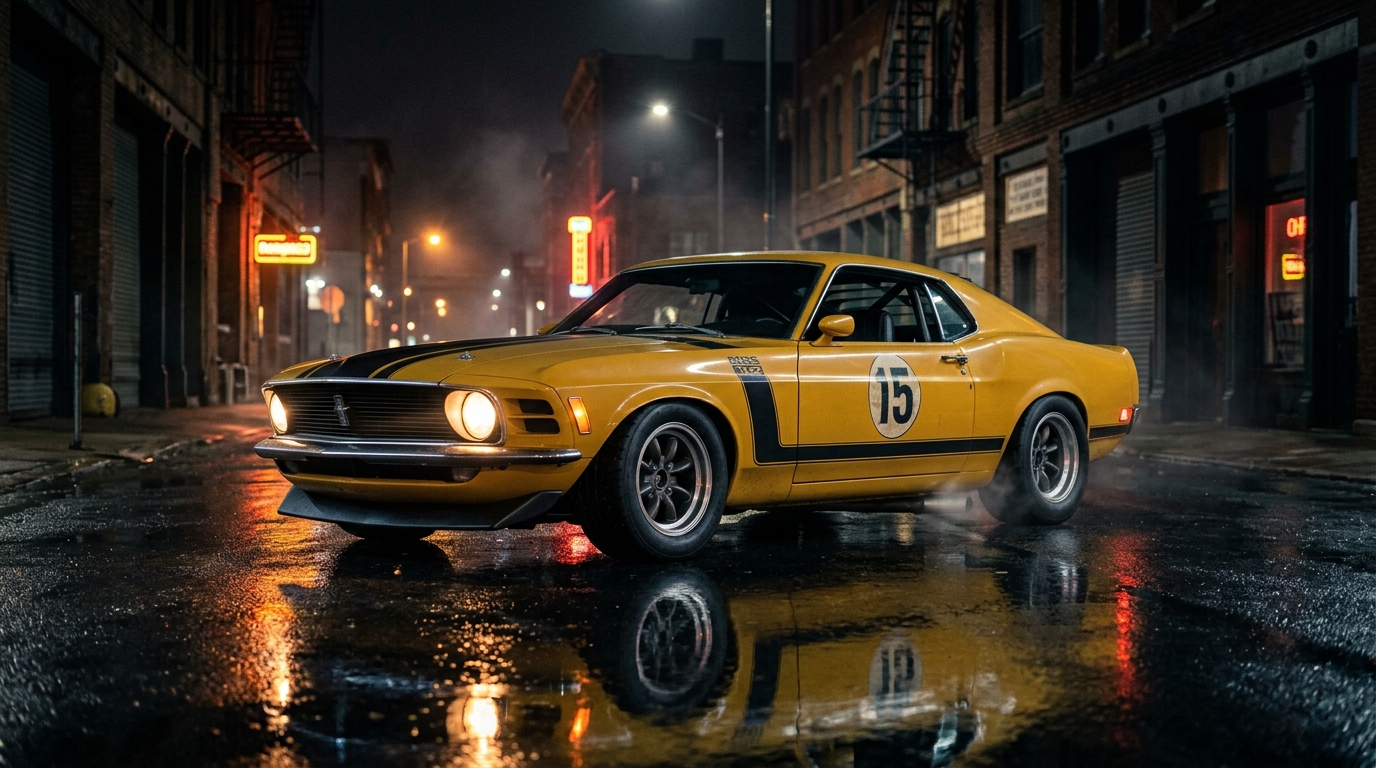
For 1970 the Boss 302 lost the 1969 car’s side-mounted stripe style in favor of a reflective hockey-stick stripe that swept along the flank and ended at the rear fender with the Boss 302 lettering. The matte black hood treatment with a cowl-induction look was available, as were the rear window louvers and a rear spoiler. The front end was revised with a new nose and a single pair of headlights replacing the earlier quad-lamp arrangement, which gave the car a slightly cleaner face. Ford also dropped the 1969 car’s hood-mounted tach arrangement in favor of the standard instrument layout.
The Boss 302 came with a four-speed manual as standard, a Hurst-shifted unit with a precise, short throw. Power steering and front disc brakes were available, and Ford fitted heavy-duty suspension with stiffer springs, a thicker front sway bar, and Gabriel shock absorbers. Gearing was handled by a 9-inch rear axle, with ratios commonly running 3.50 or 3.91 depending on the traction option selected.
The Night Drive
Climb in after dark and the first thing you notice is how analog everything feels. The headlights of the era cast a warm, slightly yellow wash, nothing like the crisp LED arrays of a modern car, so you drive a little more deliberately, eyes reading the road ahead rather than trusting a bright beam to do the thinking. The gauges glow a soft green-white, the shifter feels cool and solid in your palm, and the whole car vibrates faintly at idle with a lumpy, impatient rumble.
Below about 3,500 rpm the Boss is polite enough, though never silent. Then you press on, and the small-block comes alive. Between 4,000 and 6,500 rpm the engine pulls with a metallic, ripping howl that bounces off shuttered storefronts and parked cars. On an empty road at night, that sound is the whole show. You hear the intake gasp, the exhaust bark, and the solid lifters ticking away beneath it all. It is the closest a road car of the era got to the soundtrack of an actual Trans-Am race.
Handling is a revelation compared with most Detroit muscle of the day. The Boss carries its weight better than a big-block Mustang because the 302 is lighter, and the stiffened suspension keeps the front end planted. Steering is quick for the period, though it still feels vague by modern standards, and the drum or optional disc brakes demand respect when you carry real speed into a corner. At night, with the dark hiding most of the road, you learn to trust the chassis in a way that daylight does not require.
Production and Legacy
Ford built 7,013 Boss 302 Mustangs for the 1970 model year, following 1,628 for 1969. The 1970 car also marked the end of the line, as the Boss 302 was dropped after that year when the Trans-Am rules and Ford’s racing priorities shifted. That scarcity, combined with its racing pedigree, has made the 1970 Boss 302 one of the most collectible Mustangs ever built. Well-kept examples now routinely command high five-figure and often six-figure sums at auction.
What keeps the Boss relevant is its honesty. It was not the biggest or the fastest muscle car of its day, but it was one of the most balanced and most purposeful. Under a streetlight, with its hockey-stick stripes glowing and its engine ticking as it cools, it looks every bit the race-bred homologation special it was.
The 1970 Boss 302 is a race car wearing a street suit, and it never lets you forget it. It is raw, loud, and demanding, but on a quiet road at night, with that Cleveland-headed small-block screaming toward redline, there are few experiences in classic muscle that feel more authentic or more alive.