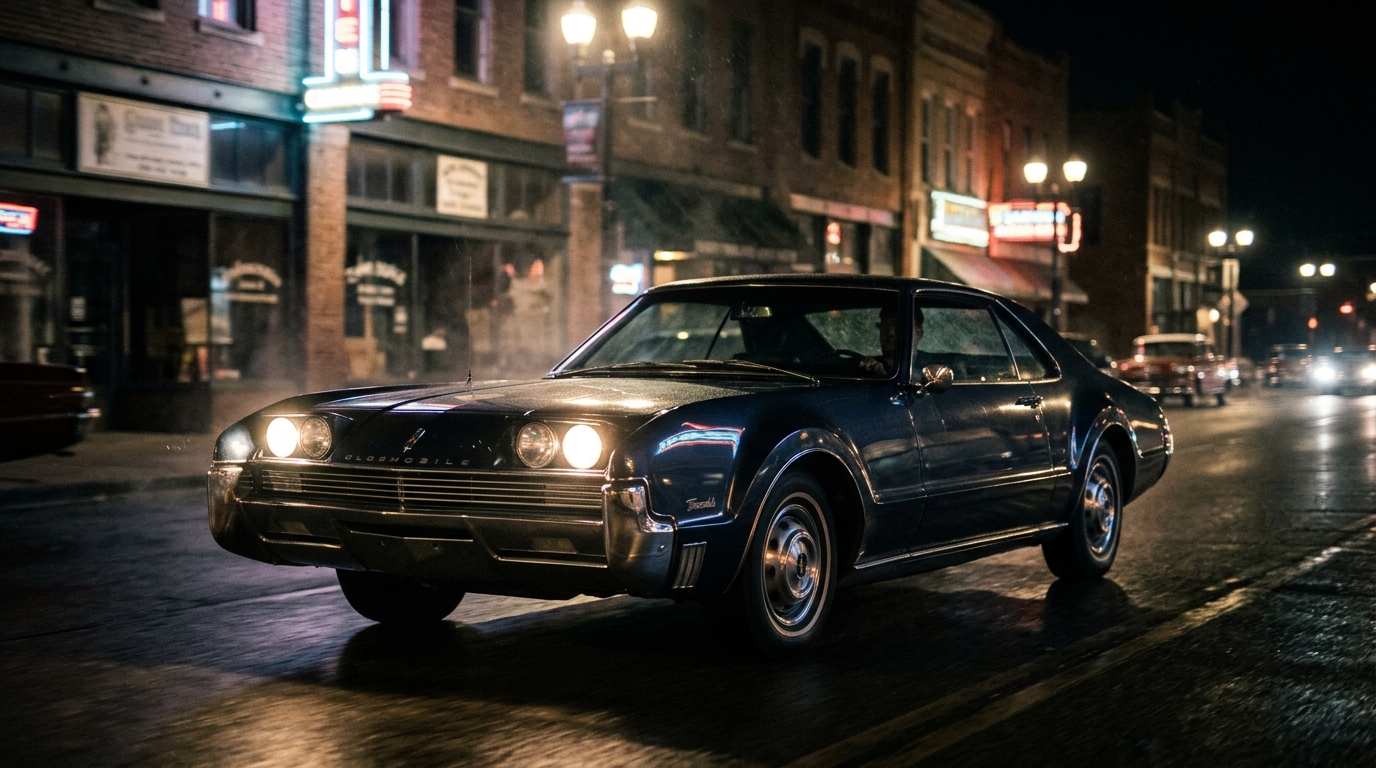
It is a little past midnight, the sodium lamps are humming orange over an empty boulevard, and a 4,300 pound slab of Detroit sculpture is gliding along in near silence, pulled rather than pushed. The 1966 Oldsmobile Toronado does not look like a car that should work, and yet it does something no American production car had done since the Cord 810 in 1936: it sent a big V8’s power to the front wheels. After dark, with the city thinned out and the road wide open, the Toronado makes a more convincing case for itself than it ever did in a showroom.
The Car That Pulled Instead of Pushed
Introduced for 1966, the Toronado was a bold statement from General Motors. Oldsmobile had spent years developing a front-drive layout, and the result was the Unitized Power Package, a compact assembly that bolted the 425 cubic inch Rocket V8 to a Turbo Hydra-Matic transmission through a chain drive. A chain transferred power from the torque converter to the transmission sitting beside the engine, which kept the whole drivetrain short enough to fit under that long hood without a transmission tunnel eating into the cabin.
The payoff was a flat floor and genuine six-passenger room in a personal luxury coupe. The cost was engineering complexity, but the system worked well enough that Oldsmobile won Motor Trend’s Car of the Year award for 1966. It was also a styling landmark. Designer David North penned a fastback profile with flared wheel arches, a razor-edged beltline and a long, low nose that looked like nothing else on the road.
Headlights, Hideaways and the Night Look
The Toronado is a car that was clearly designed with the evening in mind. Its hidden headlights rotated out of the front fenders when switched on, a mechanism that gives the nose a clean, almost blank face by day and a wide-eyed, purposeful stare after dark. The headlamps were vacuum-operated, and when they swing into place beneath the ribbed grille, the effect is genuinely theatrical.
Practicality at night is a mixed bag by modern standards. The sealed-beam units of the period are modest, and a mid-sixties Toronado on a dark country road reminds you how far lighting technology has come. But the dash layout is a pleasure. The horizontal band speedometer, with a rolling drum that sweeps across the glass, glows in a soft amber that is easy on the eyes, and the sheer expanse of glass makes the cabin feel airy even with the world pitch black outside.
Driving Impressions: Smooth, Wafting, Unexpectedly Capable
The 425 Rocket V8 produced 385 horsepower and a mighty 475 lb-ft of torque in 1966 trim, fed through a four-barrel carburetor. In a car this heavy that translates to a 0-60 time in the mid-seven-second range, which was quick for the era. Top speed was claimed at roughly 135 mph, though few owners ever tested it.
On the move, the Toronado feels effortless. The torque arrives low and steady, and the Turbo Hydra-Matic shifts with a velvety lack of drama. At night, with traffic scarce, you settle into a long, easy lope. The ride is soft and floaty, tuned for cruising, and the steering is light and slow, with about 3.6 turns lock to lock when ordered with the standard power assist.
The front-drive layout does show its character. Heavy front weight bias means pronounced understeer if you push hard, and the standard drum brakes (front discs were an option) have little appetite for repeated abuse. But a Toronado was never meant for canyon carving. It was meant for covering ground in comfort, and its stability on wet pavement under the glare of streetlights is genuinely reassuring, since the driven front wheels pull the car straight and true in poor conditions.
Sound and Atmosphere After Dark
The Rocket V8 is not a shouting engine. It rumbles at idle, gathers into a muted baritone under throttle, and settles into a distant hum at cruise. With the windows down on a still night, the sound mingles with the click of the turn signals and the soft hiss of the tires, a soundtrack that suits the car perfectly. This is not a muscle car trying to wake the neighborhood. It is a land yacht with a clever secret, content to slip quietly past sleeping houses.
Legacy and Ownership Today
The Toronado opened the door for front-wheel drive in large American cars. Cadillac followed with the Eldorado in 1967, sharing the same basic E-body platform and front-drive concept. Oldsmobile built 40,963 Toronados in the 1966 model year, a healthy debut for such a radical machine. Today a clean example is an affordable entry into collectible mid-sixties American luxury, and the Unitized Power Package has proven more durable than its reputation once suggested. For anyone who wants a classic that looks unlike anything else in the parking lot, the first-year Toronado remains one of the most distinctive choices around.
Editor’s verdict: The 1966 Toronado is not the sharpest tool in the classic garage, but it may be the most quietly audacious. Come midnight, with the hidden headlights glaring and 475 lb-ft of torque pulling you down an empty street, it feels like a glimpse of the future that Detroit actually got right.