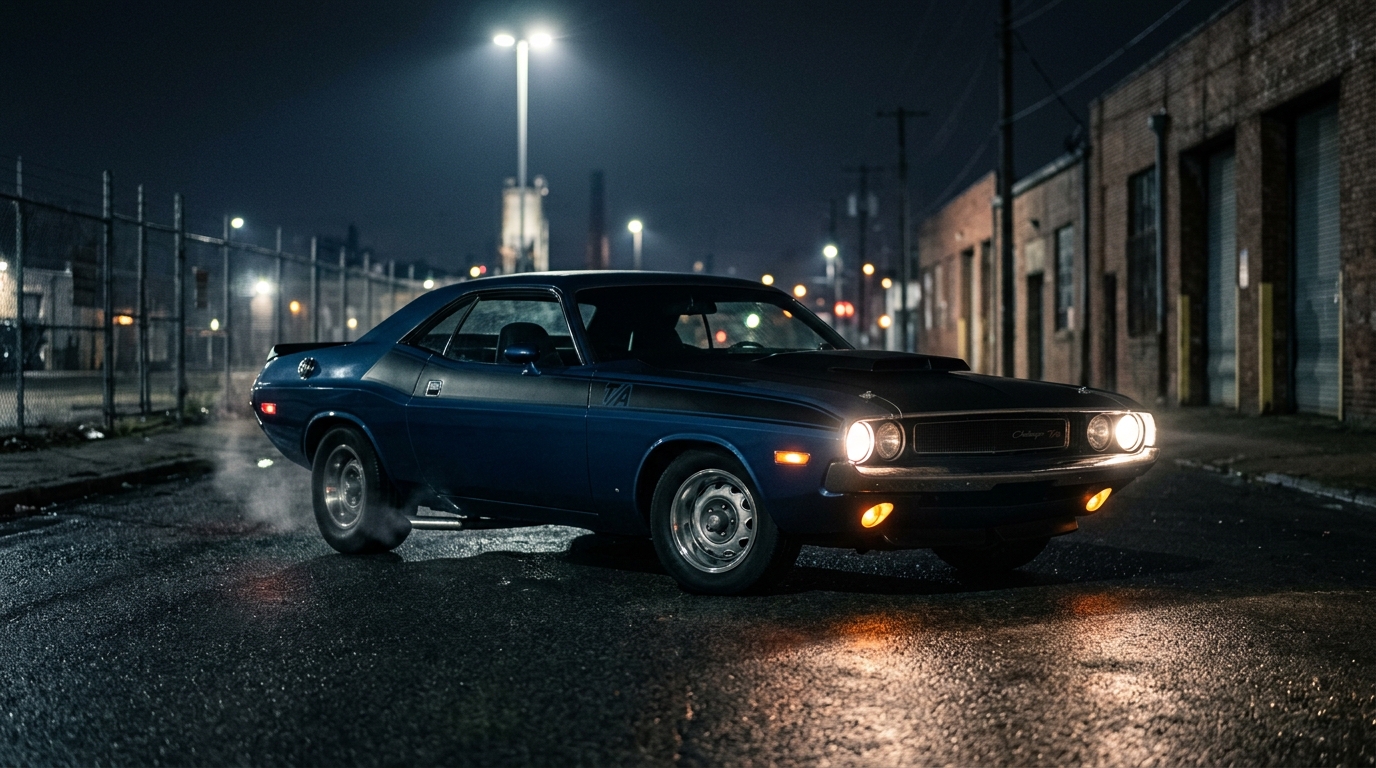
There is no moon tonight, just a ribbon of cracked asphalt, two weak yellow headlight beams, and a matte black hood scoop that swallows what little light there is. Then you roll into the throttle and three Holley two-barrels open up behind you, and the Challenger T/A stops being a museum piece and starts being what Dodge built it to be: a street-legal excuse to go racing.
A Racing Rulebook in Street Clothes
The 1970 Challenger T/A exists because of the SCCA Trans-Am series. The rules demanded that manufacturers sell at least 2,500 street versions of their race cars, and engines were capped at 305 cubic inches. Dodge’s answer was the 340 small-block, with the Challenger T/A as the homologation special. Production ran for one model year only, and roughly 2,400 were built, with figures usually cited at 2,399 or so. It was a short, sharp, deliberately weird run.
One quick note on the name before the purists write in: the 340 is the engine, and the “392” in some listings is a mix-up with the Hemi-era 392 of the 1950s. The T/A’s heart is the 340 cubic inch V8 with the Six Pack induction. The T/A was a Challenger, not a Stage 1 Buick, either, so the torque story here belongs to the 340 Six Pack, a very different animal from a big-block.
The Six Pack at Midnight
The 340 Six Pack was factory rated at 290 horsepower and 345 lb-ft of torque, a conservative number that most owners and period testers believed understated the real output. Three Holley 2300 two-barrel carburetors sit on an Edelbrock-designed aluminum intake. Here is the trick of the layout: the center carb handles everything under normal driving, and the outer two stay shut until you stomp the throttle. Under light load it behaves almost civilized. Open the outer carbs and the whole hood seems to inhale.
At night, that transition is the whole show. With no visual reference beyond your headlights, the Six Pack’s switchover is something you hear and feel before you see. The idle burble turns into a hard-edged howl, and the car squats and goes. The forged-steel crank, heavy-duty connecting rods, and cast-iron block with its hydraulic-free solid-lifter camshaft give the engine a hungry, high-revving character that feels more like a race motor than a boulevard cruiser.
That Exhaust, After Dark
The T/A’s signature touch is its side-exit exhaust, with the pipes dumping just ahead of the rear wheels through a pair of unmistakable chrome-tipped outlets. On a quiet night road the sound bounces off the bridge abutments and guardrails and comes back at you doubled. Pull up beside a sleeping row of houses and you will wake every one of them. It is not subtle. It was never meant to be.
The matte black fiberglass hood with its forward-facing scoop is the other giveaway, along with the rear spoiler and the T/A stripe package running the length of the body. In a dark parking lot under sodium light, the flat black hood simply disappears, leaving the scoop looking like a hole cut into the night.
Headlights, Honesty, and Seeing the Road
Be realistic about 1970 lighting. The sealed-beam round headlamps give a weak, yellow wash that barely reaches past a hundred feet on dark rural roads. You drive a T/A at night the way pilots fly instruments: with trust and a lighter right foot than the engine deserves. High beams help, but you will find yourself matching speed to what you can actually see, which is a useful discipline in a car with this much punch.
Handling: The Part Dodge Actually Worked On
Unlike the straight-line big-block cars of the era, the T/A was engineered to turn. Dodge fitted staggered tire sizes, with E60-15 fronts and G60-15 rears, a first for a production car and a clear nod to its racing roots. Rear leaf springs were lifted for better geometry, and thick front and rear anti-roll bars tightened the car’s response. Front discs were standard. The steering is still heavy and slow by modern standards, and the car understeers when pushed, but compared to its muscle-car peers it feels planted and purposeful.
Living With It
Inside, the T/A is a period-correct muscle car cockpit: a bucket-seat interior, a Rallye instrument cluster, and a Hurst Pistol Grip shifter for the four-speed manual, or the optional TorqueFlite automatic. The cabin is cramped, the visibility out the back is poor, and the ride is firm. None of that matters at midnight, when the gauges glow soft orange and the engine note fills the cabin.
Why It Matters Now
The T/A was a commercial footnote in its day, since Dodge sold far more mainstream Challengers, but its one-year-only rarity and genuine race pedigree have made it one of the most coveted Mopar collectibles. The Six Pack setup, the offset tires, the side pipes: it is a car where the homologation requirements shaped everything you see and hear. That honesty is what makes it feel special.
Editor’s verdict: The 1970 Challenger T/A is a racing rulebook given a body and a bellow, and it sounds best when the world is dark and quiet. It is cramped, loud, and limited by its headlights, and none of that dulls its appeal for a second. If you can find one, take it out after midnight and let the Six Pack do the talking.