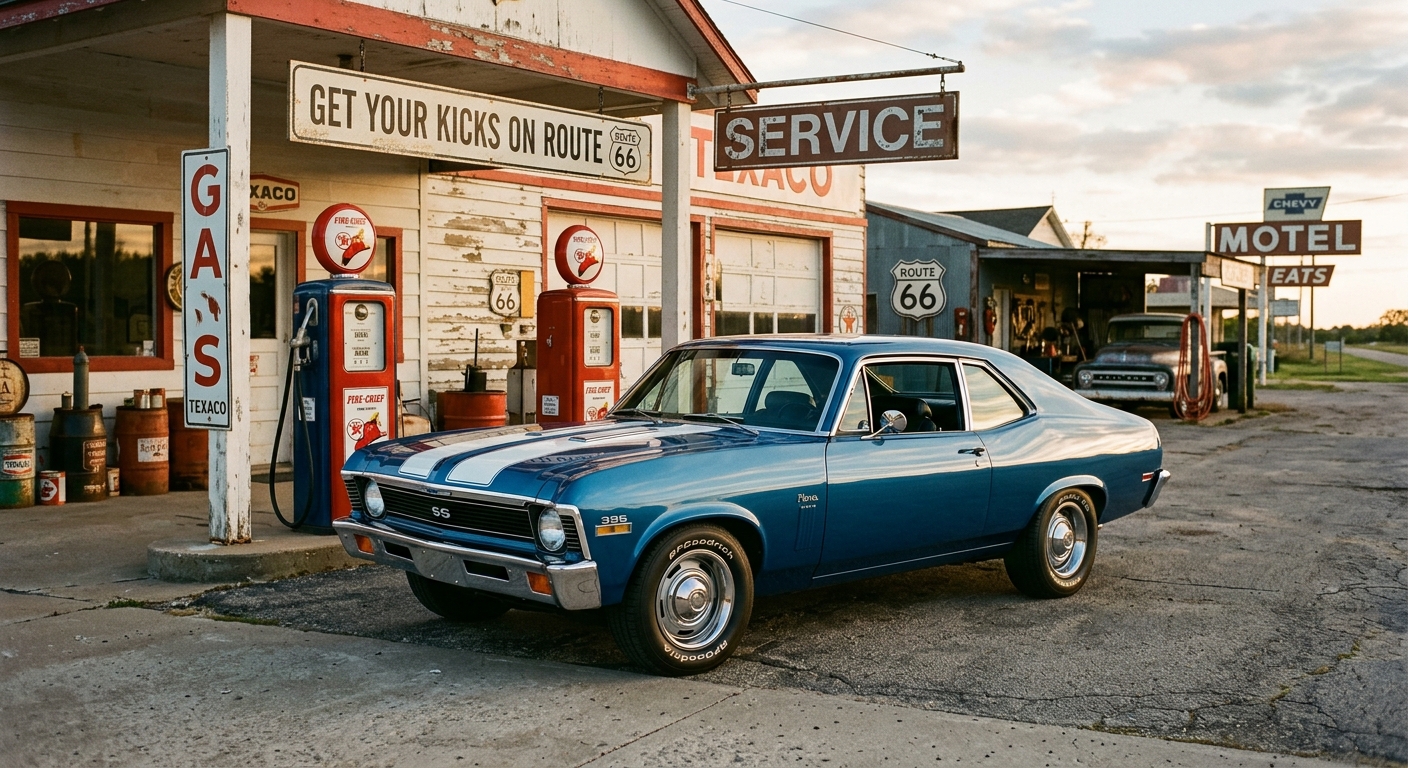
In 1969, while everyone was gawking at Camaros and Chevelles, Chevrolet quietly stuffed a 396 cubic inch big block into their compact Nova and created one of the most devastating sleepers of the muscle car era. The Nova SS 396 looked like your neighbor’s economy car until you heard it fire up and watched it disappear in a cloud of tire smoke.
The Ultimate Wolf in Sheep’s Clothing
The beauty of the 1969 Nova SS lay in its deception. Built on Chevrolet’s compact X-body platform, it shared basic architecture with the humble Chevy II but packed serious heat under that innocent hood. The 396 cubic inch L78 big block was no joke, producing 375 horsepower and 415 lb-ft of torque in its most potent form. This was the same engine that powered the legendary Chevelle SS, crammed into a car that was 200 pounds lighter and considerably less obvious.
Unlike its flashier Camaro sibling, the Nova SS 396 wore its performance credentials with subtle dignity. The only hints at its true nature were discreet SS badges, a blacked-out grille, and dual exhaust tips peeking out the back. Many unsuspecting victims at traffic lights never saw it coming.
Raw Power Meets Compact Agility
Behind the wheel, the Nova SS 396 delivered an experience that was both brutal and surprisingly refined. The big block’s torque hit like a sledgehammer, launching this compact rocket from 0-60 in just 5.5 seconds. The quarter-mile disappeared in 13.8 seconds at 103 mph, numbers that embarrassed much more expensive machinery.
The shorter wheelbase and lighter weight gave the Nova SS a different character from other GM muscle cars. It felt more nimble, more urgent, with less body roll in corners than its bigger brothers. The trade-off was a slightly harsher ride and more pronounced torque steer, but enthusiasts welcomed these as signs of the car’s serious intent.
The Sound and the Fury
Fire up a Nova SS 396 and you’re greeted by one of the most distinctive sounds in automotive history. The big block’s deep, rumbling idle transitions to a thunderous roar under acceleration, with the exhaust note growing increasingly violent as the tachometer needle climbs. It’s a sound that announces serious business without pretense or apology.
Built for the Street, Born to Run
Chevrolet offered the Nova SS with several 396 configurations, from the relatively mild L34 with 350 horsepower to the race-ready L78 that dominated drag strips across America. The four-speed manual transmission was the enthusiast’s choice, though a Turbo Hydra-Matic automatic was available for those who preferred point-and-shoot simplicity.
The suspension setup was surprisingly sophisticated for the era, with front coil springs and rear leaf springs providing a good balance between performance and street manners. Optional Positraction helped put the power to the ground, though even with traction aids, the Nova SS was happy to light up the rear tires on command.
The 1969 Nova SS 396 represents everything great about the muscle car era: serious performance, honest engineering, and the kind of character that modern cars simply can’t replicate. In a world of flashy stripes and aggressive styling, it proved that sometimes the most dangerous predator is the one that doesn’t look like it wants to eat you. This is automotive sleeper perfection, period.





Man, the Nova SS is such a classic sleeper! I’ve been doing some deep dives into classic muscle car efficiency lately, and it’s wild how those 396s could move with relatively simple engineering. Makes me wonder what that power output would look like if they’d had modern EV tech back then – the Chevy Bolt EV hits 259 hp and does 0-60 in under 7 seconds while getting the equivalent of like 120+ mpg, so the engineering has come a long way! Anyway, great writeup on a car that definitely didn’t need flashy badges to get the job done.
Log in or register to replyThat 396 is seriously impressive for its era, though I’d love to know what the actual tailpipe emissions looked like on those things, haha. The simple engineering you mentioned is part of why they were so effective, but by modern standards those carburetors were basically just spraying fuel into the void. If Chevy had thrown even basic fuel injection and oxygen sensors on a Nova SS back then, you’d probably see the same power with way less pollution, which is the sweet spot we’re always chasing in emissions testing now.
Log in or register to replyYeah that’s the thing, right – those carbs were incredible engineering for the time but they were dumping unburned hydrocarbons like crazy, especially at idle and light throttle. If you ran a ’69 Nova through a modern smog test you’d probably see NOx and particulates that would make your head spin, but honestly I think about what that platform could’ve done with even early 80s fuel injection tech. It’s not about killing the fun or performance, it’s about realizing we didn’t have to choose between power and clean air, we just hadn’t figured out how to have both yet.
Log in or register to replySara you’re hitting on something I think about a lot, honestly – we’ve basically proven you don’t have to sacrifice performance for efficiency and lower emissions, like the data from modern EVs with 300+ mile ranges shows that pretty clearly. That said, I’m genuinely curious what a tuned carb setup from that era could’ve achieved if they’d had even basic fuel injection, because you’re right that a lot of that waste was just waste, not inherent to the power-making process itself.
Log in or register to replyThe thermal signature tells the real story here – those carbs were bleeding heat energy out the tailpipe because of inconsistent fuel atomization and lean/rich cycling, especially under transient throttle conditions. You’re spot on that basic sequential fuel injection would’ve tightened that up significantly; I’ve thermal imaged enough carbureted engines to see exactly where the combustion inefficiency lives. Modern EFI’s closed-loop feedback would’ve kept those 396s running cleaner and honestly probably made similar power with better throttle response, but yeah, that carb simplicity was the whole appeal back then.
Log in or register to replyngl that 396 is basically the automotive equivalent of pulling a 350 block and slapping a bigger carb on it – simple stuff that just works. ive got an old chevelle in my garage thats been through three engine swaps and that kind of straightforward engineering is why i can actually wrench on it myself instead of plugging it into a computer like these new cars. bet you could rebuild one of those novas in a weekend with basic hand tools, not like dealing with modern emissions garbage.
Log in or register to reply