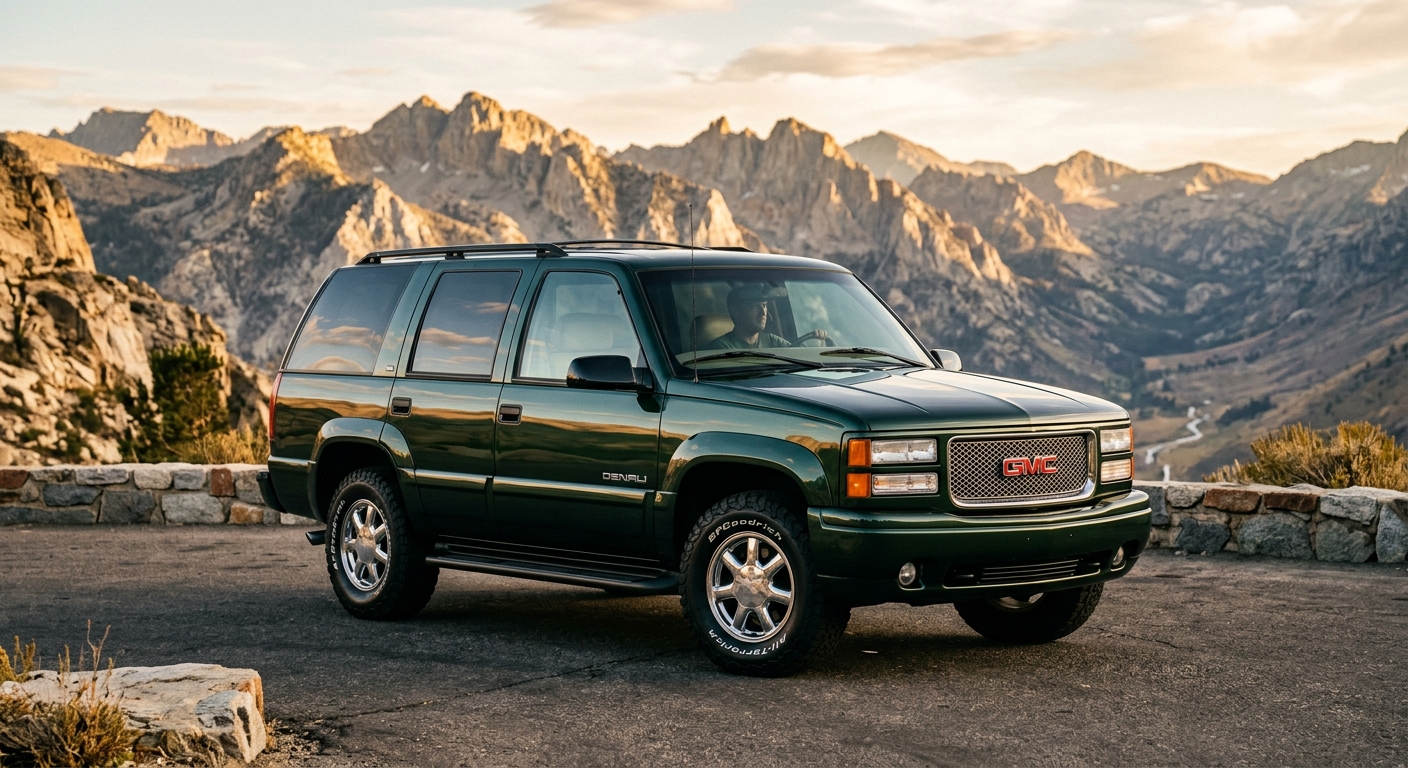
In 1999, GMC took a gamble that would reshape the luxury SUV landscape forever. The Yukon Denali wasn’t just another trim level, it was a statement that American truck makers could play in the same sandbox as the Germans and British, delivering genuine luxury wrapped in uncompromising capability.
This wasn’t your basic work truck with leather seats. GMC engineered the Denali as a halo vehicle, complete with unique bodywork, a more powerful engine, and an interior that wouldn’t look out of place in a Cadillac. The result was a vehicle that could haul a boat to the lake on Saturday and pull up to the country club on Sunday without missing a beat.
Power and Presence
Under the Denali’s sculpted hood lies GM’s legendary 6.0-liter Vortec 6000 V8, producing 320 horsepower and 360 lb-ft of torque. This wasn’t just more power than the standard Yukon, it was a different engine entirely, borrowed from GM’s heavy-duty truck lineup and refined for luxury duty.
The power delivery is exactly what you’d expect from a big-displacement American V8: immediate, authoritative, and accompanied by a satisfying rumble that lets everyone know you mean business. Mated to a four-speed automatic transmission and available with GM’s sophisticated AutoTrac four-wheel-drive system, the Denali could accelerate from 0-60 mph in just 8.2 seconds, impressive for a 5,600-pound SUV.
Luxury Redefined
Step inside the Denali’s cabin and you’re greeted by an environment that was revolutionary for its time. Real wood trim, not the plastic imitations found in lesser SUVs, spans the dashboard and door panels. The leather-appointed seating surfaces are thick and supportive, with power adjustments for both front seats and memory functions for the driver.
The attention to detail extends beyond the obvious luxury touches. Sound deadening materials were used extensively throughout the cabin, creating a serene environment even at highway speeds. The premium Bose audio system delivered concert-hall acoustics, while dual-zone climate control ensured comfort for all occupants.
Engineering Excellence
GMC didn’t just throw luxury appointments at the standard Yukon and call it a day. The Denali received unique body cladding that enhanced both its appearance and aerodynamics. The distinctive chrome grille, body-colored bumpers, and polished aluminum wheels created a cohesive design language that screamed premium from every angle.
Underneath, the Denali rode on a fully independent front suspension with torsion bars, while the rear maintained a solid axle with leaf springs for maximum towing capability. This combination provided a surprisingly refined ride quality while maintaining the truck-based bones that made it genuinely capable off-road.
The Towing Champion
Where the Denali truly separated itself from luxury car-based SUVs was in capability. With a maximum towing capacity of 8,500 pounds, it could handle serious trailer duty while keeping occupants comfortable. The integrated trailer brake controller and heavy-duty cooling system meant it was engineered for real work, not just weekend adventures.
The four-wheel-drive system featured both high and low range, with a two-speed transfer case that provided serious off-road capability. Unlike many luxury SUVs that were essentially tall cars, the Denali maintained genuine truck DNA while adding a level of refinement that was unprecedented in the segment.
The 1999 Yukon Denali didn’t just raise the bar for luxury SUVs, it practically invented the category as we know it today. Twenty-five years later, it still represents one of the most successful formulas in automotive history: take proven truck capability, add genuine luxury, and price it competitively. GMC created a template that the entire industry would follow, and frankly, few have done it better since.