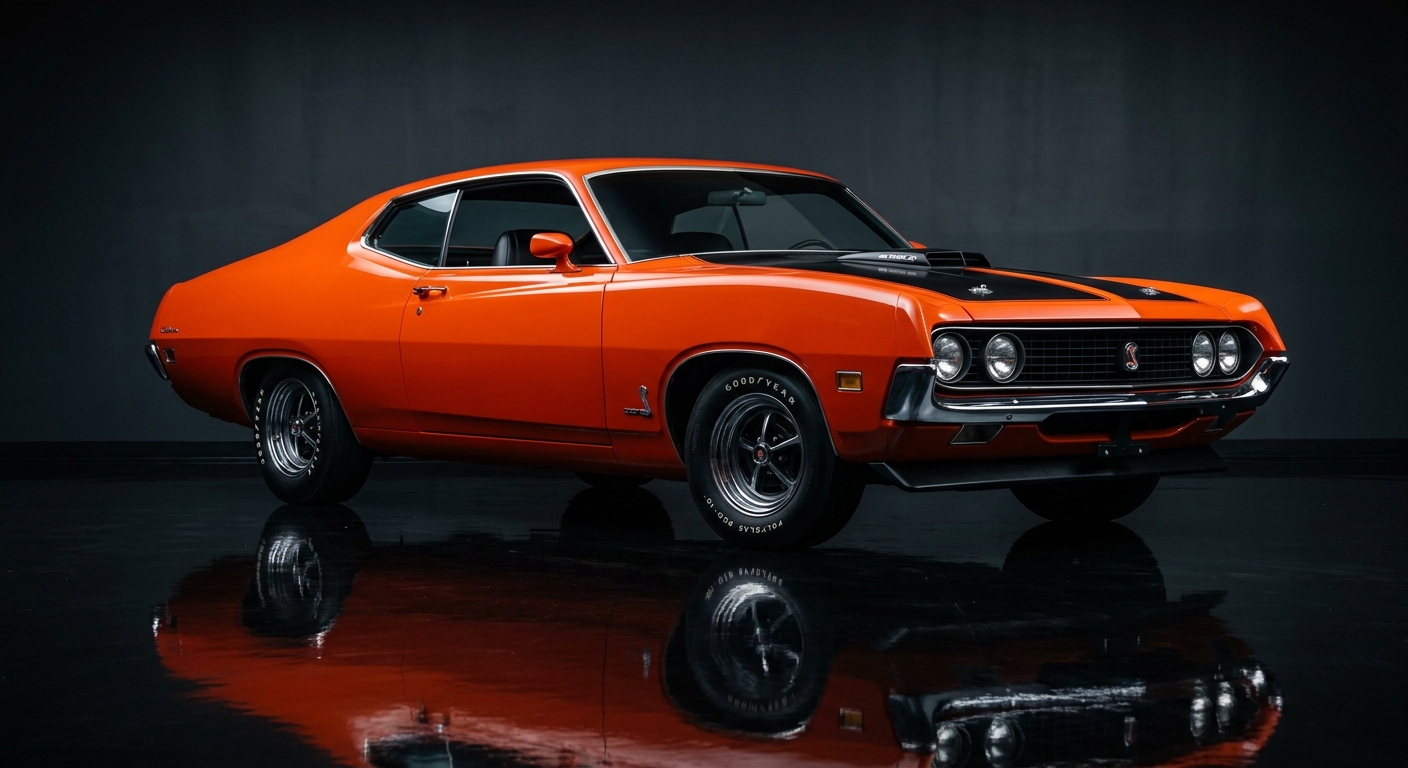
While Plymouth had its Road Runner and Dodge brandished the Super Bee, Ford answered back with something arguably more menacing: the 1970 Torino Cobra. Built on Ford’s intermediate platform and stuffed with serious big-block power, the Torino Cobra represented Detroit’s philosophy that there was no replacement for displacement. This was Ford’s street fighter, designed to run with the nastiest muscle cars of the era while maintaining a slightly more civilized demeanor than its competition.
Thunder Road Heritage
The Torino line emerged in 1968 as Ford’s answer to the GM A-body intermediates that were dominating both the street and the strip. By 1970, Ford had refined the formula to near perfection. The Cobra variant sat at the top of the performance hierarchy, distinguished by its functional ram-air hood scoop, racing stripes, and enough attitude to back up its aggressive styling cues.
Under that power bulge hood lived the legendary 429 Cobra Jet engine, a powerplant that had already proven its mettle in everything from Mustangs to Galaxies. In Torino Cobra trim, this mill delivered a conservative 370 horsepower, though seasoned enthusiasts knew the real output was closer to 400 horses. The torque figure of 450 lb-ft told the real story: this was an engine built for straight-line acceleration and tire-shredding launches.
Behind the Wheel
Climbing into the Torino Cobra’s interior revealed Ford’s commitment to both performance and comfort. The high-backed bucket seats provided adequate support for spirited driving, while the console-mounted shifter for the available four-speed manual fell readily to hand. The instrumentation was comprehensive for the era, with a full set of gauges monitoring the big-block’s vital signs.
Fire up the 429, and the Cobra immediately announces its intentions. The idle is lumpy and aggressive, promising serious performance once the throttle opens. The clutch is heavy but manageable, and the four-speed transmission shifts with the mechanical precision expected from a purpose-built muscle machine.
On the street, the Torino Cobra delivers exactly what its specifications promise. The 429 provides massive low-end torque that makes effortless acceleration a given in any gear. Zero to sixty happens in the mid-five-second range, impressive for a car weighing over 3,700 pounds. The quarter-mile disappears in the high 13-second range at over 100 mph, putting it squarely in Super Bee and Road Runner territory.
Road Manners and Character
While straight-line performance was clearly the priority, the Torino Cobra handled its substantial bulk with more composure than expected. The suspension was tuned for performance, featuring heavy-duty components that kept body roll in check during spirited cornering. The steering, though lacking modern precision, provided adequate feedback and control.
The Cobra’s character was distinctly different from its Mopar competition. Where a Road Runner felt raw and barely civilized, the Torino maintained a degree of refinement that made it equally at home on long highway cruises or quick trips to the grocery store. This versatility was both a strength and a weakness: it lacked some of the manic personality that made cars like the Super Bee so memorable, but offered superior daily drivability.
Market Position and Legacy
In 1970, the Torino Cobra carried a base price that positioned it competitively against other intermediate muscle cars. However, Ford’s conservative marketing approach meant it never achieved the cult status of some rivals. The Cobra was often overshadowed by the Mustang Boss series and the Galaxie-based performance models in Ford’s own lineup.
Today, clean examples of the 1970 Torino Cobra command significant collector interest, particularly cars equipped with the four-speed manual and functional ram-air system. The combination of distinctive styling, proven performance, and relative rarity has elevated the Cobra’s status among muscle car enthusiasts who appreciate its unique blend of power and practicality.
The 1970 Torino Cobra 429 stands as proof that Ford knew how to build serious muscle cars when the competition demanded it. While it may have lacked the pure theater of a Super Bee or the cult following of a Road Runner, it delivered genuine performance wrapped in a package that worked equally well for Saturday night street racing or Monday morning commutes. For collectors seeking an underappreciated classic with serious performance credentials, the Torino Cobra deserves serious consideration.