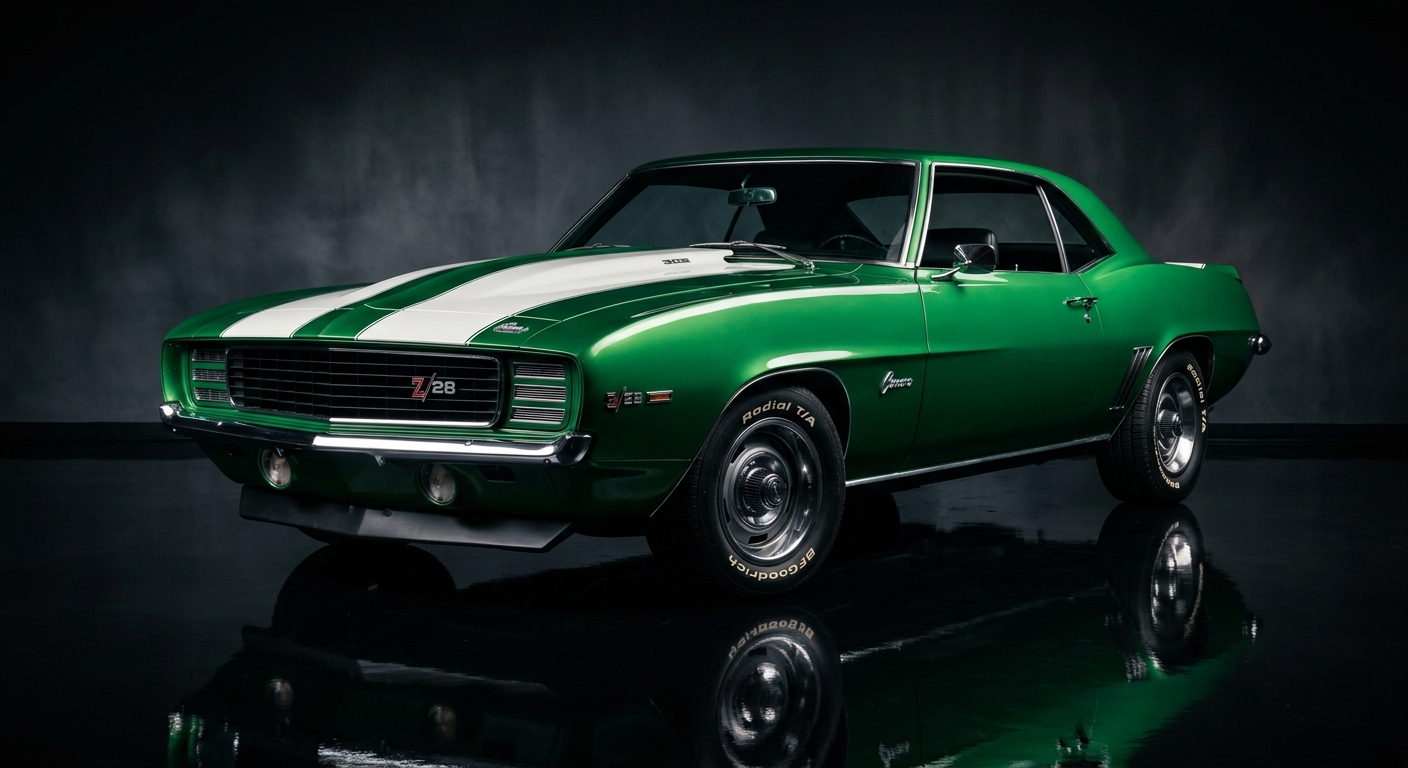
In 1969, while other manufacturers were locked in a horsepower arms race with increasingly massive engines, Chevrolet took a different approach with the Camaro Z/28. Born from Trans-Am racing homologation requirements, this wasn’t about straight-line bragging rights but rather a sophisticated blend of power and precision that would redefine what American performance could be. The Z/28 proved that bigger wasn’t always better, it just needed to be smarter.
Racing Bred, Street Legal
The Z/28’s genesis lies in the Sports Car Club of America’s Trans-Am racing series, which mandated engines under 305 cubic inches. Chevrolet’s solution was ingenious: take the 327’s block, stroke it down to 302.4 cubic inches, add the 350’s large-port heads, and top it with a radical solid-lifter cam. The result was 290 horsepower that felt like much more, wrapped in a package that could actually turn corners.
Unlike the tire-smoking antics of big-block muscle cars, the Z/28 demanded finesse. The high-revving 302 loved to be wound tight, delivering its peak power at 5800 rpm with a mechanical symphony that built to a crescendo most American cars of the era couldn’t match. This was an engine that rewarded skill over brute force, making every drive feel like a masterclass in automotive dynamics.
More Than Just an Engine
What separated the Z/28 from lesser Camaros wasn’t just the engine but the comprehensive performance package. Heavy-duty suspension components, wider F70-15 tires on rally wheels, and four-wheel disc brakes created a platform that could exploit every one of those 290 horses. The close-ratio four-speed manual transmission was the only option, reinforcing the car’s serious sporting intentions.
Inside, the Z/28 maintained the Camaro’s driver-focused cockpit while adding touches that hinted at its racing pedigree. The instrument cluster was comprehensive for the era, though drivers quickly learned to rely on their ears and seat-of-the-pants feel when pushing the 302 to its 7000-rpm redline. This was visceral driving in its purest form.
The Track-Day Hero
On the road, the Z/28 revealed its dual personality. Around town, it could be civilized enough for daily duty, though the solid-lifter cam’s loping idle and stiff suspension served as constant reminders of its serious nature. But point it toward a winding road or race track, and the transformation was immediate and intoxicating.
The steering was quick and communicative, the brakes strong and fade-resistant, and the suspension delivered grip levels that embarrassed many supposed sports cars. This wasn’t just American muscle; it was American precision engineering that could hold its own against the best Europe had to offer.
Legacy of the Original
Today, the 1969 Z/28 stands as perhaps the most significant performance car Chevrolet ever built, not for its raw numbers but for proving that American manufacturers could build sophisticated, balanced performance machines. It established the template for every high-performance Camaro that followed and demonstrated that the future of muscle cars lay not in ever-larger engines but in optimized, purpose-built packages.
Values for clean examples have climbed steadily as collectors recognize the Z/28’s historical significance and driving excellence. Finding an unmolested car requires patience and deep pockets, but the reward is ownership of one of the most important chapters in American automotive history.
The 1969 Z/28 remains the template for what an American performance car should be: sophisticated, purposeful, and utterly thrilling to drive. This isn’t just a muscle car, it’s the muscle car that proved brains could triumph over brawn.