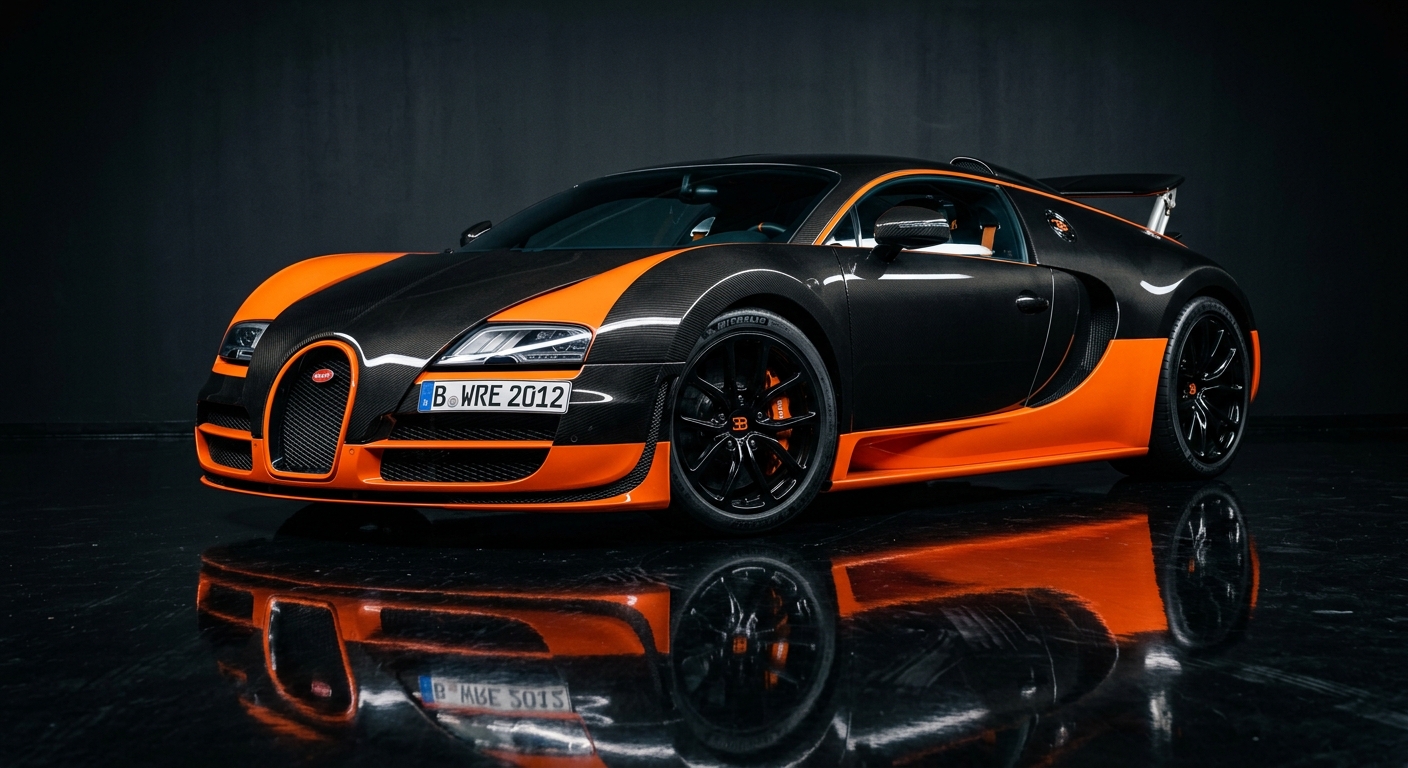
When Bugatti set out to create the ultimate expression of automotive excess, they didn’t just build a car that could hit 267 mph. They built a monument to human ambition that happened to have four wheels. The Veyron Super Sport represents the moment when engineering constraints became irrelevant and the laws of physics became the only boundary worth respecting.
The Science of Insanity
At the heart of this mechanical marvel sits an 8.0-liter W16 engine that reads more like a scientific paper than a specification sheet. Four turbochargers force-feed this sixteen-cylinder monster, generating 1,184 horsepower and 1,106 lb-ft of torque. These aren’t just numbers; they’re a declaration of war against automotive convention. The engine bay resembles mission control more than anything Detroit ever conceived, with cooling systems that could air-condition a small building and fuel pumps that flow like fire hoses.
Behind the wheel, the Veyron Super Sport doesn’t just accelerate, it warps reality. The surge from standstill to 60 mph in just 2.4 seconds feels less like automotive propulsion and more like being fired from a railgun. Your internal organs struggle to keep pace with the relentless thrust that continues well past the point where mere mortals would lift their right foot in terror.
Beyond the Sound Barrier
Achieving 267 mph required Bugatti to solve problems that NASA might find challenging. The aerodynamics package generates enough downforce to pin the car to the earth while managing airflow through radiators the size of dinner tables. At top speed, the Veyron consumes fuel at a rate that would make a fighter jet blush, draining its tank in twelve minutes of full-throttle running.
The carbon fiber bodywork isn’t just lightweight; it’s a masterclass in materials science. Every panel serves multiple functions, channeling air, dissipating heat, and maintaining structural integrity under forces that would tear lesser vehicles apart. The iconic horseshoe grille isn’t mere styling flourish but a carefully calculated air intake that feeds the beast within.
Daily Driver from Another Dimension
Perhaps the most remarkable achievement isn’t the Veyron’s ability to obliterate speed limits, but its willingness to crawl through city traffic with the docility of a luxury sedan. The seven-speed dual-clutch transmission shifts with butter-smooth precision in automatic mode, while the adaptive suspension soaks up road imperfections that would rattle lesser supercars into submission.
The interior matches the mechanical complexity with hand-stitched leather surfaces and aluminum trim that costs more than most people’s annual salary. Every surface whispers of craftsmanship that takes months to complete, from the center console that houses enough switches to launch a space mission to the seats that could grace a private jet.
The Price of Perfection
At $2.4 million when new, the Veyron Super Sport represented a financial commitment that most manufacturers wouldn’t risk on an entire model lineup. Bugatti reportedly lost money on every unit sold, treating each car as a four-wheeled advertisement for Volkswagen Group’s engineering capabilities rather than a profit center.
The Veyron Super Sport stands as automotive’s Manhattan Project: a demonstration that when resources become unlimited, the impossible becomes inevitable. It’s less a car than a four-wheeled proof of concept that physics, not finance, represents the final frontier of automotive achievement.