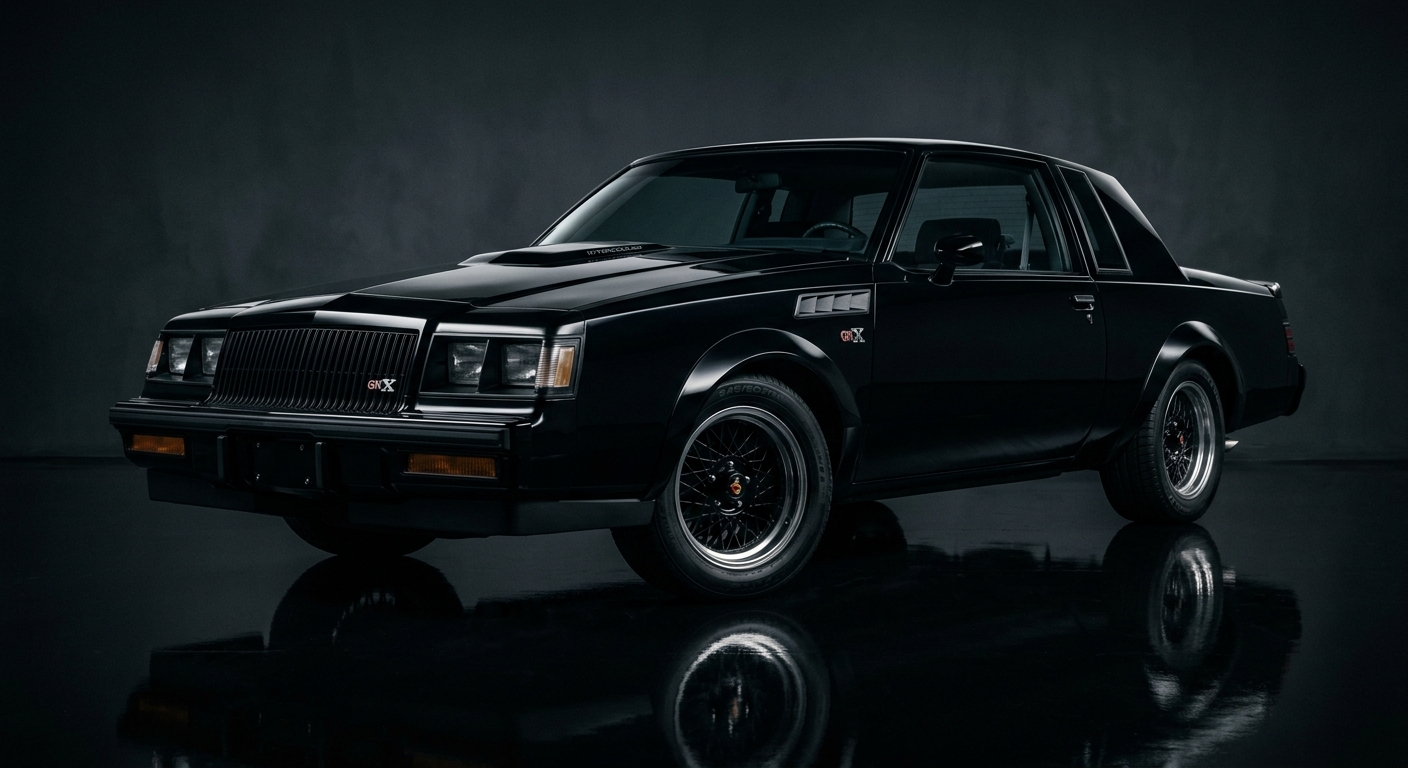
In 1987, when the automotive world expected Buick to bow out gracefully from the muscle car scene, they instead delivered the darkest, most sinister farewell imaginable. The Grand National GNX wasn’t just the end of an era, it was a thunderous exclamation point that left supercars scrambling to keep up with a blacked-out Buick.
The Birth of a Dark Legend
The GNX story begins with McLaren Performance Technologies (yes, that McLaren) being tasked with creating the ultimate Grand National. With only 547 examples ever built, this wasn’t meant to be a volume seller, it was Buick’s middle finger to anyone who thought American performance was dead. Starting with the already potent Grand National, McLaren engineers threw out the rulebook and created something genuinely terrifying.
The heart of the beast remained the 3.8-liter turbocharged V6, but everything else was fair game. A larger Garrett turbocharger, revised intercooler, and reprogrammed engine management pushed output to an underrated 276 horsepower and 360 lb-ft of torque. In reality, dyno tests revealed numbers closer to 300 horsepower, making the GNX one of the most dishonestly rated cars of the decade.
Performance That Redefined Expectations
The numbers tell only part of the story. Zero to sixty in 4.6 seconds and quarter-mile times in the mid-13s made the GNX quicker than the Corvette of the same year. But it was the way it delivered that performance that truly set it apart. The turbo V6 built boost with a mechanical violence that felt more like controlled explosions than smooth acceleration.
McLaren’s chassis modifications included a torque arm rear suspension, Panhard rod, and specific springs and shocks that transformed the Grand National’s already competent handling into something genuinely sports car-like. The result was a car that could embarrass Porsches in a straight line and still navigate corners with surprising composure.
The Ultimate Sleeper’s Disguise
What made the GNX truly special wasn’t just its performance, but its ability to hide in plain sight. To the untrained eye, it looked like any other Grand National, perhaps even a base Regal. The subtle GNX badges, unique wheels, and flared fenders were the only hints that this particular Buick could run with the exotic car crowd.
Inside, the story continued with surprisingly comfortable accommodations wrapped in period-correct velour and plastic. The digital dashboard and turbo boost gauge were the only real indicators that this wasn’t your grandmother’s Buick, though the violent acceleration would quickly dispel any confusion.
Cultural Impact and Legacy
The GNX arrived at a pivotal moment in automotive history. American manufacturers were still recovering from the malaise era, while import performance was gaining serious momentum. Here was proof that Detroit could still build world-class performance cars, just not in the way anyone expected.
The car’s influence extended far beyond its production run. It demonstrated the potential of turbocharged engines at a time when most manufacturers still viewed forced induction with suspicion. The GNX’s success paved the way for the modern turbocharged performance landscape we know today.
The GNX represents everything that made 1980s American performance special: outrageous capability wrapped in understated menace, with enough attitude to intimidate supercars and enough rarity to ensure legendary status. It proved that the best way to end an era isn’t with a whimper, but with a turbocharged roar that still echoes through automotive history.