In the pantheon of automotive beauty, few cars capture the imagination quite like the Alfa Romeo Montreal. Born from a 1967 Expo show car and evolved into a production reality by 1970, the Montreal represented Alfa Romeo’s most ambitious attempt at creating a true grand touring supercar. With its race-derived V8 engine and Bertone’s masterful bodywork, it stood as a testament to Italian engineering artistry at its most passionate and uncompromising.
Yet for all its beauty and technical sophistication, the Montreal arrived at perhaps the worst possible moment in automotive history. As emissions regulations tightened and fuel crises loomed, Alfa’s exotic V8 grand tourer found itself swimming against an increasingly powerful tide of pragmatism and environmental consciousness.
The Heart of a Racer
At the Montreal’s core lay one of the most exotic engines ever fitted to a road car. The 2.6-liter V8 was directly descended from Alfa Romeo’s Tipo 33 sports racing car, sharing the same fundamental architecture that had powered the company’s endurance racing campaigns. With its dry-sump lubrication, forged internals, and SPICA fuel injection, this was genuine race car technology adapted for street use.
The engine’s character was unlike anything else on the road. Peak power of 200 horsepower arrived at a screaming 6,500 rpm, while the soundtrack was pure Italian opera. The V8’s high-strung nature meant it needed to be worked hard to deliver its best, rewarding committed drivers with an intoxicating blend of mechanical music and genuine performance.
Bertone’s Masterpiece
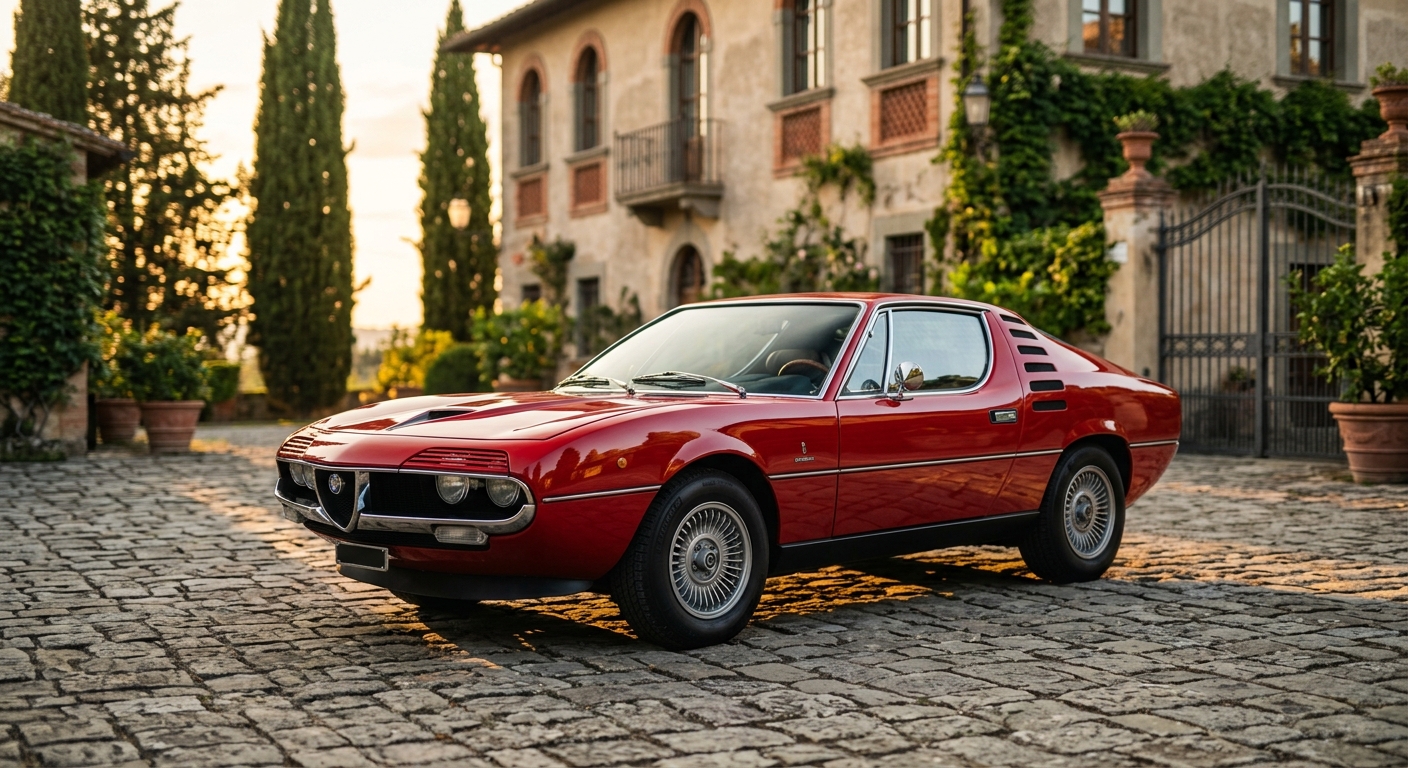
Marcello Gandini’s design for the Montreal remains one of Bertone’s greatest achievements. Every line served both aesthetic and functional purposes, from the distinctive NACA ducts that fed air to the rear brakes, to the slatted rear window that became a signature design element. The front end, with its unique headlight treatment and aggressive nose, perfectly captured the car’s predatory nature.
Inside, the Montreal continued the theme of purposeful beauty. The dashboard was a study in 1970s modernism, with its comprehensive array of gauges and toggle switches creating an almost aeronautical atmosphere. The seats offered excellent support, while the driving position was perfectly judged for spirited driving.
The Driving Experience
Behind the wheel, the Montreal revealed itself as a car of fascinating contradictions. The steering was beautifully weighted and precise, providing exceptional feedback through the Bertone-designed suspension. The car’s balance was exemplary, with neutral handling characteristics that inspired confidence even when pushing hard.
Yet the Montreal demanded commitment from its driver. The V8 engine needed to be kept on the boil to deliver its best performance, while the complex SPICA fuel injection system required careful maintenance to function properly. This was never a car for the casual enthusiast, but rather a machine that rewarded those willing to understand its unique character.
The transmission, a five-speed manual developed specifically for the Montreal, offered precise shifts and well-chosen ratios that perfectly complemented the engine’s power delivery. The car’s top speed of 137 mph was impressive for its era, while the 0-60 mph time of 7.4 seconds put it in serious sports car territory.
A Victim of Timing
The Montreal’s greatest tragedy was its timing. Launched just as the automotive world was grappling with new realities of emissions control and fuel economy, the car’s high-strung V8 and exotic construction made it increasingly obsolete. Production ended in 1977 after just 3,925 examples had been built, making it one of the rarest Alfas ever produced.
Today, the Montreal is recognized as one of the most significant Italian grand tourers of the 1970s. Its combination of racing pedigree, stunning design, and limited production numbers has made it highly sought after by collectors and enthusiasts who appreciate its unique place in automotive history.
The Montreal remains one of automotive history’s most beautiful mistakes, a car that prioritized passion over practicality in an era increasingly hostile to such idealism. Its race-derived V8 and Bertone’s masterful styling created something truly special, even if the world wasn’t quite ready for it. Today, it stands as a monument to Italian automotive artistry at its most uncompromising and romantic.