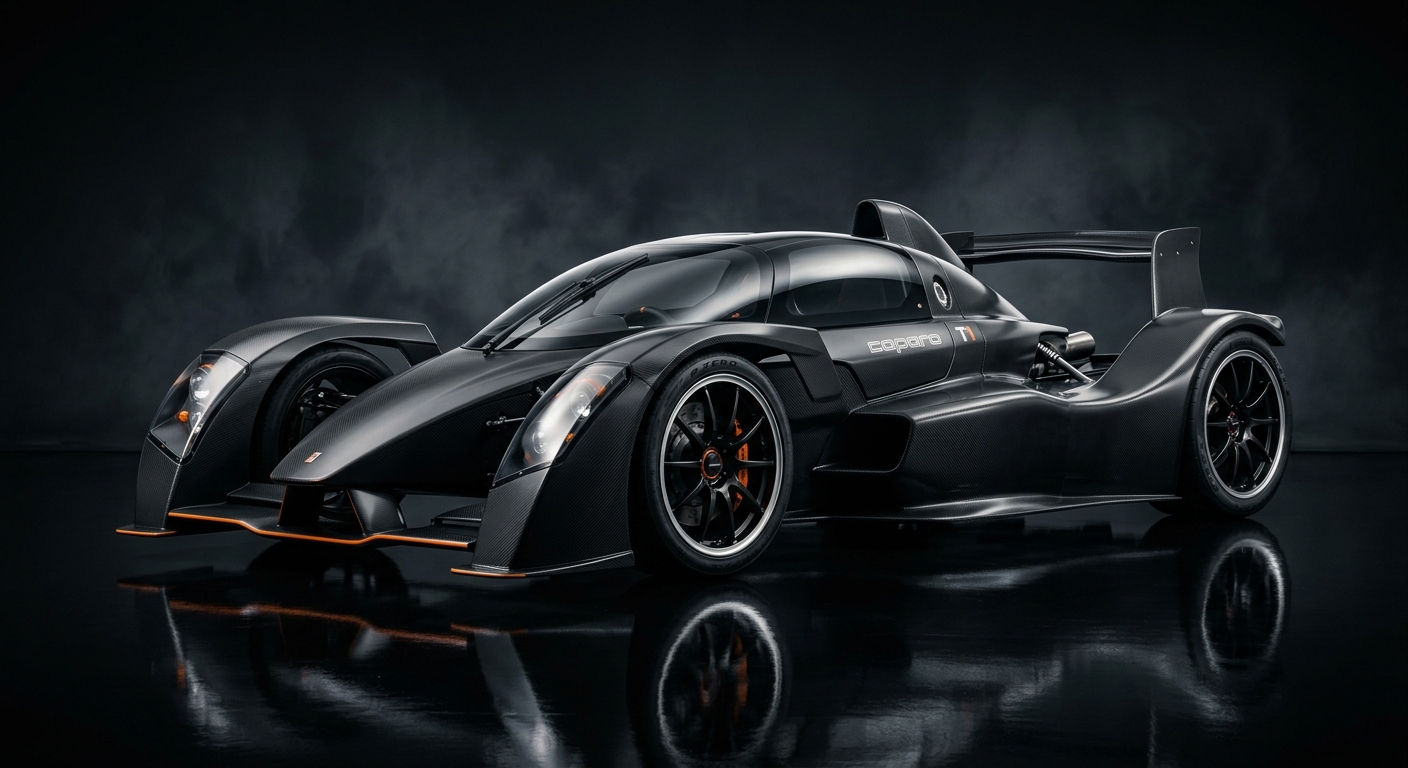
In the pantheon of automotive extremism, few cars have pushed the boundaries between street legality and pure racing madness quite like the Caparo T1. This British-built missile represented the absolute pinnacle of what happens when Formula 1 engineers are given free rein to create the ultimate road-going track weapon, consequences be damned.
A Formula Car for the Road
The Caparo T1 wasn’t just inspired by Formula 1 technology, it was essentially a Formula 1 car with number plates. Developed by former McLaren F1 engineers, the T1 featured an open-cockpit design, exposed wheels, and aerodynamics so aggressive they could generate more downforce than the car’s own weight at speed. The result was a machine that weighed just 470kg yet produced 575 horsepower from its naturally aspirated 3.5-liter V8 engine.
Every aspect of the T1’s construction prioritized performance over practicality. The carbon fiber monocoque chassis was lifted directly from racing car principles, while the suspension geometry mimicked that of contemporary F1 cars. Ground effect aerodynamics worked in conjunction with active aerodynamic elements to keep this featherweight missile glued to the tarmac at triple-digit speeds.
Driving the Undrivable
Getting into a T1 required the flexibility of a yoga instructor and the commitment of a test pilot. The cockpit was so cramped and purposeful that most drivers needed assistance just to climb aboard. Once strapped in, the experience was unlike any other road car ever built.
The T1’s power-to-weight ratio of 1,220 horsepower per ton meant acceleration was not just violent, it was borderline dangerous. The car could theoretically reach 60 mph in 2.5 seconds and continue to a top speed of 200 mph, but getting there required skills that few mortals possessed. The steering was so direct and responsive that tiny inputs translated into dramatic course changes, while the brakes could generate forces that threatened to compress internal organs.
What made the T1 truly terrifying was its aerodynamic dependency. Below 60 mph, the car felt loose and unpredictable. Above that speed, the aerodynamics began to work, transforming the T1 into something approaching controllable. But this Jekyll and Hyde behavior meant that slow-speed maneuvers, like navigating car parks or urban streets, became exercises in terror management.
The Price of Extremism
The T1’s development was plagued by setbacks that highlighted just how extreme this machine really was. Early prototypes suffered from overheating issues, aerodynamic instability, and a tendency to catch fire during testing. The car’s debut at the 2006 British Motor Show ended in embarrassment when the demonstrator burst into flames, earning it the unfortunate nickname of “the world’s most expensive barbecue.”
Production delays and technical problems meant that very few T1s ever reached customers. Those brave enough to take delivery found themselves owning perhaps the most uncompromising road car ever created, a machine that demanded race-level maintenance and offered zero concessions to comfort or convenience.
Engineering Without Compromise
The T1’s engine was a masterpiece of high-revving engineering. The naturally aspirated V8 produced its peak power at 9,000 rpm and could rev to 10,500 rpm, creating a soundtrack that was pure Formula 1 fury. Power was delivered through a six-speed sequential gearbox with paddle shifters, because a conventional manual would have been too slow for the T1’s extreme performance envelope.
Every component was designed for maximum performance and minimum weight. The wheels were forged magnesium, the body panels were paper-thin carbon fiber, and even the seats were integrated into the chassis to save weight. Optional extras included a passenger seat, though why anyone would willingly subject a passenger to the T1 experience remained a mystery.
The Caparo T1 stands as automotive history’s most unhinged experiment in street-legal extremism, a machine that proved some boundaries exist for good reason. It remains the closest thing to a Formula 1 car you could theoretically drive to the shops, assuming you were brave enough to try and skilled enough to survive the journey. For those few souls who experienced the T1’s brutal honesty, it represented the absolute pinnacle of automotive purity, a reminder of what happens when engineering brilliance meets complete disregard for human comfort.