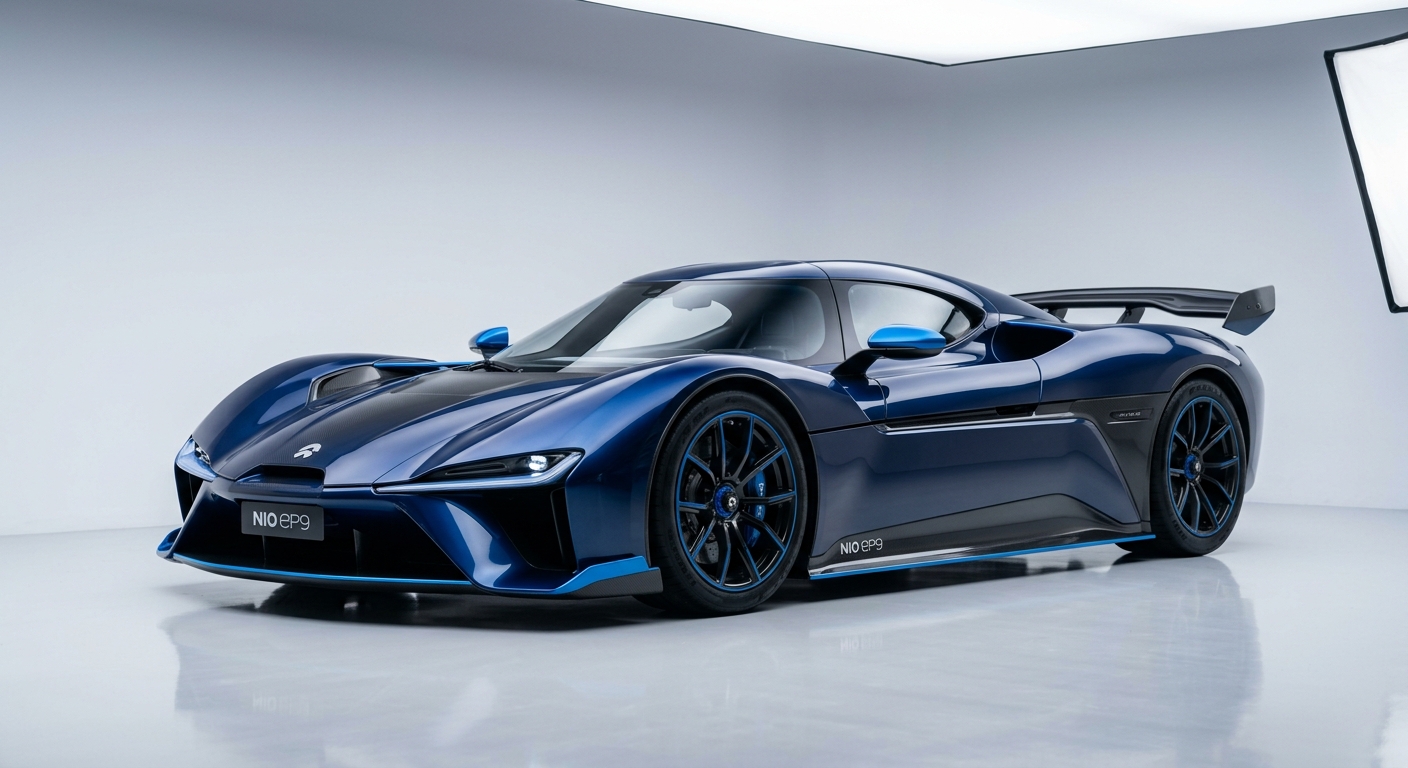
When NIO’s EP9 lapped the Nürburgring in 6:45.90, it didn’t just break the electric vehicle record. It obliterated it by over seven seconds, announcing China’s arrival in the hypercar arena with four-motor authority and uncompromising track focus.
Four Motors, One Mission
The EP9 represents NIO’s unfiltered approach to electric performance. Four individual motors, one at each wheel, deliver a combined 1,341 horsepower and 1,092 lb-ft of torque. This isn’t just all-wheel drive; it’s four-wheel everything. Each motor can be controlled independently, creating a level of torque vectoring precision that would make a Formula 1 engineer weep with joy.
The acceleration figures speak for themselves: 0-60 mph in 2.7 seconds, 0-124 mph in 7.1 seconds, and a top speed of 194 mph. But raw numbers only tell part of the story. The EP9’s party trick lies in its ability to distribute power with millisecond precision, effectively rotating the car through corners using differential torque rather than traditional steering inputs alone.
Track-Bred Engineering
Every surface of the EP9 serves aerodynamic purpose. The active rear wing adjusts continuously based on speed and cornering loads, while the aggressive front splitter and side-mounted air intakes channel airflow with surgical precision. The carbon fiber monocoque weighs just 1,735 kg, remarkable for a car carrying a 70 kWh battery pack.
The suspension setup borrows heavily from Formula 1, with inboard dampers front and rear connected to carbon fiber wishbones. Michelin Pilot Sport Cup 2 tires, sized 265/35 R19 front and 325/30 R20 rear, provide the connection to tarmac that allows those four motors to work their magic.
Interior Focus
Step inside and the EP9’s track intentions become immediately clear. Carbon fiber racing seats hold you in place while a minimalist dashboard focuses attention on the essentials: a digital instrument cluster and a steering wheel borrowed from NIO’s Formula E program. There’s no infotainment screen, no climate controls, no compromise.
The driving position puts you low and forward, with excellent visibility over the front fenders. Every control falls naturally to hand, from the regenerative braking adjustment paddles to the drive mode selector that transforms the car’s character from merely savage to absolutely brutal.
The Nürburgring Achievement
That record-setting lap wasn’t achieved through straight-line speed alone. The EP9’s four-motor system allows it to accelerate out of corners with devastating effectiveness, while the advanced aerodynamics keep it planted through the Nordschleife’s most challenging sections. The car’s ability to individually control each wheel’s power delivery means it can rotate through tight hairpins and maintain perfect balance through high-speed sweepers.
The NIO EP9 proves that electric hypercars can deliver more than just straight-line speed. They can rewrite the laws of physics at the world’s most demanding racetrack. This is the future, and it’s devastatingly fast.