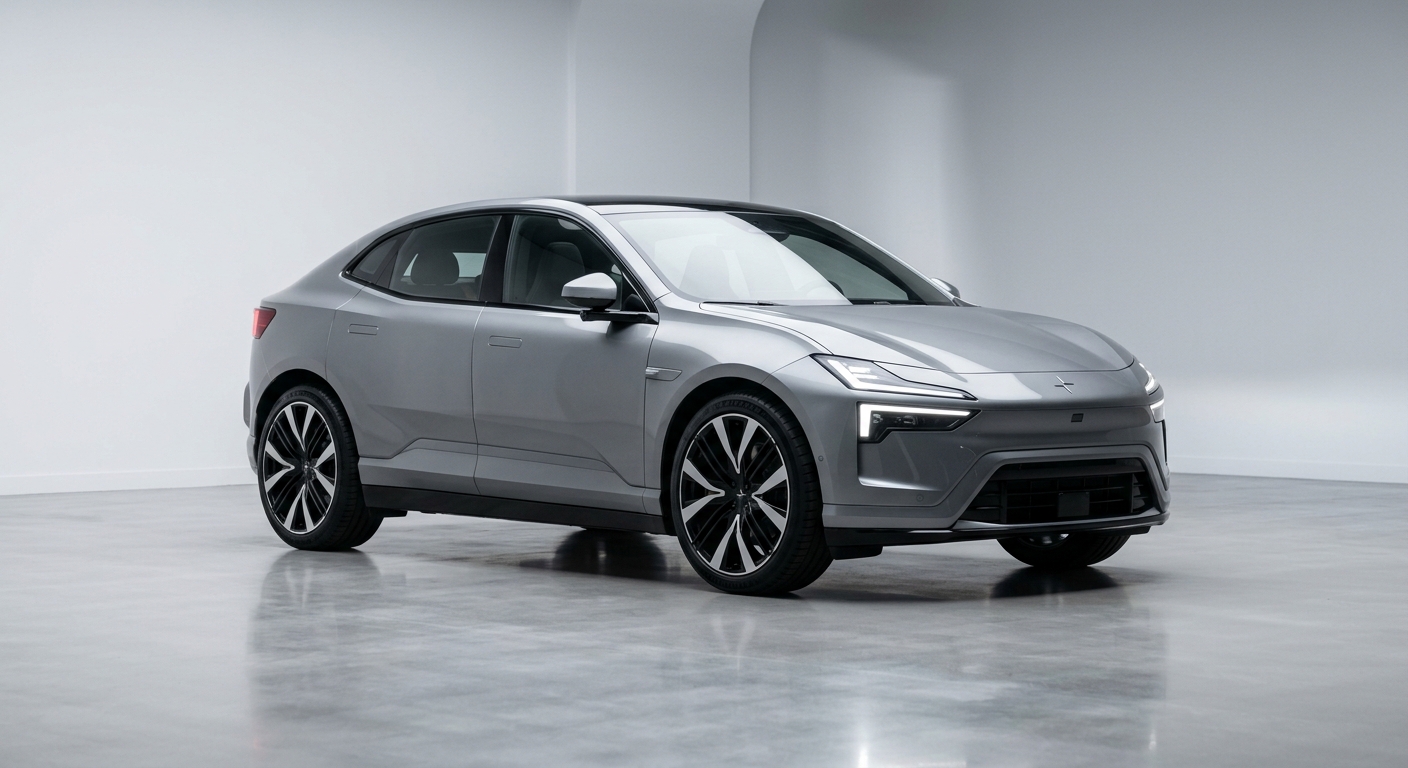
When Polestar announced their fourth model would be a coupe SUV without a rear window, the automotive world collectively raised an eyebrow. In an era where every manufacturer seems determined to create the most polarizing design possible, the Swedish-born brand has somehow managed to craft something that’s both daring and deeply desirable. The Polestar 4 isn’t just another electric crossover, it’s a statement about what luxury EVs can become when freed from conventional thinking.
A New Kind of Space
Step inside the Polestar 4 and you’re immediately struck by what’s missing: that familiar rear window frame in your peripheral vision. Instead, Polestar has created what they call a “sky lounge” rear cabin, with an uninterrupted glass roof that floods the space with light. The rear-facing camera system provides a crystal-clear view of what’s behind you, displayed on a high-resolution screen in the rearview mirror position. It takes about five minutes to adjust, and then you wonder why every car doesn’t work this way.
The cabin itself is a masterclass in Scandinavian minimalism. Premium materials like recycled plastics, sustainably sourced wood, and soft-touch surfaces create an environment that feels more like a premium lounge than a traditional car interior. The 15.4-inch central touchscreen handles most functions with surprising intuitiveness, while physical controls for climate and volume remain thankfully present.
Electric Performance with Soul
Under the sleek bodywork, the Polestar 4 Long Range Dual Motor delivers 544 horsepower and 506 lb-ft of torque through a sophisticated all-wheel-drive system. The sprint to 60 mph takes just 3.8 seconds, but it’s the way the power is delivered that impresses most. There’s none of the harsh, immediate slam of some performance EVs. Instead, the acceleration builds with a smooth, relentless surge that feels both civilized and deeply satisfying.
The adaptive air suspension does an excellent job of balancing comfort and control. In Comfort mode, the 4 glides over broken pavement with the serenity of a much larger luxury sedan. Switch to Performance mode, and the suspension firms up considerably, transforming the crossover into something genuinely sporty. The steering, while not the most communicative, offers good weight and precision for spirited driving.
Range and Charging Reality
The 102 kWh battery pack provides an EPA-estimated 270 miles of range, which proves realistic in mixed driving conditions. On the highway at 75 mph with the climate control running, expect closer to 240 miles, which is competitive for a performance-oriented electric SUV of this size. The 22 kW AC charging capability is among the fastest in class, while DC fast charging peaks at 200 kW, allowing for 10-80% charging in about 30 minutes under optimal conditions.
Cold weather performance is notably good, with the heat pump system helping maintain range even in sub-freezing temperatures. The preconditioned battery system also ensures maximum charging speeds when you arrive at a DC fast charger.
Design That Divides and Conquers
The Polestar 4’s exterior design is undeniably bold. The fastback roofline creates a coupe-like silhouette that’s rare in the SUV space, while the full-width light bar and distinctive Thor’s Hammer LED signatures give it instant recognition. Some will find the proportions odd, particularly the high beltline and small side windows. Others will see it as refreshingly different in a sea of generic electric crossovers.
The aerodynamics are impressive, with a drag coefficient of just 0.26 Cd helping both range and noise levels. At highway speeds, the cabin remains remarkably quiet, with only minimal wind or road noise intrusion.
The Polestar 4 succeeds where so many luxury EVs stumble: it has genuine character. Yes, the missing rear window will divide opinion, but it’s exactly this kind of bold thinking that the electric luxury segment needs. At $56,300, it’s not cheap, but it delivers a combination of performance, refinement, and distinctive design that justifies the premium.