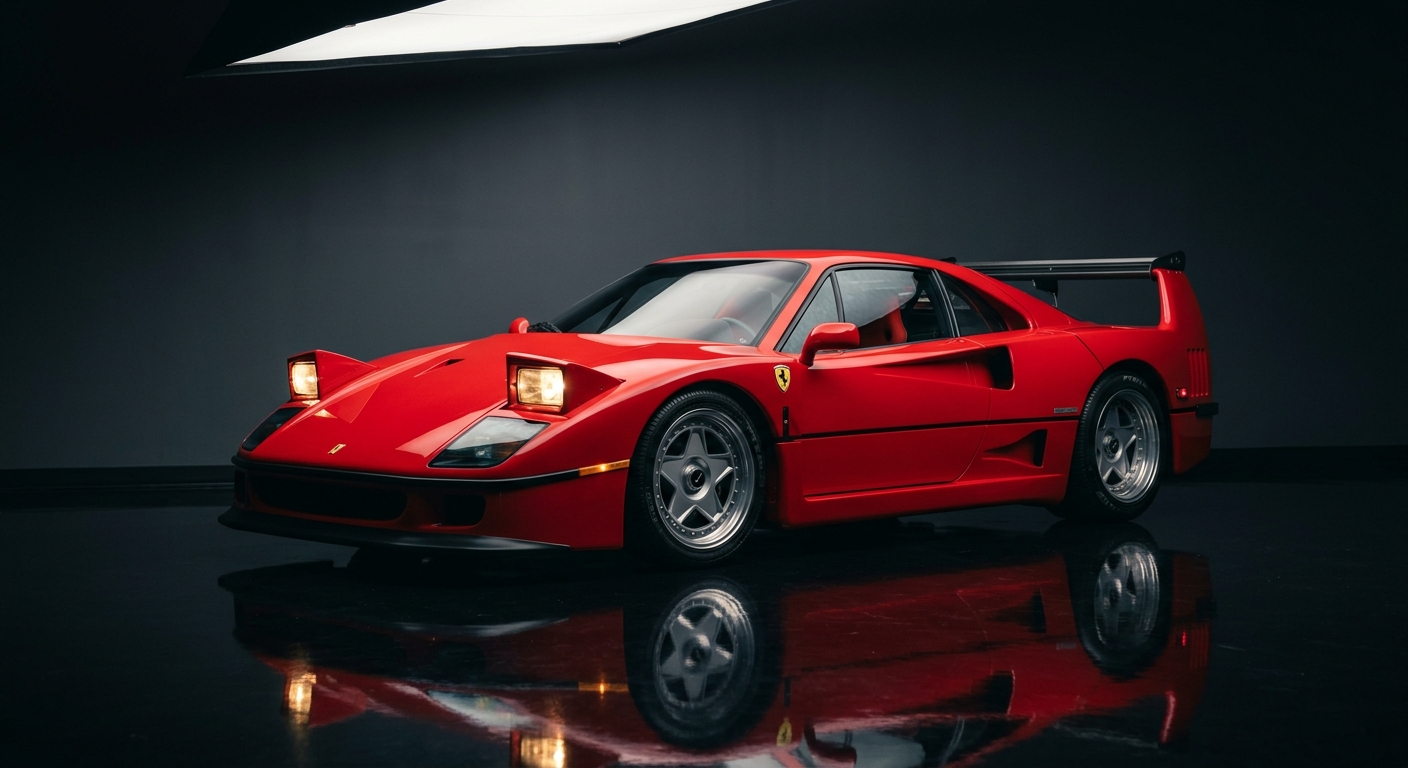
There will never be another car quite like the Ferrari F40. Born from Enzo Ferrari’s vision of the ultimate road-going racing machine, this twin-turbocharged monument to analog performance represents the final chapter of an era when supercars were built with singular focus and zero compromise. At a time when competitors were adding luxury amenities and electronic aids, Ferrari stripped everything away to create 201 mph of pure, unfiltered intensity.
The F40 emerged in 1987 as Ferrari’s 40th anniversary celebration, but more importantly, as Enzo’s personal farewell to the automotive world. He wanted to create something that captured the essence of his racing philosophy: lightweight construction, massive power, and an unwavering commitment to speed above all else.
Engineering Excellence
Under the F40’s aggressive bodywork lies a masterclass in lightweight construction. The chassis combines a tubular steel spaceframe with carbon fiber and Kevlar body panels, resulting in a curb weight of just 2,425 pounds. This obsession with weight reduction extends to every component: the door handles are simple cables, the windows are plastic, and sound deadening is virtually nonexistent.
The heart of the F40 is Ferrari’s 2.9-liter twin-turbocharged V8, producing 478 horsepower and 425 lb-ft of torque. Unlike modern turbocharged engines with their seamless power delivery, the F40’s powerplant is a study in dramatic contrasts. Below 3,000 rpm, it feels almost docile. Then the turbos spool up with explosive force, delivering a surge of acceleration that pins you to the minimalist racing seat.
The Ultimate Driving Experience
Driving an F40 is unlike any modern supercar experience. There’s no traction control, no stability management, no electronic safety net of any kind. The steering is unassisted and brutally direct, transmitting every nuance of the road surface through the thin-rimmed wheel. The suspension, tuned for maximum performance rather than comfort, communicates the car’s every move with crystalline clarity.
The five-speed manual gearbox requires deliberate, purposeful shifts, with a heavy clutch that builds serious leg muscle during city driving. This is not a car that coddles its driver or apologizes for its intensity. Every input must be precise, every decision calculated. The reward for this dedication is an emotional connection that modern supercars, for all their superior performance, simply cannot match.
Design and Presence
Pininfarina’s design for the F40 perfectly captures its no-compromise philosophy. The bodywork is all function, from the dramatic front air dam to the prominent rear wing. Side strakes feed air to the intercoolers, while NACA ducts channel cooling air throughout the chassis. Pop-up headlights maintain the clean nose profile while meeting regulations, and the rear engine cover features a transparent panel showcasing the twin-turbo V8.
Inside, the F40’s cabin is spartan by design. Carbon fiber door panels, basic instrumentation, and racing seats create an environment focused entirely on driving. The lack of modern conveniences like air conditioning (optional) or sound system emphasizes the car’s singular purpose. This is a machine built for one thing: delivering the purest possible driving experience.
The Ferrari F40 stands as the ultimate expression of analog supercar philosophy, a machine that demands complete commitment from its driver while delivering an emotional experience no modern car can replicate. In an automotive landscape increasingly dominated by electronic assistance and creature comforts, the F40 remains defiantly pure, uncompromising, and absolutely unforgettable.