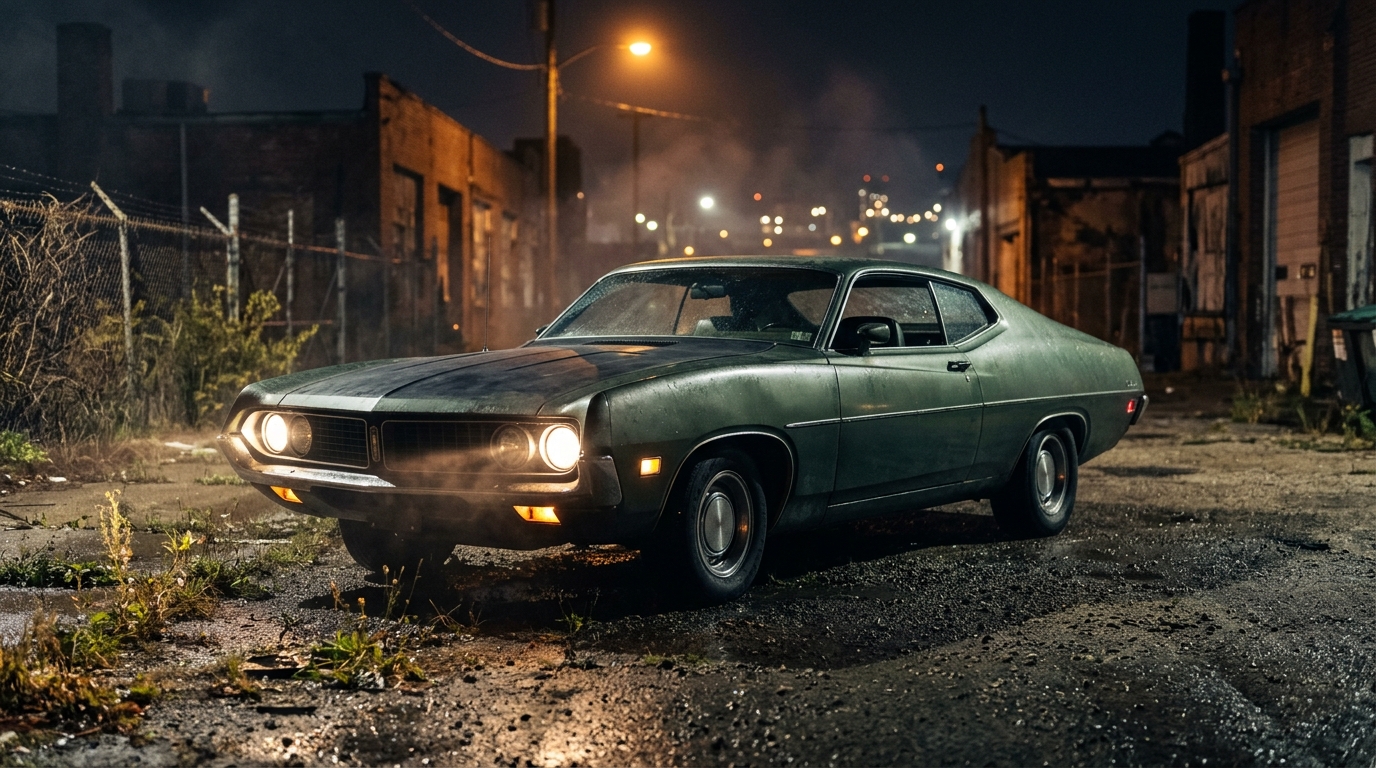
Picture a drive-in lot in the summer of 1970, the screen flickering over rows of Chevelles and Road Runners, and somewhere near the back a long, low Ford idling with a deep, loping burble that rattles the speaker pole. That car is the Torino Cobra, and it has spent half a century lurking in the shadow of louder, flashier names. After dark, with the hood scoop catching the glow of the snack bar neon, it looks like exactly what it was: Ford’s quietly lethal answer to the mid-size muscle war.
The Car Ford Forgot to Brag About
For 1970, Ford gave the Torino a dramatic redesign. The old Fairlane nameplate was fading, and the new Torino sat on a longer wheelbase with a swoopy, Coke-bottle body and a long-hood, short-deck stance that looked fast even at rest. The Torino Cobra topped the performance end of the lineup, available as a SportsRoof fastback or a two-door hardtop, with the fastback being the one most people picture. It was positioned as a no-nonsense muscle machine that undercut many rivals on price, and it came with a standard 360 horsepower 429 cubic inch Thunder Jet V8.
The real prize, though, was the optional 429 Cobra Jet, rated at 370 horsepower and an enormous 450 lb-ft of torque. Add the Ram Air option and the shaker hood scoop bolted to the engine and poked through the hood, shaking with every blip of the throttle. Order the Drag Pack with a Traction-Lok differential, and the car became a legitimate stoplight terror. Ford’s own advertising leaned on the Cobra name, borrowed from Carroll Shelby’s snake-themed lineage, to signal that this was the serious one.
Behind the Wheel After Midnight
Driving a 1970 Torino Cobra at night is a lesson in how much the era’s cars asked of their drivers. The sealed-beam headlights, a pair of round units set in the grille, cast a warm, yellowish pool that fades quickly past a couple hundred feet, so you learn to respect the dark and drive within what you can see. On an empty two-lane road, that limited glow makes the car feel intimate, almost private, with the dash gauges glowing a soft green in front of you.
The sound is the star. The 429 Cobra Jet does not shriek like a small-block; it rumbles, a deep and unhurried bass that rolls off the buildings in a quiet suburb and announces your arrival a block early. Roll into the throttle and the shaker hood leans forward, the intake roars, and the whole car squats as the rear tires dig in. With 450 lb-ft on tap, the Cobra surges forward in a way that feels effortless rather than frantic. Period testing put the quarter mile in the low 14-second range, with the Drag Pack cars able to dip into the high 13s.
It is not a corner carver. The Torino is a big, heavy car by the standards of its day, with a front-heavy balance, slow steering, and drum brakes on many examples unless you ordered the front discs. Push hard into a dark bend and you feel the nose lean and the tires protest. But that is part of the charm. The Cobra rewards a smooth, confident right foot, not a frantic wrestling match, and on a long straight with nobody else around, it feels unstoppable.
A Legacy Lost in the Dark
So why does the Torino Cobra sit in the shadows of the Mustang Boss 429 and the Chevelle SS 454? Part of it is timing. The 1970 model year was the peak of the horsepower war, and Ford had plenty of weapons, from the Mustang to the Boss 302. The Torino Cobra was a solid, honest performer, but it lacked the headline-grabbing halo of its siblings. NASCAR success with the Torino Talladega and Cyclone Spoiler variants captured more attention than the street Cobra ever did.
Yet for collectors who know, that obscurity is the appeal. A well-optioned 429 Cobra Jet Torino delivers big-block thrills at a fraction of the price of a Hemi or LS6 car. It was built to be driven, not hoarded, and driving it at night, windows down with the big V8 echoing off the storefronts, is the best argument for why this overlooked Ford deserves a second look.
The 1970 Torino Cobra is the muscle car that history misplaced, a big-block bruiser with a thunderous soundtrack and a price that still makes sense. Find one with the 429 Cobra Jet and a shaker hood, take it out after dark, and you will wonder why anyone ever overlooked it.