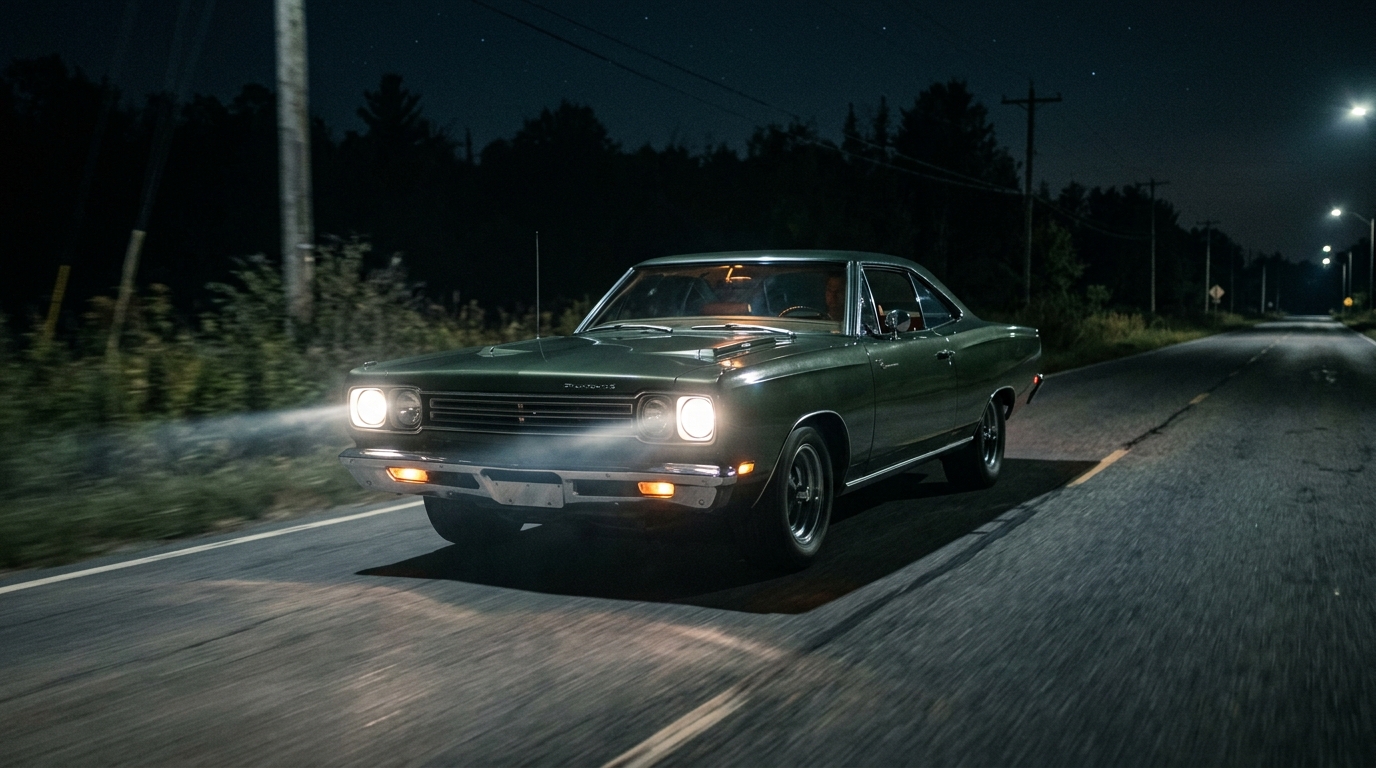
Somewhere past midnight on an empty stretch of two-lane blacktop, a lone AMX once thundered by with nobody to race but the dark, and the car that should have been chasing it was usually a Plymouth. The 1969 GTX is that car: a big, loud, unapologetic Mopar that treated the night like a private drag strip. I spent a long, quiet evening with one to find out whether the legend holds up when the streetlights thin out.
The Gentleman’s Hot Rod
Plymouth launched the GTX in 1967 with a clear mission: take the mid-size Belvedere platform and turn it into the premium muscle car of the lineup, the “gentleman’s hot rod.” By 1969 the GTX was no longer a separate model but the top performance trim of the Satellite line, wearing the Chrysler B-body’s clean, coke-bottle-flavored sheet metal. Standard equipment included hood-mounted air scoops with bright trim, a heavy-duty suspension, dual exhausts, Red Line tires, and a standard engine that most rivals would have charged extra for.
That engine was the 440 cubic inch RB V8 in Super Commando form, rated at 375 horsepower and 480 lb-ft of torque with a single four-barrel Carter AVS carburetor. For buyers who wanted the nuclear option, the 426 Hemi was available at 425 horsepower, and it is the reason a Hemi GTX commands the kind of money it does today. Only a few hundred 1969 GTX models left the factory with the Hemi, which is why most cars you encounter at night meets are 440 cars, and honestly, that is a fine thing to be.
Driving It After Dark
Turn the key and the 440 settles into a deep, lumpy idle that rattles the whole cabin. At night that sound is everything. Without daylight distractions, the exhaust note fills the dark and bounces off every guardrail and overpass. The throttle response is immediate, and the torque curve is an absolute gift: 480 lb-ft arrives low in the rev range, so you never need to chase the redline to feel a shove in the back.
The TorqueFlite three-speed automatic is the transmission most buyers chose, and it suits the car’s personality. Shifts are firm and confident, and a stab of the throttle drops the car a gear with a satisfying thump. A four-speed manual with a Hurst shifter was also offered, and it rewards drivers who want to stay busy. Period testing by the magazines of the day put the 0-60 mph sprint in the mid-six-second range and the quarter mile in the low 14s, with trap speeds around 100 mph. Those numbers are still quick by modern standards for a car of this size and age.
Headlights, Visibility, and Reality
Here is where honesty matters. The 1969 GTX uses sealed-beam headlamps, and compared with a modern LED or HID setup the output is modest. On a dark country road, the beams show you the next hundred feet or so, and you learn to respect the car’s pace accordingly. The upside is a wide, upright greenhouse with thin pillars, so outward visibility is excellent. The big hood stretches out ahead of you, and the two scoops glow in oncoming headlights like a pair of eyes.
Handling is period-correct. The front torsion bars and rear leaf springs were tuned for straight-line stability, and the car is happiest in long sweepers where the steering can load up and the front end stays planted. Standard front disc brakes were a welcome feature for 1969, and they haul the heavy GTX down with more confidence than drum-only rivals, though you still plan your stops well ahead. This is a car that wants a long road and an empty night.
Why It Matters
The AMX, American Motors’ two-seat sports car, was a fascinating and slightly lonely proposition in 1969, a small, sharp coupe going its own way. The GTX took the opposite approach: more car, more cubic inches, more presence. Where the AMX was a scalpel, the GTX was a sledgehammer wrapped in a tailored suit. Together they represent the two competing philosophies of the muscle era, and driving the Plymouth at night makes the argument for brute force surprisingly persuasive.
As a collectible, the GTX sits in a sweet spot. It shares the B-body bones of the Road Runner, so parts support is strong, yet it is rarer and more upscale. A well-kept 440 car is an attainable classic, while genuine Hemi cars sit firmly in six-figure territory.
Editor’s verdict: The 1969 GTX is the muscle car for people who want their thunder served with a little class. It will not carve corners like a modern sports car, but on an empty road after midnight, with that 440 rumbling through the dark, nothing else comes close to the feeling.