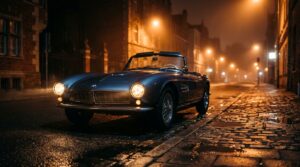
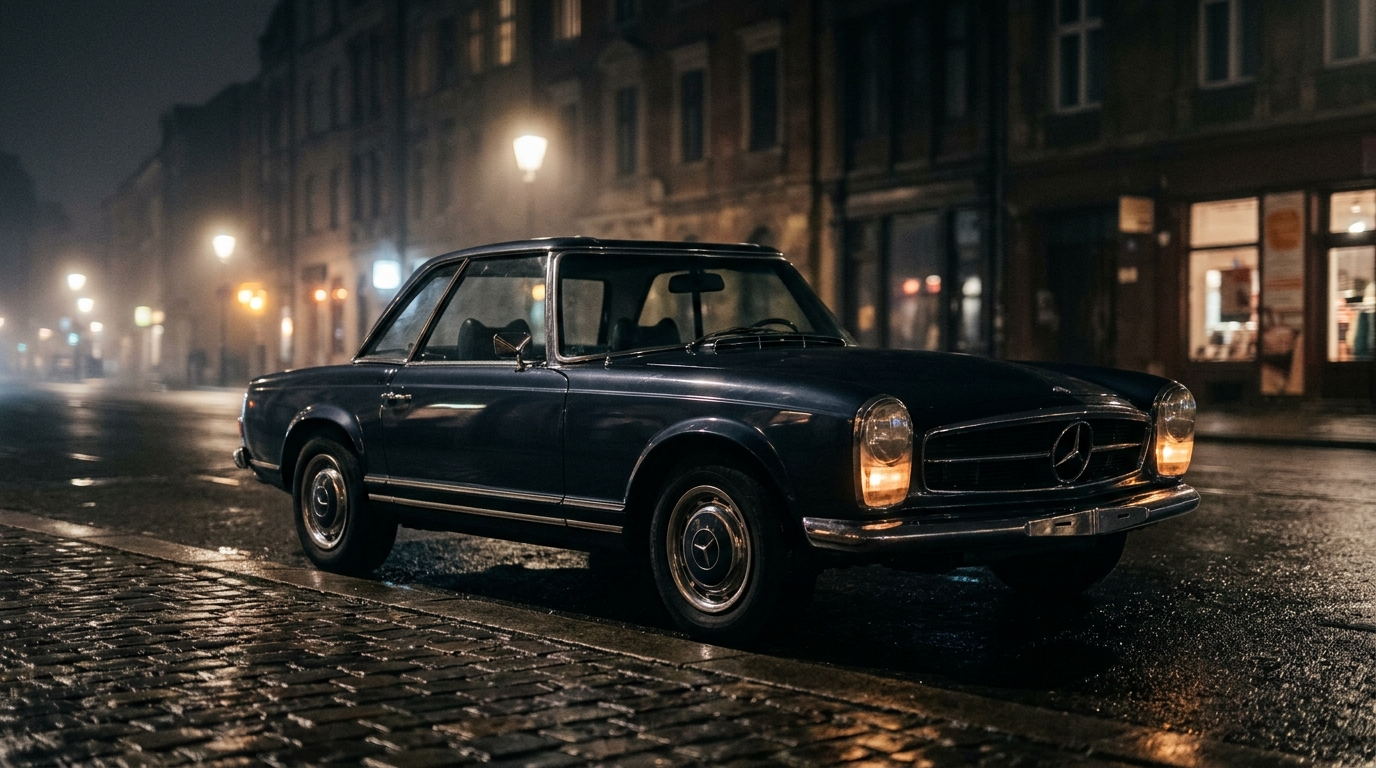
There is a particular hour, somewhere past eleven, when a quiet street under sodium lamps turns every parked car into a shape. Most vanish into the dark. The Mercedes-Benz 280SL Pagoda does the opposite: its dished roofline, upright greenhouse and tidy chrome pick up the amber glow and draw a silhouette so clean it feels drawn rather than built. We spent an evening with a 1969 car to see whether the driving lives up to the shadow it casts.
A Shape Designed to Be Seen Clearly
The W113 generation SL was styled under Paul Bracq with Friedrich Geiger’s earlier sketches feeding the direction, and engineered with Béla Barényi’s safety philosophy in mind. The nickname comes from that concave hardtop, which dips in the middle and rises at the edges like a pagoda roof. It was not purely decorative. The shape allowed a large glass area while keeping the roof pillars slim, and at night that glass matters. Sitting in the 280SL after dark, you notice how upright and airy the cabin feels. The thin pillars and tall windows give a commanding view of the road that modern cars, with their thick crash structures and high beltlines, simply cannot match.
Headlights, Honestly
Let us be fair to the era. The 280SL’s lighting is 1960s lighting, and North American cars of this period wore sealed-beam units rather than the elegant European-spec lenses. Output is modest by today’s standards, a warm yellow-white wash that reaches out sensibly but never floods the road. On a dark country lane you drive to the lights, not the other way round, and that suits the car’s temperament perfectly. The upright, vertical headlight clusters sit beside the tall radiator grille, and in your rear-view mirror they look charmingly formal. It is a car that asks you to slow down and notice the night.
The Heart: Fuel Injection in 1969
The 280SL arrived for the 1968 model year, replacing the 250SL, and it carried the new M130 inline-six at 2.8 litres. The headline feature was Bosch mechanical fuel injection driving a straight-six, producing 170 horsepower SAE gross (180 DIN gross in European trim) and around 193 lb-ft of torque. For its day, that was a sophisticated powerplant. The injection gives crisp throttle response and a refined, even idle that a carbureted car of the era could not match.
Late evening is when the engine character shows best. At a walking pace through quiet town streets, the six hums with a smooth, mechanical whirr and a faint metallic edge from the injection pump. Open it up on a clear road and the note builds into a creamy, purposeful rasp, never loud, always cultured. Many US-market cars were sold with the four-speed automatic, though a four-speed manual and, from the factory, a ZF five-speed manual were also available. Manual cars reward you with a precise if slightly long-throw action, while the automatic suits the car’s relaxed cruising nature.
Behind the Wheel After Dark
Do not expect sports-car frenzy. A 280SL weighs roughly 1,400 kg and runs to 60 mph in the neighbourhood of ten seconds, depending on gearbox. What you get instead is a beautifully damped, unflappable grand tourer. The front double wishbone and rear single-joint swing axle suspension, with coil springs, is a serious piece of 1960s engineering, and the car rides with composure. Ventilated discs up front with servo assistance give reassuring stopping power, and recirculating-ball steering is light and slightly vague by modern standards, but perfectly consistent once you adapt.
The night amplifies the experience. The dashboard glows with a soft green-tinged illumination, the big thin-rimmed steering wheel feels delicate in your hands, and the dials are clear and analog. There is no screen, no distraction, just you, the road and that engine note. The swing axle can twitch if you are clumsy in the corners, which is a good reason to treat darkness with respect and drive smoothly. Done properly, it is deeply relaxing.
Why the 1969 Car Matters
The 280SL ran from 1967 to 1971, and 1969 sits right in the middle of production, when the car was fully developed and well sorted. The W113 line as a whole, spanning the 230SL, 250SL and 280SL, saw about 48,912 cars built, with the 280SL accounting for roughly 23,885 of them. That makes it the most numerous Pagoda, and arguably the best all-rounder thanks to its stronger engine and improved cooling and braking over earlier models.
Today the Pagoda is firmly blue-chip. Concours-quality examples change hands for well into six figures, while good driver-quality cars sit lower but still command respect. Many wear the optional removable hardtop, and some owners keep an additional folding soft top as well, a practical touch for cool evening drives with the top down.
Editor’s verdict: The 1969 280SL Pagoda is not fast, but it is flawless company after dark: smooth, graceful and beautifully engineered, with a silhouette that glows under any streetlight. Buy one for the quiet midnight drives, and let the shape do the talking.