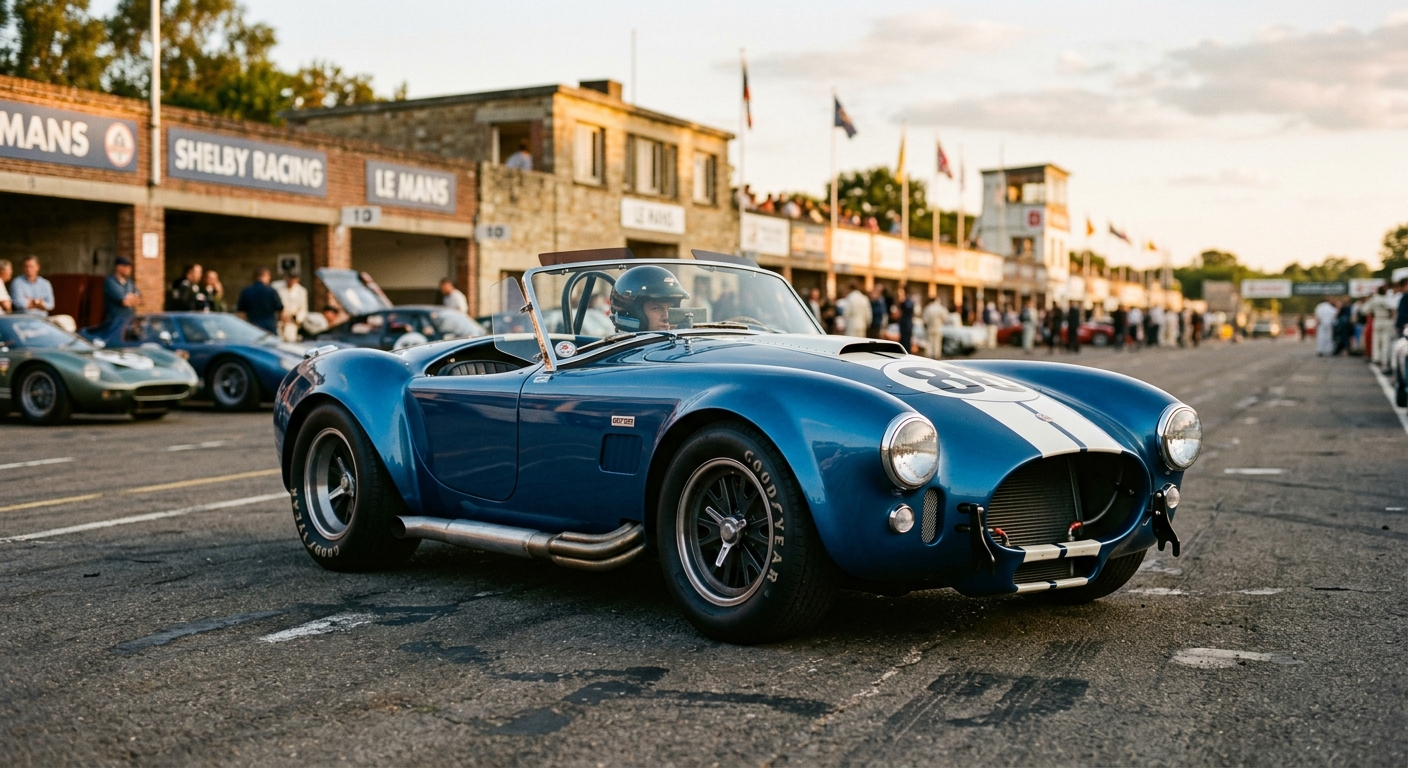
There are fast cars, and then there’s the Shelby Cobra 427. Carroll Shelby’s masterpiece wasn’t just built to be quick; it was engineered to be absolutely terrifying. When Ford’s massive 427 cubic inch big block was shoehorned into AC Cars’ lightweight British roadster chassis, the result was automotive alchemy of the most dangerous kind.
The Birth of a Legend
By 1965, Carroll Shelby had already made his mark with the small-block 289 Cobra, but Ford’s new 427 side-oiler big block presented an irresistible opportunity. The challenge was immense: how do you fit a 500+ horsepower monster into a car that weighs less than 2,500 pounds? Shelby’s solution involved widening the AC Ace chassis, flaring the fenders dramatically, and reinforcing everything that might survive the violent forces unleashed by the 427.
The visual transformation was striking. Where the 289 Cobra was sleek and elegant, the 427 was purposefully brutal. Those massive fender flares weren’t just for show; they housed significantly wider tires that were desperately needed to contain the big block’s fury. The side exhaust pipes became part of the car’s menacing soundtrack, announcing the 427’s presence with a sound that could wake the dead.
Driving the Beast
To drive a Cobra 427 is to commune with automotive chaos theory. The power-to-weight ratio defies rational thought: over 500 horsepower in a car that tips the scales at just 2,460 pounds. That translates to roughly 4.9 pounds per horsepower, a figure that modern supercars struggle to match even today.
The driving experience begins before you even turn the key. Climbing into the cockpit requires a certain athletic ability, and once settled into the surprisingly comfortable bucket seats, you’re surrounded by purposeful simplicity. The dashboard is sparse, dominated by large, clear gauges that seem to vibrate with anticipation.
Fire up the 427, and the idle alone tells you this isn’t a normal car. The lopey cam creates an irregular heartbeat that resonates through the aluminum body and straight into your soul. Blip the throttle, and the side pipes bark with authority that makes conversations impossible.
On the Road
Motion in a Cobra 427 happens in two distinct phases: cruising and launching into orbit. There’s very little middle ground. The big block produces massive torque from almost any rpm, meaning wheelspin isn’t just likely, it’s inevitable. The narrow rear tires, period-appropriate as they are, simply cannot cope with the 427’s output under full acceleration.
The steering is immediate and unassisted, requiring real muscle to change direction at parking lot speeds but lightening up beautifully once moving. There’s no power steering, no ABS, no traction control, and certainly no stability management. It’s just you, 500+ horsepower, and whatever driving skills you’ve managed to accumulate.
Braking is an exercise in faith. The four-wheel disc brakes were advanced for 1965, but they’re still 1965 brakes trying to stop a missile. Plan ahead, brake early, and pray the rear wheels don’t lock up and send you spinning toward immortality.
The Numbers Game
Official performance figures for the Cobra 427 vary depending on the specific engine configuration, but the numbers remain staggering even by today’s standards. The 0-60 mph sprint takes approximately 4.2 seconds, a figure that embarrassed contemporary Ferraris and Lamborghinis. Top speed was estimated at over 165 mph, though few drivers possessed the courage or open road necessary to verify this claim.
But raw acceleration numbers don’t tell the complete story. The Cobra’s party trick was its ability to break traction at will, turning every drive into a master class in car control. This wasn’t necessarily a character flaw; it was the inevitable result of putting racing engine power into a street car chassis with 1960s tire technology.
The Ultimate Expression
What makes the 427 Cobra truly special isn’t just its performance; it’s the purity of the experience. This is automotive expression stripped of all pretense and safety nets. Every drive is a negotiation between man and machine, where respect for the car’s capabilities isn’t just advisable, it’s essential for survival.
The Cobra 427 represents the end of an era when cars could be built without compromise, regulation, or committee oversight. Carroll Shelby saw an opportunity to create the ultimate street rod and took it, consequences be damned. The result was a machine so potent that even today, nearly six decades later, it commands both fear and reverence from anyone brave enough to turn the key.
The Shelby Cobra 427 isn’t just a landmark achievement in American automotive history; it’s the definitive answer to the question “how fast is too fast?” The answer, evidently, is that there is no such thing. This is raw American muscle in its most concentrated form, a machine that proves sometimes the best solution to any problem is simply more horsepower. Modern supercars may be faster, safer, and more sophisticated, but none carry the primal terror and joy that comes with every mile in Shelby’s masterpiece.