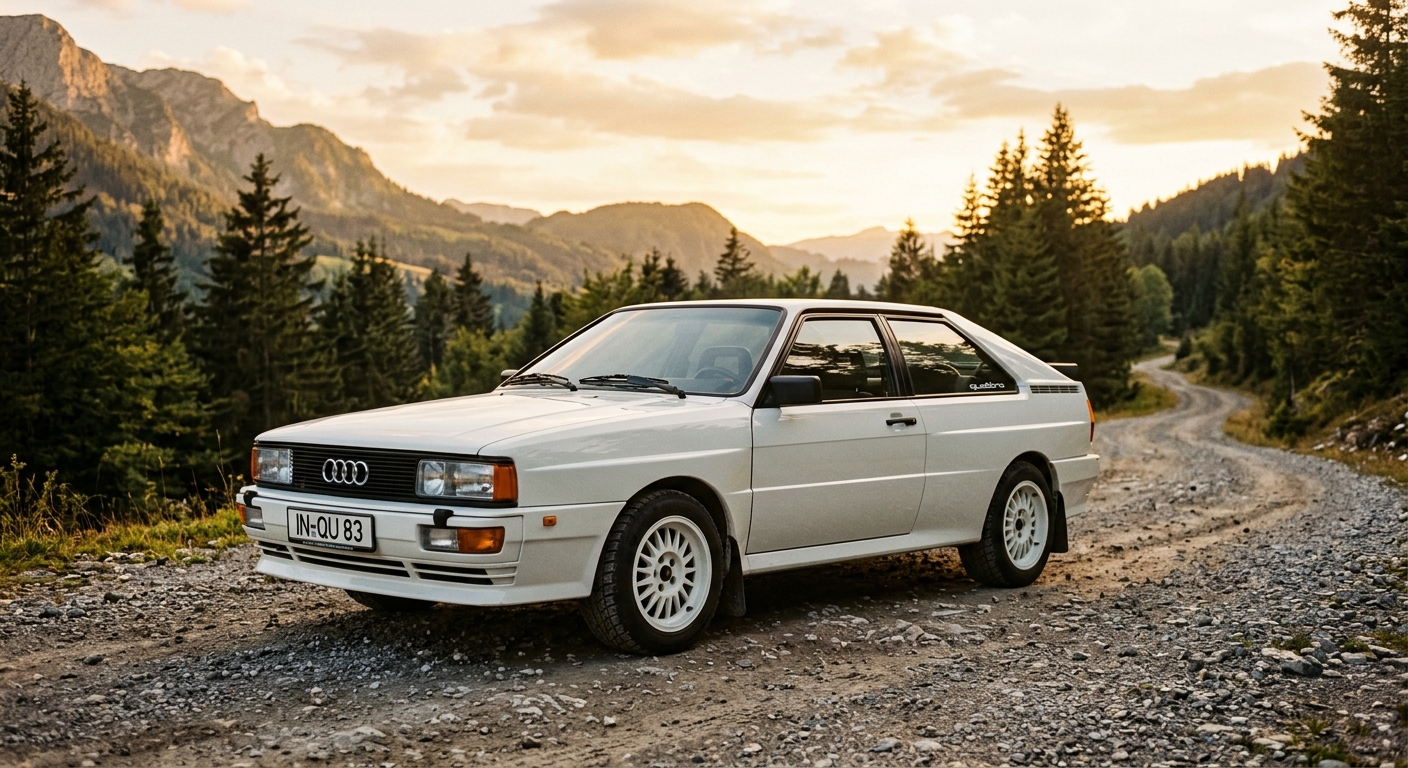
In 1983, Audi unleashed a technological revolution disguised as a boxy German coupe. The quattro didn’t just introduce all-wheel drive to the performance car world, it rewrote the rulebook entirely. While other manufacturers were still perfecting rear-wheel drive dynamics, Audi’s engineers were busy creating a machine that could defy physics and dominate any surface it touched.
This wasn’t just another sports car. The quattro was Audi’s declaration of war on conventional wisdom, a turbocharged testament to German engineering that would go on to humble Porsche 911s on twisty mountain passes and obliterate the competition on rally stages worldwide.
The Revolutionary Technology
At the heart of the quattro lay Audi’s groundbreaking permanent all-wheel-drive system. Unlike part-time systems that engaged only when needed, quattro sent power to all four wheels continuously through a sophisticated center differential. The default split was 50:50, but the system could automatically adjust power distribution based on traction conditions.
The 2.1-liter turbocharged five-cylinder engine produced 200 horsepower and 210 lb-ft of torque, figures that were impressive for 1983 but told only part of the story. What made the quattro special wasn’t just its power output, but how effectively it could deploy that power regardless of road conditions.
Driving the Legend
Behind the wheel, the 1983 quattro feels unlike anything else from its era. The steering is heavy and mechanical, requiring real effort at parking lot speeds but coming alive with feedback once you’re moving. The turbo five-cylinder engine has a distinctive warble that builds to an intoxicating growl under acceleration.
What’s immediately apparent is the car’s incredible traction. Where a contemporary BMW or Mercedes might struggle for grip in wet or loose conditions, the quattro simply hooks up and goes. The confidence this inspires is addictive, allowing drivers to carry speeds that would be impossible in a rear-wheel-drive car of the same vintage.
The ride quality is firm but not punishing, befitting a car designed to excel on everything from smooth tarmac to rough rally stages. Body roll is well-controlled, and the quattro changes direction with surprising agility for a car of its era and weight.
Rally Dominance
The quattro’s competition pedigree is legendary. In World Rally Championship competition, quattro-equipped Audis won 23 rallies and took four manufacturers’ championships between 1982 and 1987. The car’s ability to put power down on loose surfaces gave it an enormous advantage over rear-wheel-drive competitors.
Drivers like Michèle Mouton, Hannu Mikkola, and Walter Röhrl became household names piloting various iterations of the quattro rally car. The technology proved so dominant that it forced other manufacturers to develop their own all-wheel-drive systems just to remain competitive.
Design and Interior
The quattro’s exterior design is quintessentially 1980s, with angular lines, pronounced wheel arches, and a purposeful stance. It’s not conventionally beautiful, but it has an undeniable presence that announces its serious intentions. The flared fenders were necessary to accommodate wider tires and the all-wheel-drive hardware.
Inside, the cabin is typical period Audi: well-built but austere by modern standards. The seats are supportive, the instruments are clear and functional, and the build quality is exemplary. This is a driver’s car first and foremost, with little concession to luxury or comfort.
The 1983 Audi quattro stands as one of the most influential performance cars ever built, a machine that proved all-wheel drive could be about more than just bad weather capability. It’s a piece of automotive history that you can still drive and enjoy today, assuming you can find a good example. This is the car that made Audi a performance brand and changed the automotive landscape forever.