While Detroit’s bean counters declared the muscle car dead in 1976, someone forgot to tell Pontiac. The Firebird Trans Am refused to go quietly into that emissions-strangled night, emerging as perhaps the most defiant and stylish survivor of America’s performance purge. With its screaming chicken hood decal and unapologetic attitude, the ’76 Trans Am became an icon that transcended its modest horsepower numbers.
Design That Screamed Performance
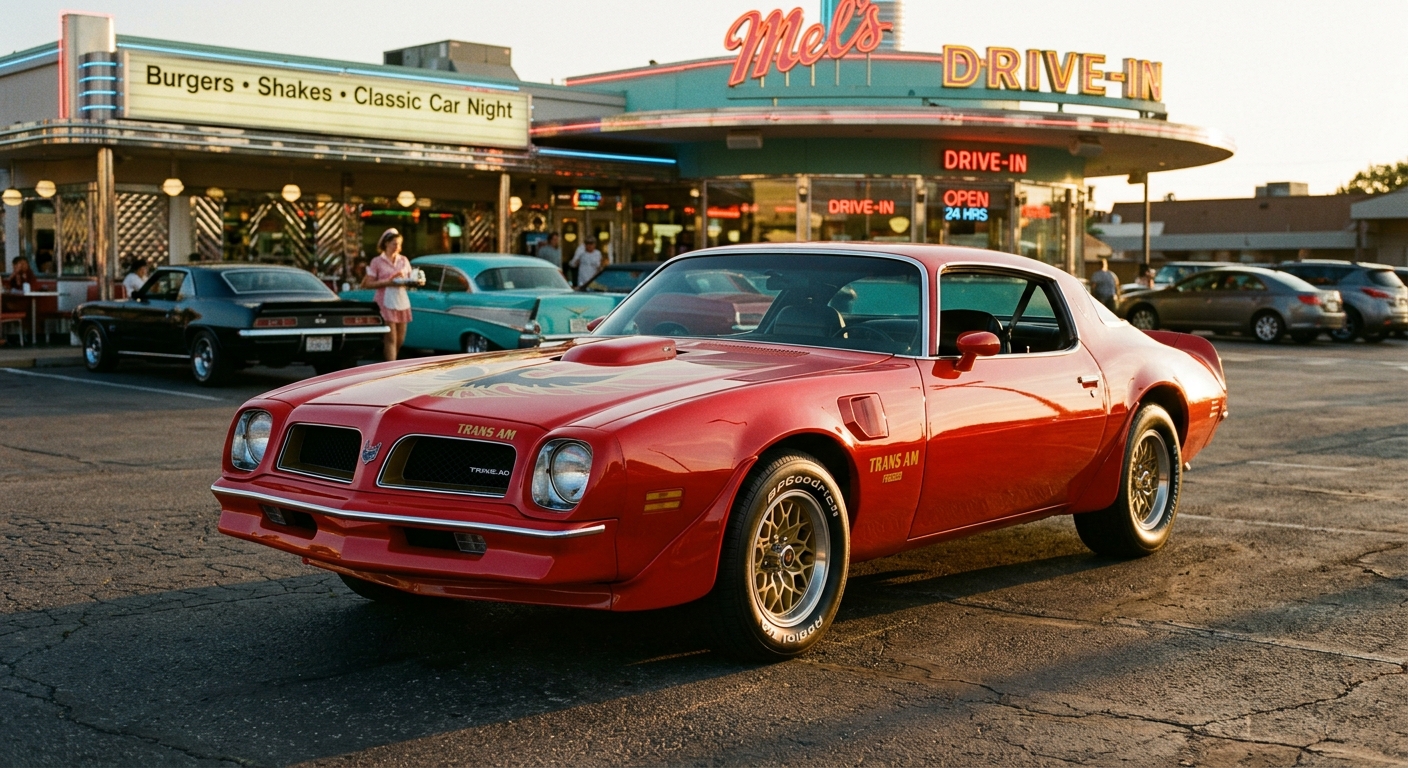
The 1976 Trans Am was all about visual drama. Pontiac’s designers understood that if raw power was being neutered by regulations, they’d compensate with pure theater. The massive Firebird decal sprawled across the hood like a phoenix rising from the ashes of the muscle car era. Those distinctive “shaker” hood scoops weren’t just for show, they actually funneled cool air to the engine while creating an intimidating presence that few cars could match.
The wraparound rear spoiler, flared fenders, and aggressive stance gave the Trans Am a purposeful look that promised performance even when emissions controls were sapping power from American V8s. The distinctive split grille and quad headlight setup created a face that was unmistakably Pontiac, while the available T-top configuration added an element of open-air freedom that would become synonymous with the Trans Am experience.
The 455 Experience
Under that dramatic hood lived Pontiac’s 455 cubic inch V8, the largest engine available in any 1976 production car. While it produced a modest 200 horsepower by modern standards, the real story was the massive 330 lb-ft of torque that gave the Trans Am surprising low-end grunt. The engine’s lazy, lopey idle and thunderous exhaust note through the dual exhausts created an authentic muscle car soundtrack that smaller engines simply couldn’t replicate.
Paired with either a four-speed manual or three-speed Turbo Hydra-Matic automatic, the big 455 delivered the kind of effortless cruising power that defined American performance. It wasn’t about high-revving sophistication, it was about massive displacement doing the work with minimal stress. The Trans Am could accelerate from 0-60 mph in about 8 seconds, respectable for the era, but more importantly, it felt powerful in a way that smaller engines couldn’t match.
Handling the Heavyweight
The Trans Am’s suspension setup balanced comfort with sporting pretensions. The front and rear stabilizer bars, along with the performance-oriented shock tuning, kept body roll in check during spirited driving. The wide Goodyear tires mounted on distinctive Rally II wheels provided adequate grip, though the Trans Am was always more about straight-line performance and cruising comfort than carving canyons.
Power steering was standard, making the hefty Trans Am manageable in parking lots, while power brakes helped rein in the car’s considerable mass. The driving experience was quintessentially American: relaxed, powerful, and dramatic rather than precise or nimble.
Cultural Impact
The 1976 Trans Am became a cultural phenomenon that extended far beyond automotive circles. Its starring role in “Smokey and the Bandit” just one year later would cement its place in American pop culture, but even before Hollywood came calling, the Trans Am represented rebellion against the increasingly sanitized automotive landscape of the mid-1970s.
This was a car that refused to apologize for being American, for being loud, for being dramatic in an era when European efficiency was becoming fashionable. The Trans Am stood as a middle finger to fuel economy regulations and emissions controls, a last bastion of the “more is more” philosophy that had defined American performance cars in the previous decade.
The 1976 Trans Am succeeded not because it was the fastest or most sophisticated car on the road, but because it refused to compromise its character in the face of changing times. While other manufacturers were building smaller, more efficient cars, Pontiac doubled down on drama and delivered a machine that looked and sounded like it could conquer the world, even if the horsepower figures told a different story. Nearly five decades later, that defiant spirit still resonates with anyone who believes cars should stir emotions, not just transport bodies efficiently from point A to point B.