In an era when supercars were becoming increasingly brutal and uncompromising, the 1984 Lotus Esprit Turbo offered something different: sophistication married to surgical precision. While its contemporaries relied purely on displacement and drama, the Esprit Turbo proved that intelligence could triumph over brute force. This was the thinking person’s supercar, a machine that demanded skill and rewarded finesse.
The Giugiaro Masterpiece
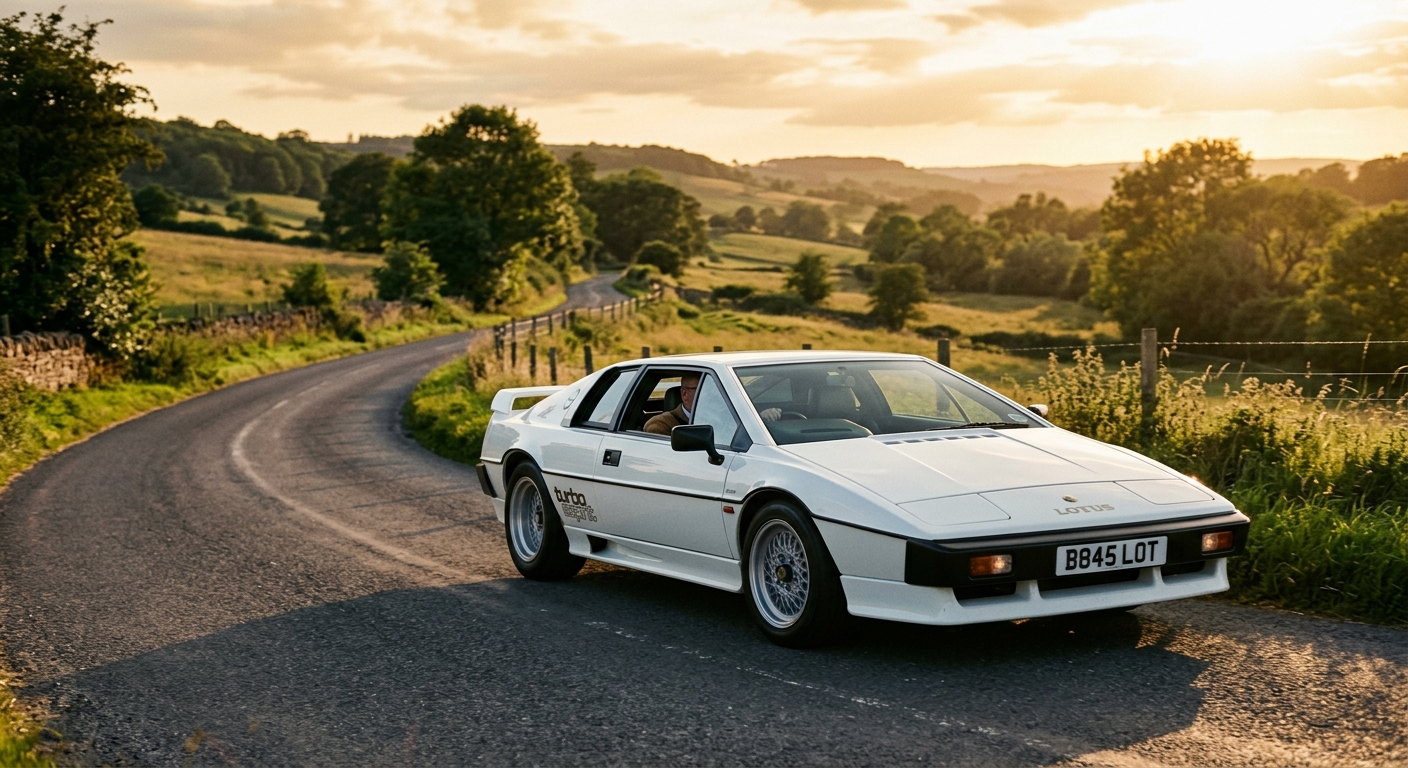
Giorgetto Giugiaro’s wedge design had already been stunning onlookers since 1976, but by 1984, the Esprit had evolved into its most compelling form. The addition of forced induction transformed what had been a beautiful but somewhat underpowered exotic into a genuine supercar threat. The visual changes were subtle but meaningful: revised front and rear spoilers, side strakes that actually served a purpose, and those distinctive telephone dial wheels that became an icon of 1980s automotive design.
The cabin remained true to Lotus philosophy: driver-focused, purposeful, and refreshingly free of unnecessary luxury. Every control fell naturally to hand, every gauge was positioned for optimal visibility. The flat dashboard and angular forms echoed the exterior’s geometric precision, creating a cockpit that felt like a fighter jet more than a grand tourer.
Turbocharged Revolution
Under the engine cover sat Lotus’s 2.2-liter turbocharged four-cylinder, producing 215 horsepower and 220 lb-ft of torque. On paper, these numbers might seem modest by today’s standards, but in the Esprit’s featherweight 2,650-pound body, they provided devastating performance. The turbo lag was real and dramatic, a characteristic that modern drivers might find jarring but period enthusiasts learned to exploit.
The key was patience and planning. Keep the revs up, anticipate corner exits, and when the turbo finally spooled, the Esprit would catapult forward with an intensity that caught many by surprise. This wasn’t the instant gratification of modern forced induction; this was old-school turbo theater that rewarded skilled drivers and punished the ham-fisted.
Handling Nirvana
Where the Esprit Turbo truly separated itself from the pack was in the corners. The chassis, developed from Lotus’s extensive Formula 1 experience, delivered handling that bordered on the telepathic. Turn-in was immediate and precise, with none of the nose-heavy characteristics that plagued many mid-engine designs of the era.
The steering, unassisted and perfectly weighted, communicated every nuance of the road surface. Body roll was virtually nonexistent, yet the ride remained surprisingly compliant for such a focused machine. This was Colin Chapman’s philosophy made manifest: simplify, then add lightness.
The Daily Reality
Living with an Esprit Turbo required commitment. Visibility was challenging, particularly when reversing. The clutch was heavy, the driving position uncompromising, and reliability could be… variable. Air conditioning was more hope than reality, and the electrical system displayed typical Lucas quirks.
Yet for those who understood what they were buying, these compromises were part of the appeal. The Esprit demanded active participation from its driver. There were no electronic aids, no stability systems, no margin for error. It was pure, unfiltered connection between human and machine.
Legacy and Impact
The 1984 Esprit Turbo represented Lotus at its peak as a manufacturer of exotic road cars. It proved that a small British company could create something that challenged Ferrari and Lamborghini while maintaining its own distinct character. The car’s influence extended far beyond its production numbers, inspiring a generation of lightweight, precision-focused supercars.
Today, clean examples have become increasingly valuable as collectors recognize the Esprit Turbo’s significance in automotive history. It represents the last generation of analog supercars, machines that relied on mechanical sympathy rather than electronic wizardry.
The 1984 Lotus Esprit Turbo remains the definitive expression of Colin Chapman’s lightweight philosophy applied to the supercar realm. It’s a machine that rewards patience, skill, and mechanical sympathy in ways that modern exotics simply cannot match. For those seeking pure, unfiltered driving pleasure, few classics deliver it more intensely.