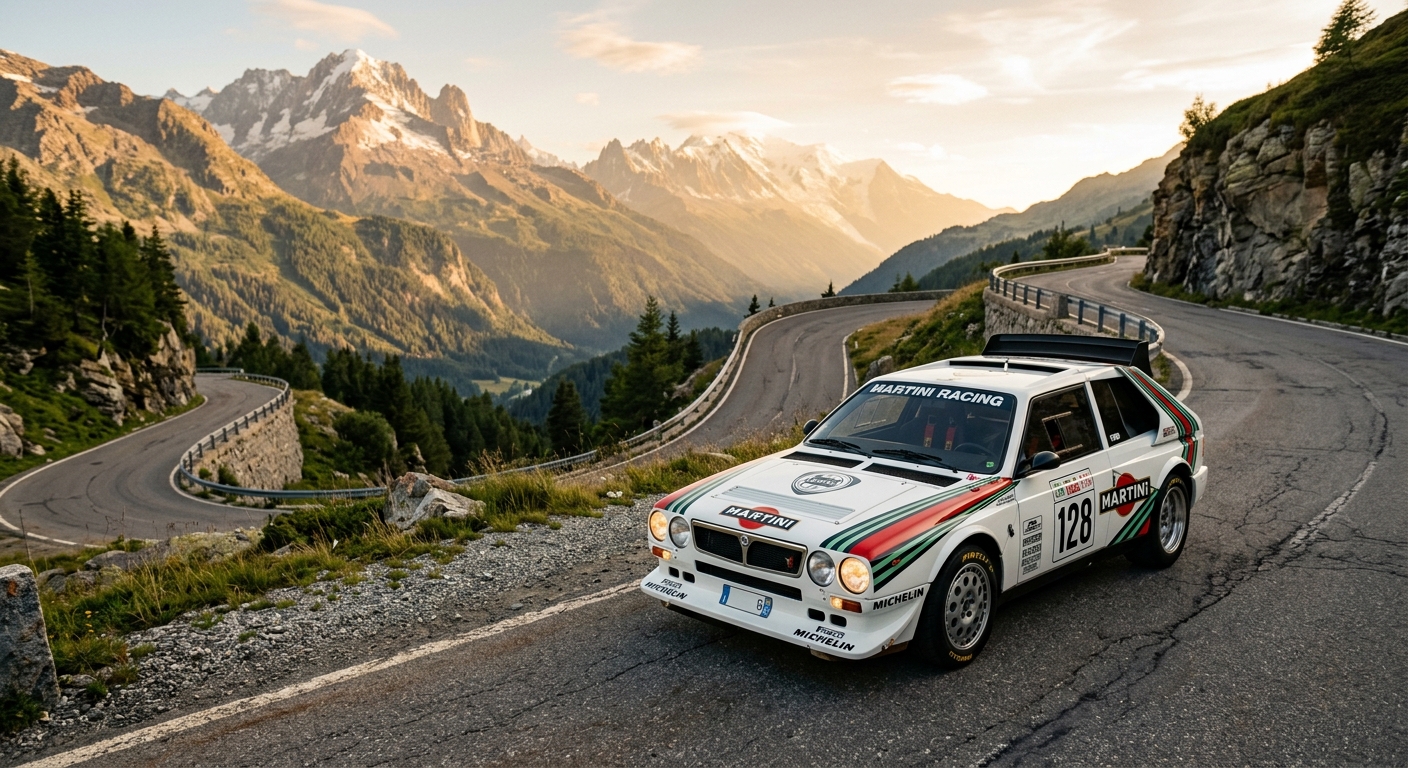
In 1986, when the world of rallying had descended into complete madness, Lancia created perhaps the most extreme road car ever built for homologation purposes. The Delta S4 Stradale wasn’t just a sports car, it was Group B rally technology barely disguised as something you could theoretically drive to the shops.
With its twin-charged engine (both supercharged AND turbocharged), space-frame construction, and aerodynamics that belonged more on a race track than a public road, the S4 Stradale represented the absolute peak of 1980s automotive insanity. Only 200 were ever built, making it one of the rarest and most sought-after homologation specials in history.
The Twin-Charged Monster
At the heart of the S4 Stradale lies one of the most complex engine setups ever fitted to a road car. The 1.8-liter four-cylinder engine features both a supercharger and a turbocharger working in sequence. The supercharger provides instant low-end response, eliminating turbo lag, while the turbocharger takes over at higher revs for maximum power output.
This twin-charging system produces 250 horsepower in street trim, though the rally version pushed out over 500 hp. The engine note is unlike anything else, a mechanical symphony of whining superchargers, whistling turbos, and angry four-cylinder combustion that announces the car’s presence from miles away.
The power delivery is immediate and brutal. There’s no waiting for boost to build, no gentle progression of acceleration. From the moment you touch the throttle, the S4 Stradale launches forward with an urgency that modern cars, despite their superior power figures, struggle to match.
Space Frame Philosophy
Unlike the standard Delta, which used a conventional monocoque construction, the S4 Stradale sits on a tubular space frame chassis clothed in lightweight composite bodywork. This construction method was lifted directly from the rally car and results in a structure that’s both incredibly rigid and remarkably light.
The suspension is pure rally car: independent all around with adjustable dampers and springs. The setup is firm, uncompromising, and completely unsuited to normal road use. Every bump, every imperfection in the road surface is transmitted directly to the driver. This isn’t a flaw; it’s the entire point.
The steering is unassisted and heavy at low speeds, but it provides a level of feedback and precision that modern power steering systems can’t match. You feel connected to the front wheels in a way that’s both exhausting and exhilarating.
Function Over Form
The S4 Stradale’s design is purely functional. The massive hood vents aren’t for show, they’re essential for cooling the complex engine bay. The angular bodywork isn’t styled for aesthetics, it’s shaped by aerodynamics and homologation requirements. The large rear spoiler, the side air intakes, even the distinctive boxy proportions all serve specific engineering purposes.
Inside, the cabin is spartan by modern standards but purposeful in every detail. The seats are supportive racing buckets, the dashboard is focused on essential information, and every control has a mechanical precision that’s been lost in the digital age. This is a car built for driving, not comfort.
The build quality reflects Lancia’s attention to detail during their golden era. Despite being a low-volume homologation special, the S4 Stradale feels solid and well-engineered. The paint, the panel gaps, even the interior trim all meet the standards you’d expect from a premium Italian manufacturer.
Living With Legend
Daily driving an S4 Stradale would be an exercise in masochism. The ride is punishing, the engine is thirsty, and the mechanical complexity means maintenance is both frequent and expensive. But for special occasions, for mountain roads, for moments when you want to experience automotive history at its most pure, nothing else comes close.
The car demands skill and respect. There’s no traction control, no stability management, no electronic safety nets. The twin-charged engine provides more power than the chassis can easily handle, and the short wheelbase makes the car twitchy at the limit. This isn’t a car you jump into and immediately drive fast; it’s one you need to learn, understand, and gradually build a relationship with.
The Delta S4 Stradale stands as perhaps the purest expression of 1980s rally technology ever offered to the public. It’s completely impractical, monumentally expensive to maintain, and utterly brilliant in every conceivable way. This isn’t just a car, it’s a piece of motorsport history you can actually drive.