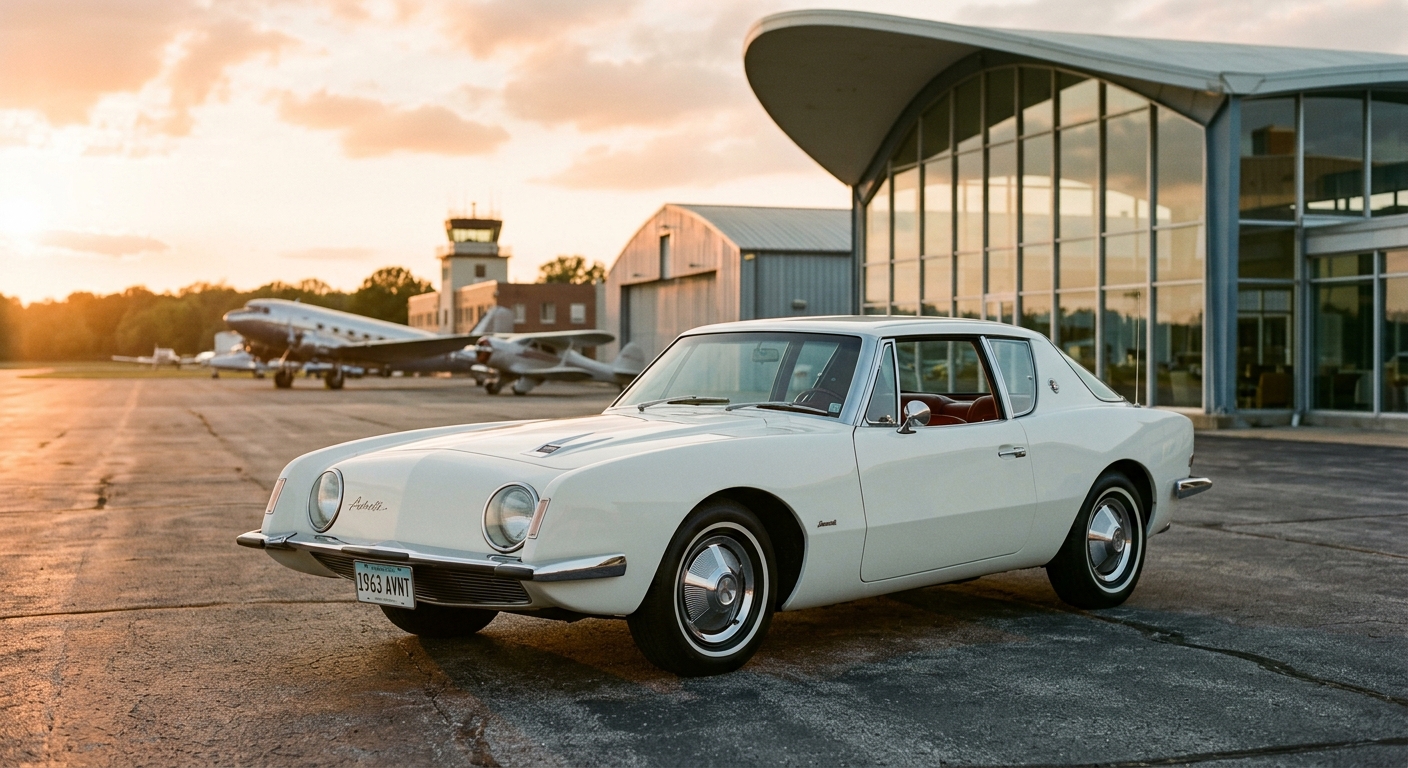
In 1962, Studebaker was a company fighting for its life. While Detroit’s Big Three churned out chrome-laden behemoths, the South Bend automaker turned to industrial design legend Raymond Loewy with a desperate plea: create something radical enough to save us. What emerged was the Avanti, a fiberglass coupe so far ahead of its time that it looked like it had driven straight out of 1975.
A Designer’s Swan Song
Raymond Loewy had already reshaped American culture through his work on everything from Coca-Cola bottles to locomotives, but the Avanti represented his automotive masterpiece. Working with just 40 days to create a running prototype, Loewy’s team crafted a design that abandoned every styling convention of the early 1960s. Gone were the fins, the chrome, and the gaudy ornamentation that defined the era. In their place stood clean lines, a distinctive coke-bottle profile, and a nose that seemed to slice through air with surgical precision.
The Avanti’s fiberglass construction wasn’t just a styling choice but a practical necessity. Studebaker lacked the resources for expensive steel stamping dies, so the lightweight composite body offered both cost savings and performance benefits. The result was a car that weighed just 3,140 pounds, remarkably light for a full-sized American coupe of the period.
Performance That Matched the Promise
Beneath that revolutionary body sat Studebaker’s trusty 289-cubic-inch V8, available in various states of tune. The R1 engine produced 240 horsepower, while the supercharged R2 variant pushed output to 289 horsepower. For the truly ambitious, R3 and R4 versions promised even more power, though these remained largely experimental.
The supercharged R2 model could sprint to 60 mph in under 8 seconds, impressive for 1963, and achieved a top speed of 168 mph during Bonneville speed runs. More importantly, the Avanti handled like a proper sports car thanks to its low center of gravity, near-perfect weight distribution, and sophisticated suspension tuning.
Advanced Engineering
The Avanti incorporated several advanced features that wouldn’t become common until years later. Disc brakes were standard at all four corners, a rarity in American cars of the period. The interior featured aircraft-inspired instrumentation with round gauges clustered in a distinctive pod ahead of the driver. Safety was paramount, with a padded dashboard and recessed controls that predated federal safety regulations.
The car’s aerodynamic efficiency was remarkable for its time. Wind tunnel testing revealed a drag coefficient that wouldn’t be matched by most American cars until the 1980s. This attention to airflow management contributed both to the Avanti’s impressive top speed and its surprisingly good fuel economy.
Too Little, Too Late
Despite critical acclaim and genuine innovation, the Avanti couldn’t save Studebaker. Production delays plagued the launch, with quality control issues in the fiberglass body construction leading to delivery problems. Only 4,647 Avantis were built during the 1963 model year, far short of the numbers needed to keep Studebaker solvent.
The automotive press praised the Avanti’s bold design and impressive performance, but buyers proved cautious about purchasing a car from a manufacturer whose future remained uncertain. By 1966, Studebaker had ceased automobile production entirely, though the Avanti nameplate would live on under different ownership.
The Studebaker Avanti remains one of automotive history’s greatest what-ifs, a car so advanced that it took the rest of the industry a decade to catch up. Today, surviving examples command respect both for their groundbreaking design and their poignant reminder that innovation alone cannot always overcome business realities. In a world of increasingly homogenized automotive design, the Avanti’s bold vision feels more relevant than ever.