In 1967, while Detroit’s Big Three were locked in an escalating horsepower war, American Motors Corporation quietly entered the fray with a contender that nobody saw coming. The Rebel SST wasn’t just AMC’s attempt at a muscle car; it was proof that innovation and clever engineering could level the playing field against much larger competitors.
The David Among Goliaths
American Motors didn’t have the luxury of unlimited budgets or multiple platforms to choose from. What they had was resourcefulness and a willingness to think differently. The Rebel SST emerged from AMC’s intermediate platform, but it packed serious heat under the hood courtesy of the company’s potent 390 cubic inch V8 engine.
This wasn’t some detuned truck motor pressed into service. AMC’s 390 was a legitimate performance engine, producing 315 horsepower in standard tune and breathing through a four-barrel carburetor. More importantly, it delivered 425 lb-ft of torque, giving the Rebel SST the kind of low-end grunt that made it a genuine threat at stoplights across America.
Distinctive Design Language
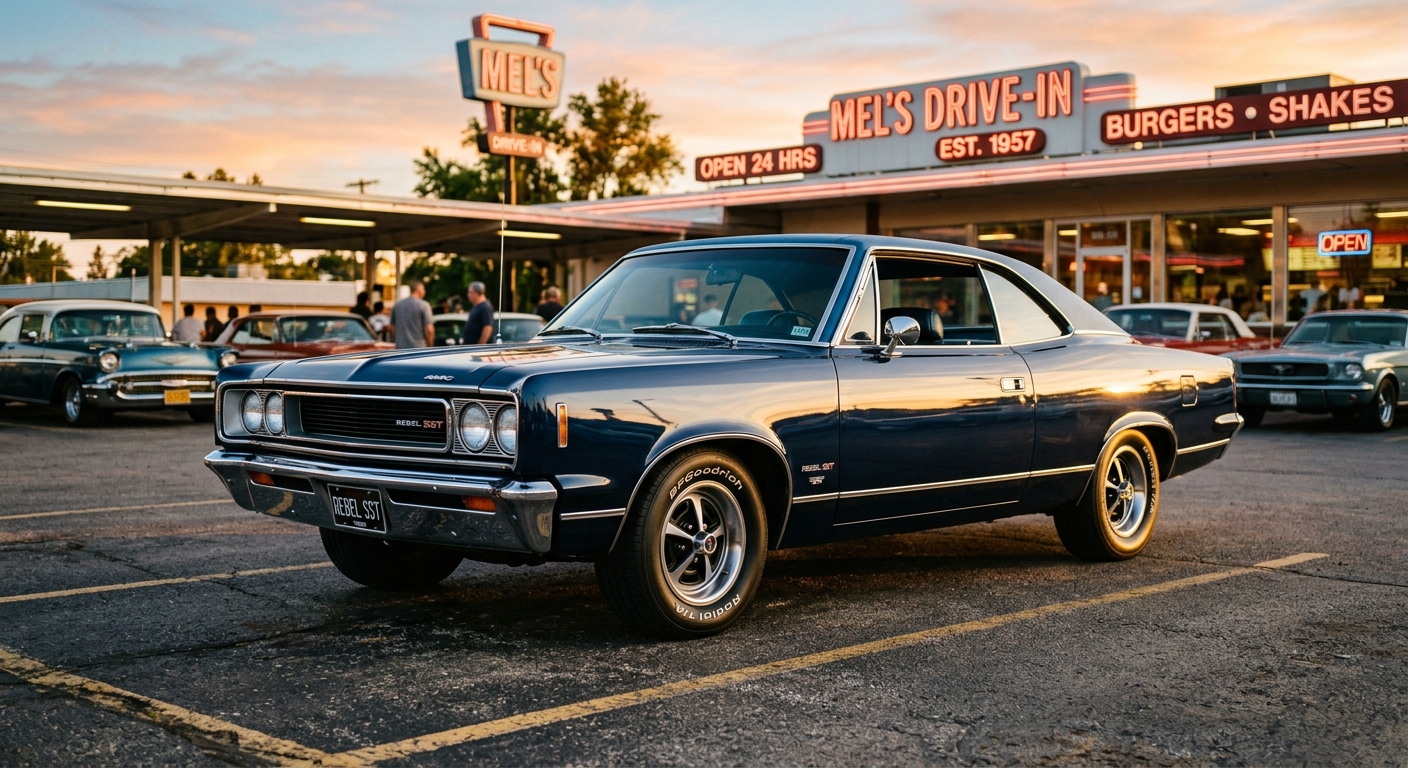
Where the Rebel SST truly distinguished itself was in its styling. While other manufacturers were chasing increasingly aggressive and angular designs, AMC opted for a more refined approach. The fastback roofline was elegantly executed, and the car’s proportions struck a perfect balance between muscular presence and sophisticated restraint.
The front end featured a distinctive split grille design that became an AMC trademark, while the rear showcased tasteful integration of the taillights into the bumper assembly. It was unmistakably American muscle, but with a maturity that suggested AMC was targeting buyers who wanted performance without the boy-racer image.
Interior Sophistication
Step inside a well-optioned Rebel SST, and you’d find an interior that could shame some luxury cars of the era. AMC knew they couldn’t compete on brand prestige alone, so they loaded their muscle car with comfort and convenience features. Air conditioning, power steering, and premium upholstery were readily available, creating a muscle car that you could actually live with daily.
The dashboard layout was refreshingly logical, with clearly marked gauges and controls that fell easily to hand. This was a muscle car built by engineers who understood that performance shouldn’t come at the expense of usability.
Performance Reality
On the road, the Rebel SST delivered exactly what AMC promised. The 390 V8 pulled strongly from idle, and while it might not have had the top-end rush of a big-block Chevelle or GTO, it offered more than enough performance to satisfy most enthusiasts. Contemporary road tests showed 0-60 times in the mid-7-second range, respectable numbers for the era.
More impressive was the car’s composure at speed. AMC’s engineers had done their homework with the suspension tuning, creating a muscle car that felt stable and predictable even when pushed hard. The steering was accurate, and the brakes, while not spectacular by modern standards, were adequate for the car’s performance envelope.
Market Position and Legacy
The Rebel SST faced an uphill battle in the marketplace. AMC dealers were fewer and farther between than those of the Big Three, and the brand lacked the racing pedigree that sold so many GTOs and SS Chevelles. But for buyers who took the time to look, the Rebel offered genuine value and surprisingly sophisticated engineering.
Today, the 1967 Rebel SST represents one of the muscle car era’s most compelling value propositions. While GTO and Chevelle prices have soared into the stratosphere, clean Rebels can still be found at reasonable prices. They offer authentic muscle car performance and period correct styling without the premium associated with more famous nameplates.
The 1967 AMC Rebel SST stands as testament to what American ingenuity could accomplish when forced to compete on merit rather than marketing budgets. It offered genuine muscle car performance wrapped in sophisticated styling, proving that the underdog could indeed run with the pack. For today’s collectors seeking authentic muscle car character without the astronomical prices, the Rebel SST remains one of the hobby’s best-kept secrets.