After years of watching Tesla dominate the premium electric vehicle space, Nissan has finally delivered its answer with the Ariya. This isn’t just another compliance EV or budget-friendly alternative: it’s a sophisticated, technology-laden crossover that signals the Japanese automaker’s serious intentions in the electric future.
A Design Language Reborn
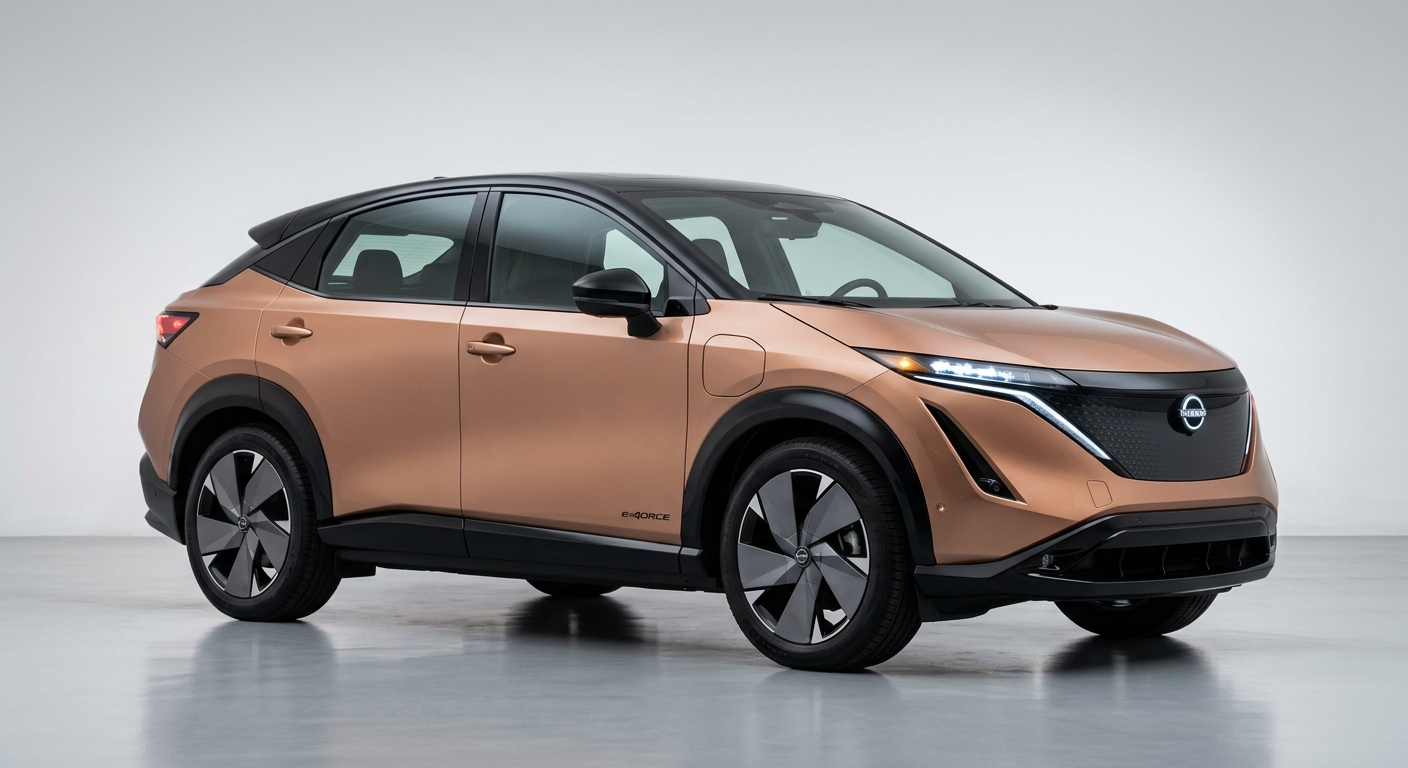
The Ariya represents nothing less than a complete reinvention of Nissan’s design philosophy. Gone are the awkward proportions and polarizing styling cues that have plagued recent Nissan products. In their place sits a sleek, minimalist crossover that looks genuinely futuristic without trying too hard to shock.
The front end is dominated by Nissan’s new illuminated logo and a light bar that spans the width of the vehicle. It’s a clean, confident face that manages to look both premium and approachable. The silhouette is remarkably sleek for a crossover, with a coupe-like roofline that doesn’t sacrifice too much interior space. At the rear, connected taillights echo the front design theme, creating a cohesive visual statement.
Interior Innovation
Step inside the Ariya and you’re greeted by what Nissan calls its “timeless Japanese futurism” philosophy. The dashboard is refreshingly clean, dominated by twin 12.3-inch displays that handle infotainment and instrument duties. Physical controls are kept to a minimum, with haptic feedback buttons integrated seamlessly into the dashboard’s wood-grain trim.
The cabin feels genuinely premium, with high-quality materials throughout and a level of fit and finish that rivals luxury brands. The front seats are comfortable and supportive, while rear passengers enjoy generous space thanks to the flat floor enabled by the EV architecture. The panoramic sunroof adds to the airy feel, making the cabin feel larger than the exterior dimensions might suggest.
Electric Performance
Nissan offers the Ariya in multiple configurations, from a single-motor front-wheel-drive model to a dual-motor all-wheel-drive variant with serious performance credentials. Our test car, the top-spec Platinum+ AWD, delivers 389 horsepower and 442 lb-ft of torque, enough to launch this 4,600-pound crossover to 60 mph in just 5.1 seconds.
The acceleration is smooth and linear, without the abrupt surge that can catch passengers off guard in some high-performance EVs. The dual-motor setup provides excellent traction in all conditions, while the low center of gravity keeps body roll well controlled through corners. This isn’t a sports car, but it’s certainly no slouch.
Range and Charging
With its 87-kWh battery pack, the Ariya Platinum+ delivers an EPA-estimated 265 miles of range. That’s competitive with rivals like the Tesla Model Y, though it falls short of the longest-range EVs on the market. In real-world driving, we found the EPA estimates to be reasonably accurate, with efficient highway cruising returning close to the rated range.
Charging capabilities are impressive, with the Ariya supporting up to 130 kW DC fast charging. That’s enough to add 175 miles of range in 30 minutes under ideal conditions. At home, the standard 7.2 kW onboard charger can fully replenish the battery overnight.
Technology and Features
The Ariya showcases Nissan’s latest ProPilot Assist 2.0 semi-autonomous driving system, which can handle highway driving with minimal driver input. The system works well in ideal conditions, though it’s not quite as refined as the best systems from Tesla or Mercedes-Benz.
The infotainment system is responsive and intuitive, with wireless Apple CarPlay and Android Auto integration. The premium Bose audio system delivers excellent sound quality, while the tri-zone automatic climate control keeps all passengers comfortable.
The Ariya proves that Nissan is serious about reclaiming its position as an electric vehicle pioneer. With its stunning design, premium interior, and impressive technology package, it successfully challenges the established order in the luxury EV crossover segment. This is the Nissan renaissance we’ve been waiting for.