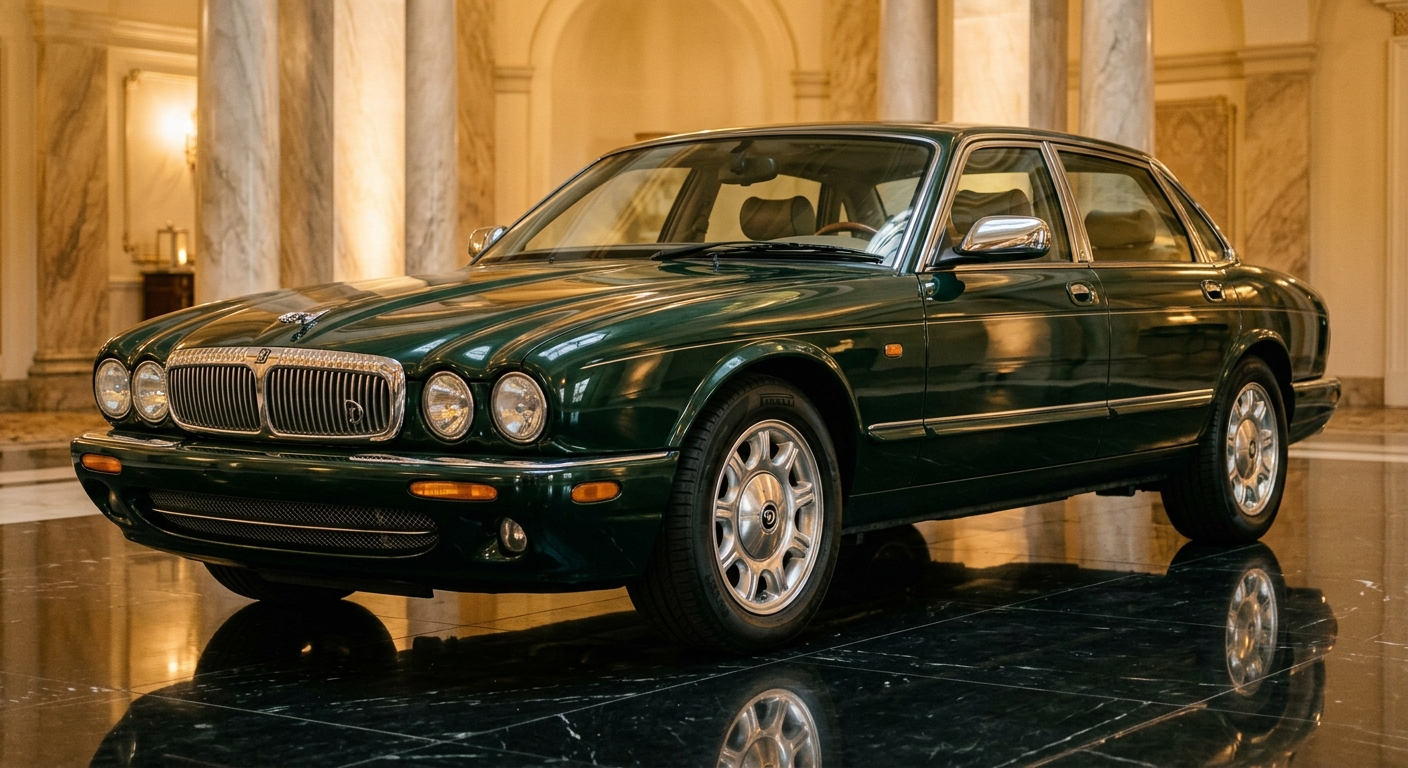
In 2001, the automotive world witnessed the quiet passing of one of Britain’s most distinguished marques. The Daimler Super V8 represented not just the pinnacle of the brand’s engineering prowess, but also its final bow after more than a century of serving royalty and discerning motorists. This wasn’t merely another luxury sedan: it was the last chapter of a story that began in 1896.
Built on Jaguar’s XJ platform but elevated with bespoke craftsmanship and a supercharged 4.0-liter V8, the Super V8 offered something increasingly rare in the modern era: authentic British luxury without compromise. While other manufacturers chased global markets, Daimler remained steadfastly focused on what it knew best, traditional elegance married to contemporary performance.
The Art of Refined Performance
Behind the wheel, the Super V8 delivers power with the sort of cultured restraint that defines British engineering. The supercharged V8 produces 370 horsepower, but it’s the manner of delivery that sets this car apart. There’s no dramatic surge or aggressive note, just an effortless surge of acceleration that propels the substantial sedan with surprising urgency.
The ZF five-speed automatic transmission shifts with the deliberate precision of a well-trained butler, never hurried but always anticipating your needs. This is a car that can dispatch the 0-60 mph sprint in just 5.3 seconds, yet does so with such refinement that passengers might not notice the considerable g-forces at work.
What truly impresses is the ride quality. The Super V8’s adaptive damping system manages to isolate occupants from road imperfections while maintaining enough connection to remind you that this is still, fundamentally, a driver’s car. The steering offers genuine feedback, a rarity in luxury sedans of any era, let alone one from 2001.
Interior Sanctuary
Step inside, and you’re transported to a world that feels more like a gentleman’s club than a motor car. The hand-selected Connolly leather covers nearly every surface, punctuated by burr walnut veneers that showcase traditional British craftsmanship at its finest. Each piece of wood is book-matched and hand-polished to a depth that modern manufacturing simply cannot replicate.
The front seats are works of art in themselves, offering 14-way electrical adjustment and featuring the distinctive Daimler fluting pattern. Rear passengers enjoy limousine-like space and comfort, with individual climate controls and fold-out picnic tables crafted from the same burr walnut used throughout the cabin.
Modern conveniences haven’t been forgotten: satellite navigation, premium audio, and advanced climate control all feature, but they’re integrated with such subtlety that they never compromise the traditional aesthetic. This is technology in service of luxury, not the other way around.
The End of an Era
Understanding the Super V8 requires appreciating its place in automotive history. By 2001, Daimler had been part of the Ford Premier Automotive Group for several years, but the brand maintained its distinct identity through meticulous attention to detail and exclusivity. Production numbers were deliberately limited, with each car essentially hand-built to order.
The fluted grille, distinctive bonnet treatment, and traditional Daimler badging marked this as something special in an era increasingly dominated by badge engineering. When production ended in 2009, it marked the conclusion of 113 years of Daimler heritage, making surviving examples increasingly significant.
Today, the Super V8 represents exceptional value in the luxury car market. While contemporary rivals have depreciated heavily, well-maintained examples of this final Daimler are beginning to appreciate as collectors recognize their historical significance and uncompromising build quality.
The 2001 Daimler Super V8 represents everything we’ve lost in modern luxury cars: genuine craftsmanship, exclusive character, and the confidence to prioritize substance over marketing. In an increasingly homogenized market, this final Daimler stands as a testament to what British luxury really means. For those seeking authentic heritage with modern performance, few cars offer such compelling value or such poignant significance.