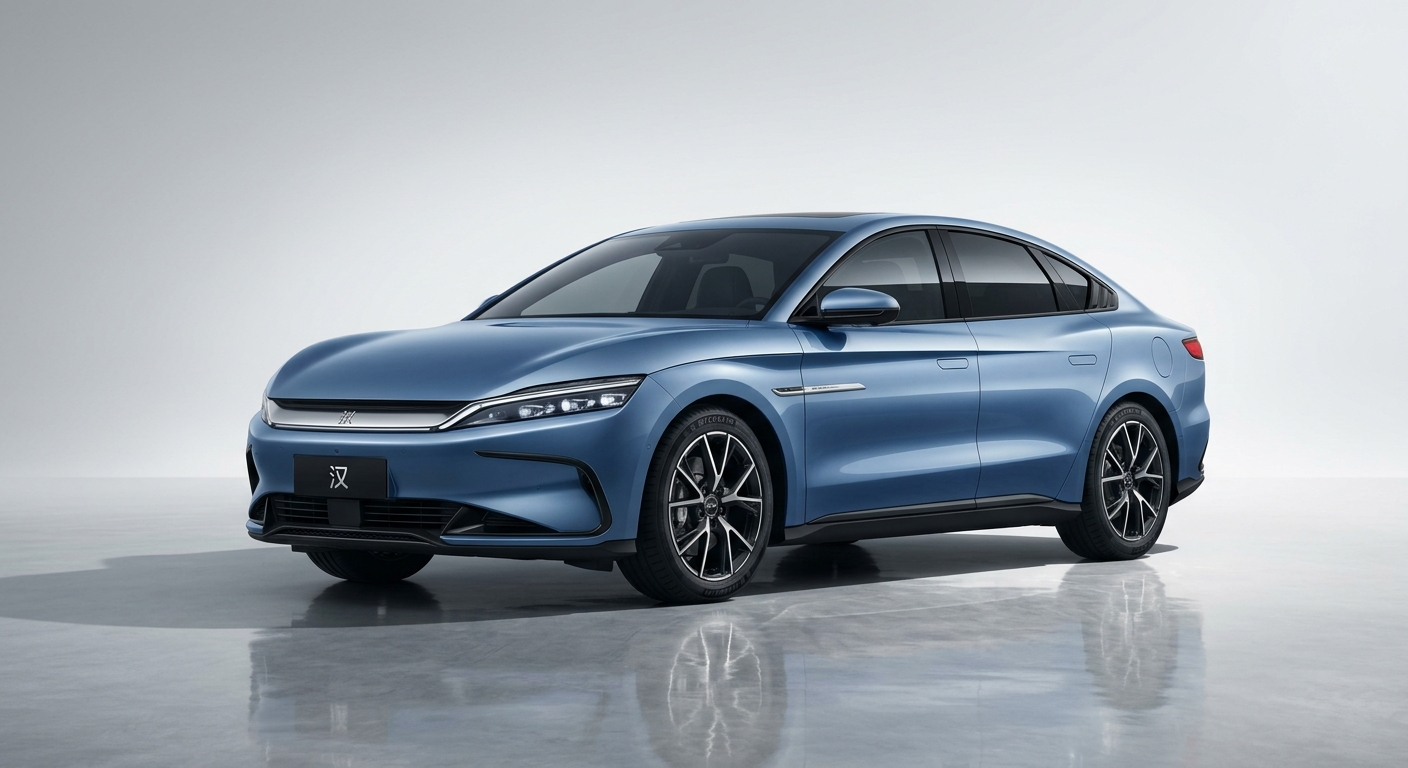
While Western markets fixate on Tesla’s every move, China’s BYD has been quietly building an electric empire. The Han EV represents the company’s flagship effort to prove that Chinese automakers can craft luxury EVs that rival anything from Silicon Valley or Stuttgart.
Named after China’s Han Dynasty, this sleek sedan carries the weight of national automotive ambition on its shoulders. With over 300 miles of range and pricing that undercuts established luxury EVs, the Han EV is BYD’s statement piece in the global electric revolution.
Design and Presence
The Han EV’s exterior strikes a careful balance between elegance and aggression. Its flowing roofline and pronounced shoulder line create a distinctly modern silhouette, while the chrome-trimmed grille and sleek LED lighting signature lend it genuine presence. At 194 inches long, it’s properly sized to compete with executive sedans from established luxury marques.
Inside, BYD has crafted an interior that feels genuinely premium. The rotating 15.6-inch touchscreen dominates the dashboard, while quilted Nappa leather and real wood trim create an atmosphere of understated luxury. Build quality feels solid throughout, with tight panel gaps and materials that rival those found in German luxury cars.
The Blade Battery Revolution
BYD’s secret weapon lies beneath the floor: the Blade Battery. This lithium iron phosphate pack offers exceptional safety characteristics, passing nail penetration tests that would cause other battery chemistries to ignite. The trade-off comes in energy density, but BYD has engineered around this limitation through clever packaging and aerodynamics.
The result is a real-world range of over 300 miles, with DC fast-charging capabilities that can replenish the battery from 10 to 80 percent in under 40 minutes. For daily driving, the Han EV’s efficiency and range eliminate any anxiety about running out of juice.
Performance and Dynamics
The single-motor Han EV produces 268 horsepower, delivering smooth and linear acceleration that feels effortlessly refined. The 0-60 mph sprint takes a respectable 7.9 seconds, quick enough for luxury sedan duty without feeling overly aggressive.
Where the Han EV truly impresses is in its ride quality and refinement. The suspension strikes an excellent balance between comfort and control, soaking up road imperfections while maintaining composure through corners. Wind and road noise are well-controlled, creating a serene cabin environment that rivals established luxury sedans.
The regenerative braking system offers multiple levels of adjustment, allowing drivers to tailor the car’s behavior to their preferences. In its most aggressive setting, true one-pedal driving becomes possible, though the transition between regeneration and friction braking could be smoother.
Technology and Features
BYD has loaded the Han EV with technology that feels genuinely cutting-edge. The rotating center screen can switch between portrait and landscape orientations depending on the application, while the infotainment system responds quickly to inputs and offers smartphone-level functionality.
Advanced driver assistance features include adaptive cruise control, lane-keeping assist, and automatic emergency braking. While not quite at the level of Tesla’s Autopilot, these systems work effectively in real-world conditions and provide genuine assistance during highway driving.
The BYD Han EV proves that Chinese automakers have arrived on the global stage with genuinely compelling products. While it may lack the brand cachet of established luxury marques, it delivers the substance where it matters most: range, refinement, and value. The future of luxury EVs isn’t just being written in California or Germany.