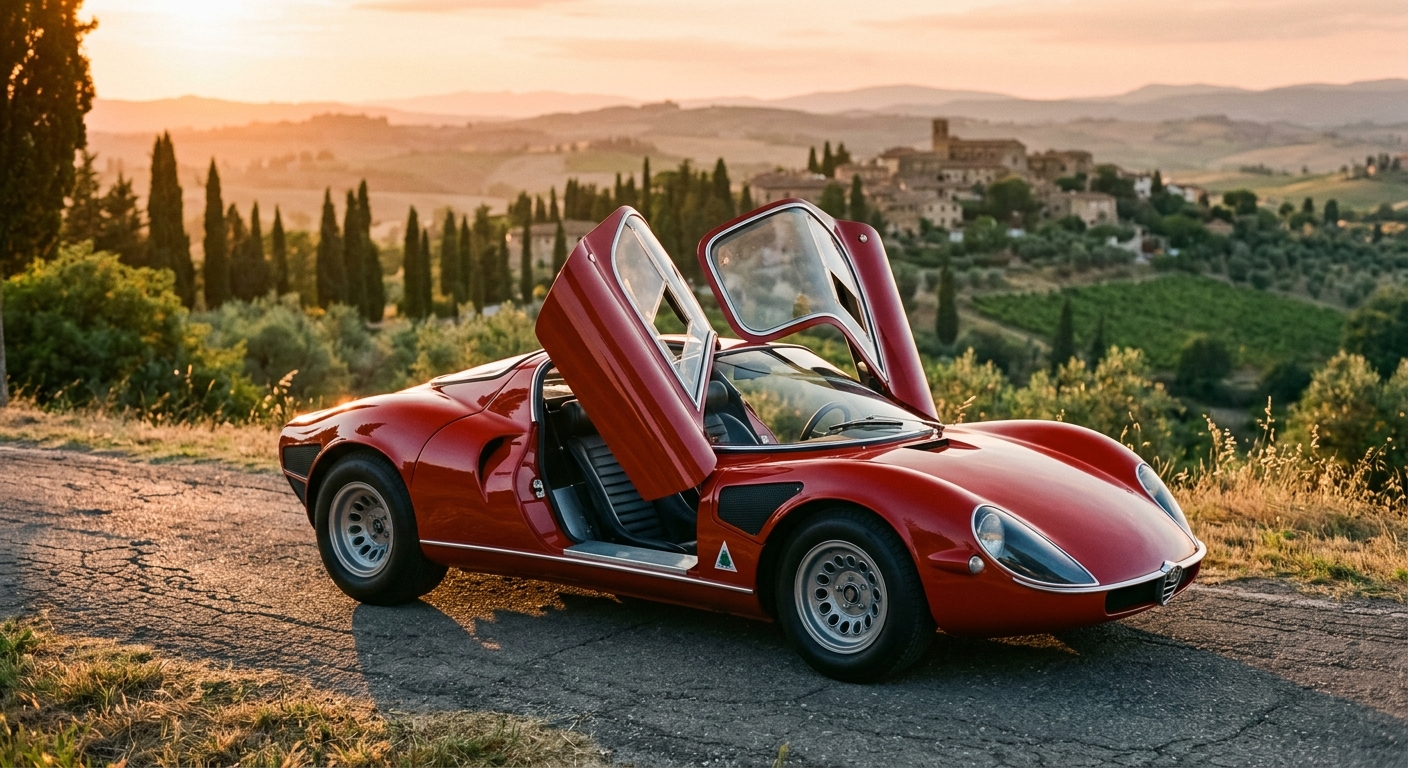
In 1967, when most supercars were still rough-edged racing machines barely tamed for the road, Alfa Romeo created something transcendent. The 33 Stradale wasn’t just fast, it was poetry in motion, a sculpture that happened to be one of the quickest cars on Earth. With only 18 examples ever built, it remains one of the rarest and most beautiful automobiles ever conceived.
Born from Alfa Romeo’s Tipo 33 racing program, the Stradale was the street-legal evolution of their sports prototype racer. But where the race car was purposeful and stark, the road car was pure artistry, clothed in bodywork so stunning that it influenced automotive design for decades to come.
Racing DNA in Road Clothes
The 33 Stradale’s foundation was serious racing hardware. Its tubular steel spaceframe chassis was lifted directly from the Tipo 33 race car, providing incredible rigidity despite weighing just 700 kilograms. The mid-mounted 2.0-liter V8 engine produced 230 horsepower, which might sound modest today but was devastating in such a lightweight package.
This wasn’t just an engine; it was a mechanical symphony. The small-displacement V8 revved to 8,800 rpm with a sound that could wake the dead and make angels weep. Fed by dual Weber carburetors and breathing through a free-flowing exhaust, it delivered power with the intensity of a bolt of lightning.
Performance That Defined an Era
With a power-to-weight ratio that embarrassed much larger engines, the 33 Stradale could sprint from 0-60 mph in just 5.5 seconds and reach a top speed of 162 mph. These figures were hypercar territory in 1967, when most sports cars struggled to break 130 mph. The performance came not just from power, but from the perfect balance of a mid-engine layout and race-bred suspension.
Sculptural Perfection
The bodywork, penned by Franco Scaglione, was nothing short of revolutionary. Every curve served both aesthetic and aerodynamic purposes, creating a shape so timeless that it looks as fresh today as it did five decades ago. The distinctive “butterfly” doors weren’t just for show; they provided access to the tight cockpit while maintaining the car’s flowing roofline.
Inside, the 33 Stradale was purposefully minimal. Racing seats, a simple dashboard, and the essential controls created an environment focused entirely on the driving experience. The gear lever fell perfectly to hand, the pedals were ideally spaced for heel-and-toe downshifts, and the steering wheel provided direct communication with the front wheels.
Living With a Legend
Make no mistake, the 33 Stradale was never intended as a comfortable grand tourer. The ride was firm to the point of brutality, the interior was cramped, and the engine heat made summer driving an endurance test. But for those brief moments when everything aligned, when the road was perfect and the engine was singing, few cars could match its transcendent driving experience.
Legacy and Impact
The 33 Stradale’s influence extended far beyond its tiny production run. Its proportions and design themes would echo through Alfa Romeo’s lineup for years, and its proof that a small-displacement engine could deliver supercar performance influenced an entire generation of Italian exotics.
Today, surviving examples are among the most valuable classic cars in the world, regularly selling for millions at auction. But their true worth lies not in their monetary value, but in representing a perfect moment when art and engineering converged to create automotive perfection.
The 33 Stradale remains the purest expression of Alfa Romeo’s racing soul wrapped in impossibly beautiful bodywork. It’s automotive art that just happens to be one of the most thrilling driving experiences ever created. For those fortunate enough to experience one, it represents the absolute pinnacle of Italian automotive passion.