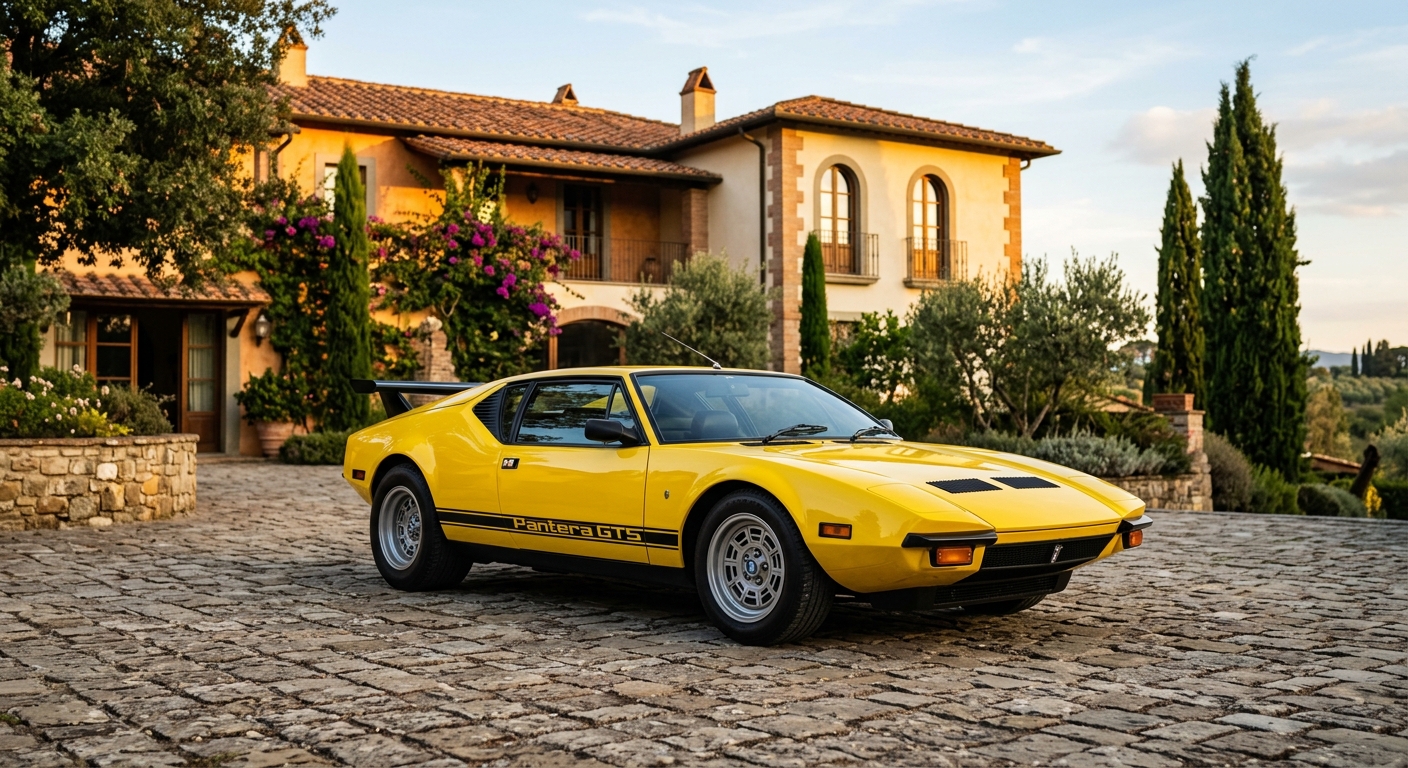
In an era when Italian supercars cost more than most people’s homes, De Tomaso offered something different: exotic Mediterranean styling wrapped around proven American muscle. The 1976 Pantera GTS represented the evolution of Alejandro de Tomaso’s audacious vision to create a supercar that could match Ferrari’s performance while maintaining the reliability and serviceability of Detroit iron.
The Perfect Storm of Design and Engineering
The Pantera’s genesis story reads like automotive folklore. When Alejandro de Tomaso struck a deal with Ford in 1970, the goal was simple: create a mid-engine exotic that could be sold through Lincoln-Mercury dealerships across America. The result was a car that looked every inch the Italian supercar but spoke fluent American V8 underneath its skin.
By 1976, the GTS had evolved into the most refined version of de Tomaso’s original concept. The sharp-edged bodywork, penned by Tom Tjaarda at Ghia, remained as striking as ever. Those distinctive side vents weren’t just for show: they fed air to the 351 Cleveland V8 mounted transversely behind the cabin, creating a soundtrack that was pure Motor City thunder wrapped in Italian passion.
Raw Performance, Refined Execution
What made the Pantera special wasn’t just its exotic appearance, but its accessible performance. The 351 Cleveland, in GTS specification, produced a robust 350 horsepower and 380 lb-ft of torque. Unlike the temperamental Italian V12s of its contemporaries, this Ford mill was bulletproof, with parts available at any American garage.
The power delivery was immediate and intoxicating. Where other supercars required delicate throttle control and precise timing, the Pantera rewarded aggression. Plant your foot and the Cleveland would launch you toward the horizon with a bellowing roar that announced your intentions to everyone within a mile radius.
Living With Lightning
Daily driving a Pantera required commitment. The cabin was tight, the visibility limited, and the interior temperature could become punishing in summer traffic. But for enthusiasts willing to make those sacrifices, the rewards were immense. This was a car that could embarrass Ferraris on the street and still make it home without calling for a tow truck.
The steering was heavy but communicative, the gear change mechanical but precise. Every input felt significant, every mile memorable. This wasn’t transportation; it was an experience that demanded your full attention and rewarded it with pure automotive theater.
The End of an Era
By 1976, federal regulations were strangling performance cars across the board, but the Pantera GTS managed to maintain its potency longer than most. The combination of Italian craftsmanship and American engineering created something unique: a supercar that was both exotic and practical, beautiful and brutal.
Today, the Pantera stands as a testament to what happens when two automotive cultures merge. It may not have had the pedigree of Maranello or the sophistication of Stuttgart, but it offered something equally valuable: accessible exotica that could be driven hard and fixed easily.
The Pantera GTS remains one of automotive history’s most compelling compromises: a supercar that prioritized drama over refinement, accessibility over exclusivity. For those seeking pure theatrical driving experience with a soundtrack that could wake the dead, few classics deliver more bang for your restoration buck.