It is 1 a.m., the highway is empty, and the only thing awake for miles is a 6.4-liter Hemi clearing its throat at a red light. The 2020 Dodge Challenger Scat Pack Widebody does not do subtle, and after dark that is exactly the point. This is a car built for the hours when the world goes quiet and the V8 gets to talk.
The Night Shift Muscle Car
Dodge introduced the Widebody package for the 2020 model year, and it changed the Challenger’s personality overnight. The standard Scat Pack was always a straight-line brawler. The Widebody added 3.5 inches of total width via bolt-on fender flares, wider 20×11-inch wheels wrapped in 305/35ZR20 Pirelli P Zero rubber, and a retuned suspension with unique Bilstein adaptive dampers. It also borrowed the larger front brakes from the Hellcat program, with six-piston Brembo calipers and 15-inch rotors up front.
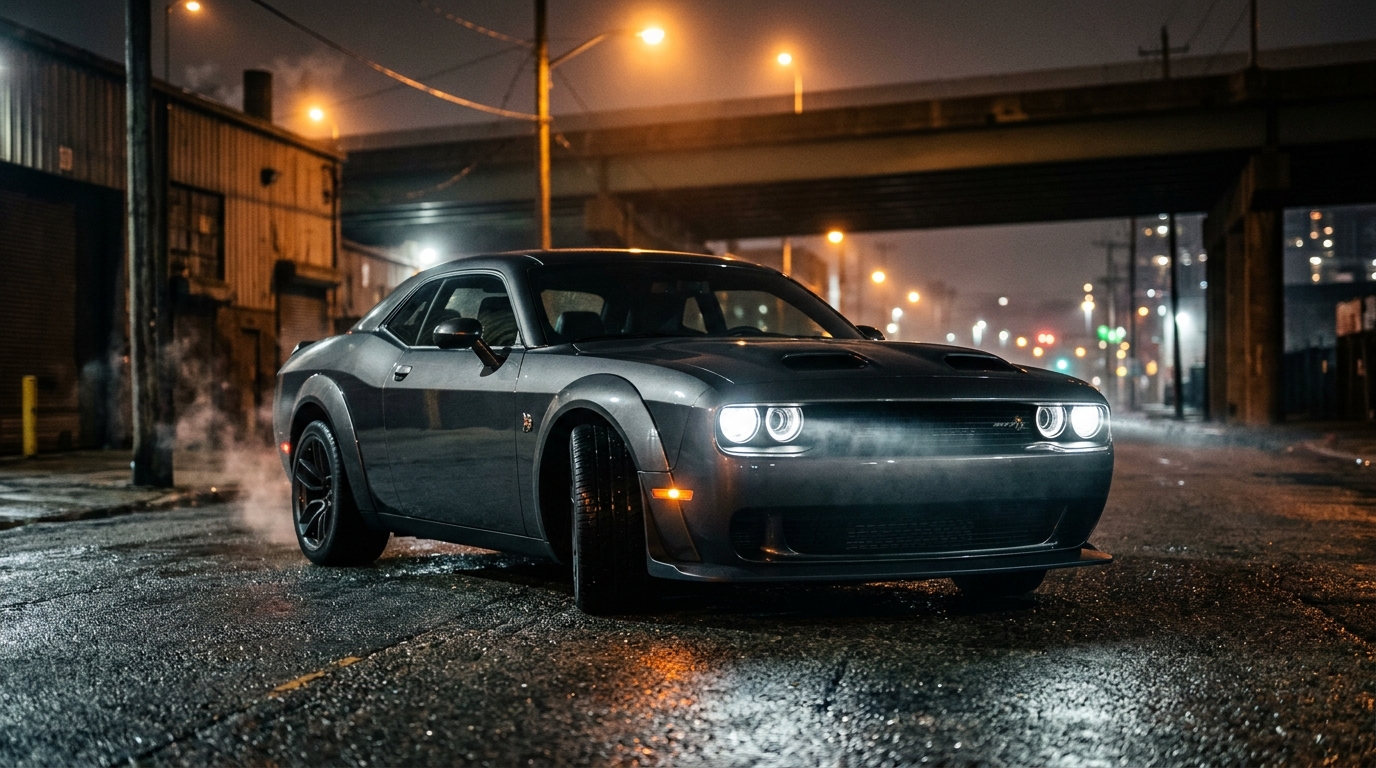
The result is a car that looks like it is flexing even while parked. Under a streetlight, those flares catch the glow in a way the narrow-body car never could, and the wide haunches make the whole shape look planted and hungry.
The Heart: 392 Hemi at Midnight
The 6.4-liter 392 HEMI V8 makes 485 horsepower and 475 lb-ft of torque in the Scat Pack, a figure that has stayed remarkably consistent through the Challenger’s later years. Mated to either a TorqueFlite eight-speed automatic or a Tremec six-speed manual, it delivers power in a thick, linear surge rather than a peaky rush. The Widebody’s extra weight, roughly 4,200 pounds at the curb, is a fair trade for the grip it buys.
At night the sound is half the experience. Dodge’s active dual-mode exhaust lets the Hemi bark on startup and settle to a baritone grumble. Cruising through a quiet neighborhood after midnight, you can ease off and keep things civil. Open a deserted stretch of road and the exhaust opens up, with the induction growl and that classic Hemi cackle bouncing off sleeping buildings.
Headlights, Visibility and the Dark
The Challenger’s cabin is a throwback in the best way: a deep cowl, upright seating, and a long hood stretching ahead into the dark. The standard halogen projector headlights are adequate on a lit road but can feel modest when you are really leaning on the car on an unlit backroad. Optional HID and the available LED fog lights help, and the distinctive quad-lamp front fascia gives you a retro face that looks wonderful glowing in a rearview mirror.
The cabin lighting deserves credit. Dodge’s Uconnect 4C system with its 8.4-inch touchscreen is bright without being blinding, and the instrument cluster stays readable with the dimmer down. The big gauges feel properly muscle-car, and the optional Alpine audio system makes late-night highway miles pass quickly.
Rear visibility is the Challenger’s weak point after dark. The thick C-pillars and small rear glass create blind spots, so the standard blind-spot monitoring and rear cross-path detection earn their keep, especially when switching lanes on a dark interstate.
Handling: Wide Tires, Wider Grin
This is where the Widebody earns its badge. The wider track and 305-section front tires give the Challenger genuine confidence in corners. Turn-in is sharper than the base car’s, body roll is better controlled, and the adaptive dampers keep the ride livable on rough pavement. It will never be a Camaro 1LE, and at over two tons it still asks you to respect its mass, but on a flowing night road it feels vastly more settled and eager than any previous Challenger Scat Pack.
Dodge’s launch control and line-lock features remain on the menu, and the Widebody’s rubber makes getting the power down far easier than on the narrow car. Tire noise is noticeable at highway speed, but the trade is worth it.
A Little History
The Challenger nameplate dates to 1970, when Dodge fired back at the Mustang and Camaro with the E-body pony car. The modern LC-generation Challenger arrived in 2008 and has been a remarkable survivor, still riding the same basic bones a decade later. The Scat Pack trim, a nod to Dodge’s 1960s Scat Pack performance club, arrived in 2015 and quickly became the sweet spot of the lineup, delivering Hemi power without the Hellcat’s price tag. The 2020 Widebody was the moment Dodge proved an old platform could still learn new tricks.
The 2020 Challenger Scat Pack Widebody is the best-value way to buy a fully modern, fully loud American muscle car, and the Widebody package finally gives it the stance and grip to match the Hemi’s swagger. It is heavy, thirsty and a little dated, but at night, with the lights low and the road empty, none of that matters. Wide body, wide eyes, wide awake.