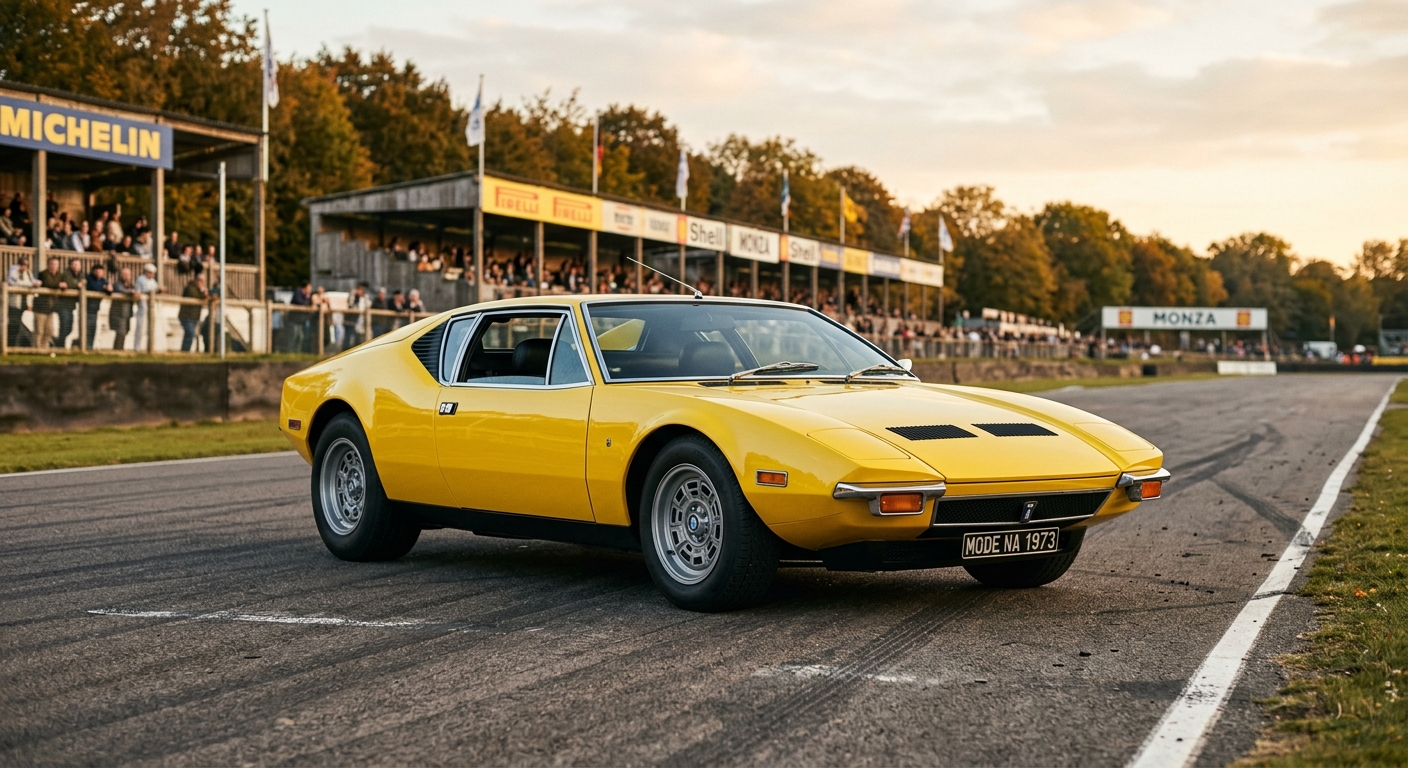
In 1973, while Lamborghini was perfecting the art of Italian temperament and Ferrari was cementing its racing legacy, a small manufacturer in Modena was busy creating something entirely different. The De Tomaso Pantera represented a radical experiment: take Italy’s finest design and engineering sensibilities, then drop in America’s most reliable powerplant. The result was a supercar that could actually be driven daily, serviced at your local Ford dealer, and still embarrass anything from Maranello on a back road.
The Pantera wasn’t just another exotic car, it was a bridge between two automotive philosophies that had never successfully merged before. Alejandro de Tomaso’s vision of accessible exotica would influence supercar design for decades to come.
The Perfect Marriage of Opposites
What made the Pantera revolutionary wasn’t just its Ford 351 Cleveland V8, though that certainly helped. It was the entire philosophy behind the car. While contemporary Italian supercars required PhD-level mechanical knowledge to keep running, the Pantera used Ford’s bulletproof small-block architecture, meaning parts were available at any American dealership and any competent mechanic could work on it.
The chassis, however, was pure Italian artistry. The steel monocoque was designed by Gian Paolo Dallara, fresh from his work at Lamborghini, and clothed in bodywork by Ghia that looked like it had been carved from a single block of aluminum by Michelangelo himself. The wedge profile was so perfectly proportioned that it influenced supercar design well into the 1980s.
Behind the Wheel
Climbing into a Pantera requires a certain athletic flexibility, but once settled into the surprisingly comfortable seats, the driving position is nearly perfect. The steering wheel sits at just the right angle, the pedals are properly spaced for heel-and-toe downshifts, and all the controls fall naturally to hand. This was a car designed by people who actually drove their creations hard.
Fire up the Cleveland V8 and the Pantera announces itself with a deep, muscular rumble that’s distinctly American in character but refined in execution. The sound is intoxicating, a constant reminder of the 330 horsepower waiting behind your right shoulder. Unlike the high-strung Italian exotics of the era, the Ford engine pulls strongly from idle and delivers its power in a wonderfully linear fashion.
The five-speed ZF transaxle shifts with mechanical precision, each gear engagement accompanied by a satisfying mechanical click. The clutch is surprisingly light for such a potent machine, making city driving far more tolerable than in contemporary Lamborghinis or Ferraris.
Road Behavior That Rewrites the Rules
On the open road, the Pantera reveals its true character. The steering is heavy at parking lot speeds but lightens beautifully as velocity builds, providing excellent feedback about what the front wheels are doing. The chassis balance is nearly neutral, with just enough natural understeer to keep novice drivers out of trouble but easily adjustable with throttle or steering inputs.
The suspension, a sophisticated setup with unequal-length A-arms at all four corners, strikes an impressive compromise between ride quality and handling precision. While it’s certainly firm by modern standards, the Pantera doesn’t punish its occupants the way many period supercars did. You could genuinely drive this car across a continent without requiring medical attention afterward.
Braking performance from the four-wheel disc setup is strong and consistent, with excellent pedal feel and minimal fade under hard use. The wide Campagnolo wheels and Michelin tires provide tremendous grip, allowing the Pantera to exploit its chassis balance and power advantage over the competition.
A Design That Defined an Era
Tom Tjaarda’s design for Ghia created one of the most influential supercars of the 1970s. The knife-edge profile, dramatic side air intakes, and aggressive nose treatment became the template for mid-engine exotics that followed. Even today, nearly five decades later, the Pantera’s proportions look absolutely correct.
The interior, while spartan by luxury car standards, perfectly matched the car’s performance mission. Every surface was functional, every control had a purpose, and the overall effect was one of serious intent rather than flashy showmanship. The Pantera was built for driving, not posing.
The De Tomaso Pantera proved that exotic cars didn’t need to be temperamental prima donnas to deliver genuine supercar thrills. By combining Italian design brilliance with American mechanical reliability, it created a template that the industry is still following today. Few classics offer this much performance, style, and relative practicality in one stunning package.