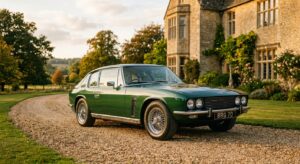
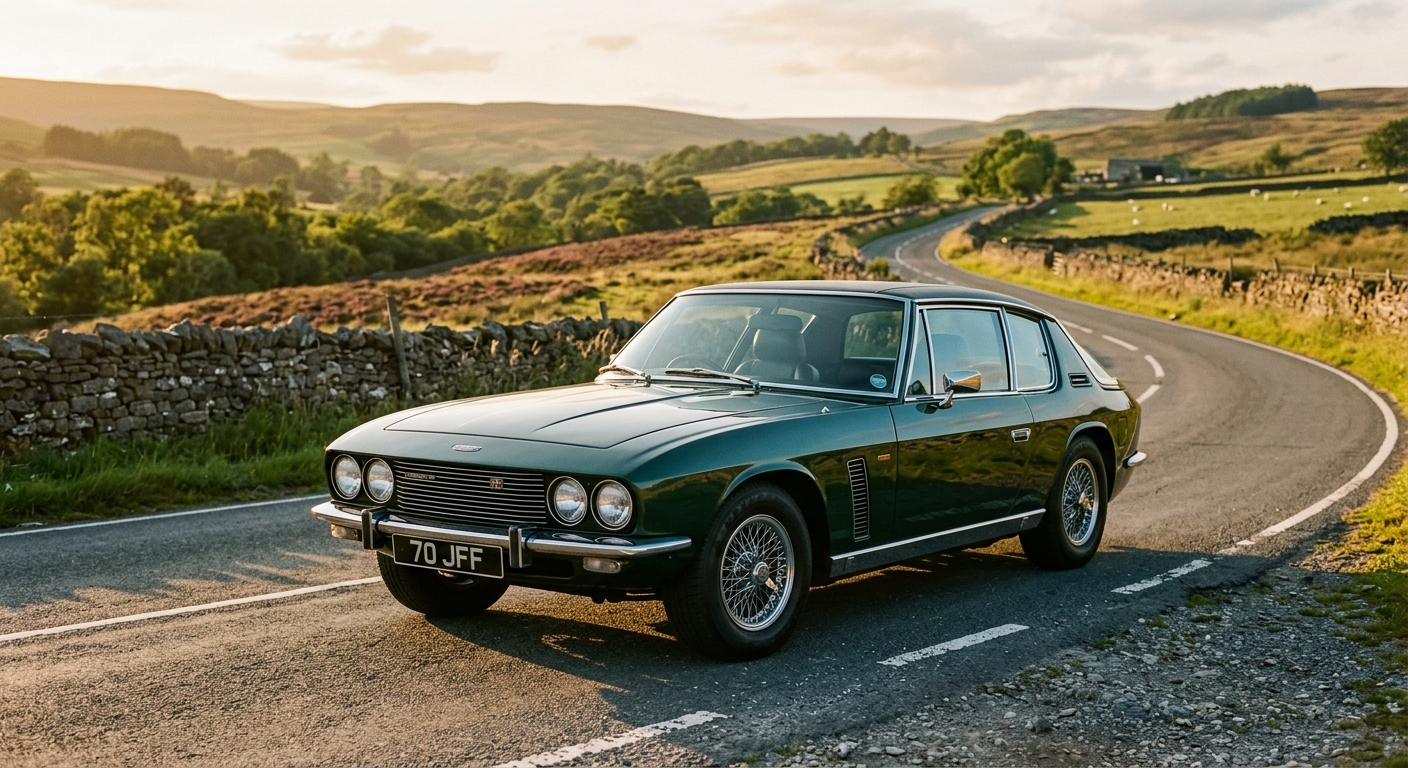
In 1970, while American muscle cars were flexing their cubic inches and European exotics were perfecting their handling, a small British manufacturer called Jensen was quietly revolutionizing automotive technology. The Interceptor FF wasn’t just another pretty face with a big V8, it was the world’s first four-wheel drive supercar, predating the Audi Quattro by over a decade. Today, this technological marvel remains one of motoring’s best-kept secrets.
The Revolutionary Ferguson Formula
The ‘FF’ in Jensen Interceptor FF stood for Ferguson Formula, a sophisticated all-wheel drive system developed by Harry Ferguson Research. This wasn’t a simple part-time 4WD setup like you’d find in a truck, it was a full-time intelligent system that could vary torque distribution between front and rear axles. The system used a viscous coupling center differential and Maxaret anti-lock brakes, technology that wouldn’t become mainstream until the 1980s.
Under the bonnet sat Chrysler’s legendary 440 cubic inch V8, producing 330 horsepower and 460 lb-ft of torque. This American muscle was mated to a TorqueFlite automatic transmission, creating a uniquely Anglo-American hybrid that could embarrass Ferraris in the wet while cruising comfortably at triple-digit speeds on the motorway.
Driving the Future
Behind the wheel, the Interceptor FF revealed its dual personality immediately. On dry roads, it felt like any other powerful grand tourer of the era, with the big Chrysler V8 providing effortless acceleration and a soundtrack that could wake the dead. The steering was precise for its time, though heavy by modern standards, and the ride quality struck an admirable balance between comfort and control.
But introduce some moisture to the equation, and the FF transformed into something almost supernatural. Where contemporary supercars would slide sideways at the first sign of rain, the Jensen maintained composure and traction that seemed to defy physics. The all-wheel drive system was so effective that many owners initially thought something was wrong with their cars, they simply weren’t used to having that much grip available on demand.
Design That Defined a Decade
Styled by Carrozzeria Touring of Italy, the Interceptor FF shared its stunning bodywork with the regular rear-wheel drive Interceptor. The design was pure 1970s aggression, with sharp angles, a distinctive fastback roofline, and that unmistakable wraparound rear window. Only subtle badges and a slightly longer wheelbase distinguished the FF from its conventional sibling.
Inside, the cabin was a study in British luxury, with rich Connolly leather, thick carpets, and a dashboard that mixed traditional wood with modern switches. The driving position was commanding, offering excellent visibility through that dramatic glass canopy, though rear-seat passengers had to contend with limited headroom thanks to the swooping roofline.
The Price of Innovation
The Ferguson Formula system came at a significant cost, both financially and practically. The FF carried a price premium of about 50% over the standard Interceptor, putting it into Aston Martin territory. The additional mechanical complexity also meant more weight, more things to go wrong, and higher maintenance costs. The system added approximately 200 pounds to the car’s curb weight and reduced fuel economy in an era when petrol prices were beginning to rise.
These factors, combined with Jensen’s limited production capacity and marketing budget, meant that only 320 Interceptor FFs were ever built between 1966 and 1971. Today, surviving examples are among the rarest and most sought-after British cars of the era, with pristine examples commanding six-figure sums at auction.
The Jensen Interceptor FF stands as one of automotive history’s greatest what-ifs, a car so far ahead of its time that the world simply wasn’t ready for it. While other manufacturers spent decades catching up to its all-wheel drive technology, Jensen quietly disappeared into obscurity, taking one of the most innovative cars ever built with it. For those lucky enough to experience an FF today, it remains a thrilling reminder that sometimes the best ideas come from the most unexpected places.